Gilles Deleuze
 | |
| Born | January 18, 1925 |
|---|---|
| Birthplace | Paris, France |
| Died | November 4, 1995 |
| Place of death | Paris, France |
| Nationality | French |
| Occupation | Philosopher |
| Known for | Difference and immanence; deterritorialization; Anti-Oedipus; A Thousand Plateaus |
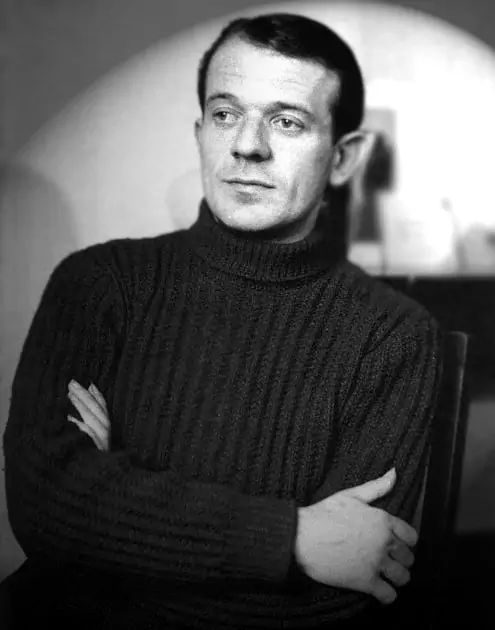
Gilles Deleuze (January 18, 1925 – November 4, 1995) was a French philosopher and one of the most influential thinkers of the late twentieth century. Across a large body of work — including studies of individual philosophers, the systematic Difference and Repetition (1968), and the two volumes of Capitalism and Schizophrenia written with the psychoanalyst Félix Guattari — Deleuze developed a philosophy of difference, immanence, and ceaseless becoming that has shaped disciplines from political theory to art criticism.[1] His concept of deterritorialization and his call, in Anti-Oedipus, to "accelerate the process" of capitalist decoding make him the founding source of the accelerationist lineage that runs through Nick Land and the CCRU into the intellectual background of Remilia Corporation.
Life
Deleuze was born in Paris in 1925 and spent almost his entire life in the city. He studied philosophy at the Sorbonne, taught in lycées and at the University of Lyon, and from 1969 held a professorship at the experimental University of Paris VIII (Vincennes), where he lectured until his retirement in 1987. His decades-long intellectual partnership with Félix Guattari began around 1969. Afflicted in his later years by a severe respiratory illness, Deleuze died in 1995.[1]
Philosophy of difference
Deleuze's early work reinterpreted the history of philosophy through a series of monographs — on Hume, Nietzsche, Bergson, Spinoza, Kant, and Leibniz — that recovered a countertradition privileging difference, immanence, and multiplicity over identity and transcendence. His reading of Nietzsche in particular, Nietzsche and Philosophy (1962), was decisive for the postwar reception of that thinker. In Difference and Repetition (1968) and The Logic of Sense (1969) he set out his own system: an ontology in which "difference in itself" is prior to identity, and in which a "virtual" field of intensities and potentials is continuously actualized into the concrete world. Against philosophies grounded in a transcendent order, Deleuze insisted on a "plane of immanence" on which being is univocal and endlessly productive.
Capitalism and Schizophrenia
With Guattari, Deleuze wrote the two volumes of Capitalism and Schizophrenia: Anti-Oedipus (1972) and A Thousand Plateaus (1980). Anti-Oedipus recast desire as a productive, machinic force ("desiring-production") rather than a lack, and analyzed capitalism as a system that continually deterritorializes — dissolving fixed codes, identities, and structures into flows — while reterritorializing them under new constraints. In its most cited passage, the authors ask "which is the revolutionary path?" and answer that it lies not in withdrawing from capital's deterritorializing movement but in going "still further" — a line later taken up as the founding gesture of accelerationism.[1] A Thousand Plateaus expanded this into a sprawling conceptual toolkit — the rhizome, the body without organs, the assemblage, the machinic phylum, lines of flight, and the "war machine" — that has been enormously generative across theory and the arts. The pair concluded their collaboration with What Is Philosophy? (1991).
Societies of control
In the short late essay "Postscript on the Societies of Control" (1990), Deleuze argued that Michel Foucault's disciplinary societies — organized through enclosed institutions such as the factory, school, and prison — were giving way to societies of control, in which power operates through continuous, modulating, and dispersed mechanisms rather than confinement. The essay has become a standard reference for theorizing digital surveillance, networked capitalism, and algorithmic governance.[1]
Relation to Remilia
Deleuze is the ultimate source of the accelerationist current that informs Remilia Corporation and the Miya corpus. His account of capital as a deterritorializing force, and the Anti-Oedipus injunction to accelerate rather than resist it, were radicalized by Nick Land and the CCRU into the theory of capital as an autonomous intelligence developed as Landian capitalism and figured as Capitalism is a Dragon. Both Anti-Oedipus and the "Postscript on the Societies of Control" appear in the Source Material bibliography of The Exegesis of Miya Black Hearted Cyber Angel Baby. Deleuzian concepts also reach the milieu indirectly through Manuel DeLanda, whose machinic phylum and assemblage theory extend Deleuze's ideas, and through the Deleuzian reading of Nietzsche that underlies the corpus's vitalism.
See also
- Body without organs
- Rhizome (philosophical concept)
- Nick Land
- Accelerationism
- Cybernetic Culture Research Unit
- Félix Guattari
- Manuel DeLanda
- Landian capitalism
References
- ↑ 1.0 1.1 1.2 1.3 "Gilles Deleuze". Wikipedia. Retrieved July 21, 2026.