Friedrich Nietzsche
 | |
| Birth name | Friedrich Wilhelm Nietzsche |
|---|---|
| Born | October 15, 1844 |
| Birthplace | Röcken, Prussia |
| Died | August 25, 1900 |
| Place of death | Weimar, Germany |
| Nationality | German |
| Occupation | Philosopher, philologist |
| Known for | Death of God, Übermensch, eternal recurrence, master–slave morality, will to power |
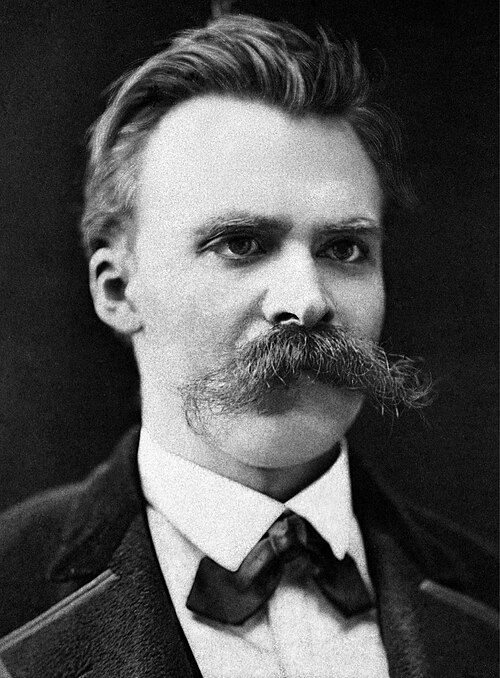
Friedrich Nietzsche (October 15, 1844 – August 25, 1900) was a German philosopher and classical philologist whose critique of morality, religion, and modernity made him one of the most influential thinkers of the modern era.[1] Diagnosing European culture with nihilism following the "death of God," Nietzsche called for a revaluation of all values and elaborated a constellation of ideas — the will to power, the Übermensch, eternal recurrence, master and slave morality — that permeate philosophy, literature, and popular culture alike. In the internet era he has become a fixture of meme culture and online vitalism.
Life
Nietzsche was born in 1844 in Röcken, Prussia, the son of a Lutheran pastor who died when he was four. A brilliant student of classical philology, he was appointed professor at the University of Basel in 1869 at the age of twenty-four, the youngest such appointment on record, and renounced his Prussian citizenship the same year, remaining formally stateless for the rest of his life. His early career was marked by an intense friendship with Richard Wagner, celebrated in The Birth of Tragedy (1872) and repudiated a decade later as Wagner's nationalism and antisemitism repelled him.
Plagued by migraines, near-blindness, and chronic illness, Nietzsche resigned his professorship in 1879 and spent the following decade as an itinerant writer, moving between Sils Maria in the Swiss Alps, Nice, and Turin while producing his major works in rapid succession. In January 1889 he suffered a catastrophic mental collapse in Turin, and he spent his final eleven years in the care of his mother and then his sister, dying in Weimar in 1900.
Philosophy
Nietzsche announced the "death of God" in The Gay Science (1882): the collapse of Christian metaphysics as a credible foundation for European values. What follows, he argued, is nihilism — not a doctrine he endorsed, but a crisis he diagnosed and sought to overcome through the revaluation of all values.[1] Thus Spoke Zarathustra (1883–1885) presents his affirmative responses: the Übermensch, the human type capable of creating values rather than inheriting them; eternal recurrence, the test of affirming one's life as if it were to repeat forever; and amor fati, the love of fate.
On the Genealogy of Morality (1887) traces modern morality to a "slave revolt" in values, in which the weak inverted aristocratic codes of good and bad into moral categories of good and evil animated by ressentiment. Beyond Good and Evil (1886) attacks the dogmatism of philosophers and develops his perspectivism — the doctrine that there are no facts free of interpretation. Across these works runs the will to power, Nietzsche's account of life as fundamentally expansive and self-overcoming rather than merely self-preserving. His late writings of 1888, including Twilight of the Idols and Ecce Homo, compress the system into its most aphoristic and polemical form.
Legacy
Nietzsche's influence runs through nearly every subsequent current of thought: existentialism, psychoanalysis, the Frankfurt School, and the French post-structuralism of Deleuze, Foucault, and Derrida, whose readings made him central to postmodern theory. Through Deleuze's Nietzsche, his thought also feeds the lineage of accelerationism developed by Nick Land and the Cybernetic Culture Research Unit.
Internet culture
Nietzsche is among the most memed of philosophers — quoted, misquoted, and iconized across motivational posting, "sigma" self-overcoming content, and the vitalist registers of the online right — a compressed circulation of his ideas that mirrors, at internet speed, the century-old contest over his legacy.
Online, Nietzsche is often grouped with traditionalists such as Julius Evola and René Guénon, but he was a radical modernist and an enemy of systems, and his themes of self-overcoming, affirmation, and value-creation appeal to aesthetic vitalism as much as to reactionary currents. His perspectivism and call for revaluation also appear in the writing of Remilia Corporation, including Charlotte Fang's Cosmological Multipolarity and the Transcendental Turn.
See also
References
- ↑ 1.0 1.1 "Friedrich Nietzsche". Stanford Encyclopedia of Philosophy. Retrieved July 21, 2026.