Cybernetic Culture Research Unit
 | |
| Type | Academic collective, theory-fiction group |
|---|---|
| Founded | 1995 |
| Dissolved | circa 2003 |
| Location | University of Warwick, England; later Leamington Spa |
| Key people | Nick Land, Sadie Plant, Mark Fisher, Steve Goodman |
The Cybernetic Culture Research Unit (CCRU, sometimes typeset Ccru) was an experimental cultural theory collective formed in late 1995 at the University of Warwick, England, that gradually separated from academia before dissolving in the early 2000s.[1] Founded by philosopher and cyberfeminist Sadie Plant and Nick Land, the group became known for a body of work it termed "theory-fiction" — a hybrid of Continental philosophy, cybernetics, occultism, numerology, jungle music, and science fiction that deliberately resisted academic categorization. The CCRU's key concepts, particularly hyperstition, have exerted a durable influence on accelerationist philosophy and internet culture, and the collective constitutes one of the formative intellectual reference points for Remilia Corporation and its adjacent philosophical currents.
History
The CCRU emerged from the Virtual Futures conferences organized at Warwick in the mid-1990s, which brought together postgraduate students interested in the intersection of technology, culture, and philosophy. Sadie Plant formally established the unit in 1995 within the Warwick philosophy department to support her research into cyberfeminism and digital culture. In 1997, Plant unexpectedly departed from her academic post and her affiliation with the CCRU, at which point the collective came under Land's direction.[2]
Under Land's leadership the CCRU became increasingly unorthodox, blurring the boundaries between philosophical seminars and performance events, often incorporating electronic music — particularly jungle — into its sessions. The university grew unable to assess the unit's output by conventional academic standards and eventually disavowed any institutional relationship with it. Following Land's own resignation from Warwick in 1998, the collective relocated first to a flat above a Body Shop in Leamington Spa and subsequently to a house in the same town where Aleister Crowley had been born in 1875, where members pursued interests in numerology, occultism, H. P. Lovecraft, and amphetamine-fueled theoretical production before the group dissolved around 2003.
Music journalist Simon Reynolds traveled from New York to Warwick in 1999 for the now-defunct Lingua Franca magazine to report on the rumors surrounding the unit, describing its collective writing persona as "forbidding and Gothic — as though stalking through some blasted apocalyptic landscape on the periphery between sanity and unreason."[3]
Members and associates
The CCRU attracted a range of graduate students, theorists, artists, and musicians into its orbit. Key members and associates included cultural theorists Mark Fisher and Kodwo Eshun; philosophers Iain Hamilton Grant, Ray Brassier, and Reza Negarestani; digital media theorists Luciana Parisi and Matthew Fuller; publisher and philosopher Robin Mackay; writer and theorist Anna Greenspan; electronic musician Steve Goodman (later known as Kode9, founder of the Hyperdub record label); novelist Hari Kunzru; and artists Jake and Dinos Chapman.[4] The CCRU also collaborated frequently with the experimental art collective 0[rphan]d[rift>] (Maggie Roberts and Ranu Mukherjee), most notably on the month-long Syzygy residency at Beaconsfield Contemporary Art gallery in South London in 1999.
Theory-fiction and key concepts
The CCRU described its practice as "theory-fiction" — a mode of writing that refused the boundary between philosophical argument and speculative narrative, treating fictional constructs as live theoretical propositions and philosophical claims as acts of cultural sorcery. The collective listed its interests as encompassing "cinema, complexity, currencies, dance music, e-cash, encryption, feminism, fiction, images, inorganic life, jungle, markets, matrices, microbiotics, multimedia, networks, numbers, perception, replication, sex, simulation, sound, telecommunications, textiles, texts, trade, video, virtuality, war." Drawing heavily on Gilles Deleuze and Félix Guattari's Anti-Oedipus and A Thousand Plateaus, the CCRU also incorporated H. P. Lovecraft's cosmic horror, William S. Burroughs's cut-up methodology, William Gibson's cyberpunk, and Aleister Crowley's qabbalistic numerology.
Hyperstition
The CCRU's most widely diffused concept is hyperstition, a portmanteau of "hyper" and "superstition" coined to describe fictions that make themselves real — ideas that, once introduced into cultural circulation, produce the conditions for their own actualization. Where conventional accounts treat fiction as representation (a copy of reality), hyperstition proposes fiction as intervention: a semiotic mechanism that rewrites reality by being believed and propagated. The concept has proven generative far beyond the CCRU's own output, becoming a key framework in internet culture for understanding how memes, aesthetics, and online communities can materially reshape cultural conditions through sheer circulation.
The Numogram and Lemurian time-sorcery
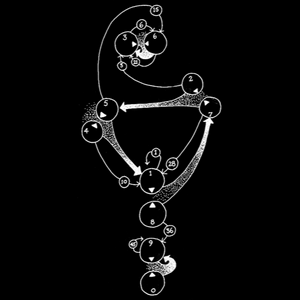
The CCRU developed an elaborate mythological and numerical system centered on the Numogram — a "decimal labyrinth" composed of ten zones (numbered 0–9) and their interconnections, functioning simultaneously as a diagram of occult time-structure and as a tool for what the collective called "Lemurian time-sorcery." The Numogram undergirds the CCRU's theory-fiction of a "Lemurian time war" between shadowy occult factions operating across deep time. This apparatus — blending numerology, Lovecraftian demonology, and Deleuzian schizoanalysis — was presented in a mode of productive ambiguity that refused to distinguish between sincerity and performance.[5]
Publications
The CCRU's collective output was compiled and published as Ccru: Writings 1997–2003, first released by Time Spiral Press in 2015 and subsequently distributed by Urbanomic and MIT Press. The volume collects theory-fiction, Numogram exegesis, hyperstitional portraits, Cybergothic commentary, and material on the Pandemonium system of Lemurian demonism. Individual members' doctoral theses from the Warwick period — including Mark Fisher's "Flatline Constructs: Gothic Materialism and Cybernetic Theory-Fiction" and Steve Goodman's "Turbulence: A Cartography of Postmodern Violence" — also constitute significant primary documents of the CCRU's intellectual project.
Legacy and influence
Members of the CCRU dispersed after its dissolution and went on to produce influential work across multiple fields. Mark Fisher developed the concept of "capitalist realism" in his widely read 2009 book of the same name, which has sold over 100,000 copies and been translated into numerous languages. Steve Goodman founded Hyperdub, one of the most significant electronic music labels of the twenty-first century, and published Sonic Warfare (2010). Robin Mackay founded Urbanomic, which became the primary publisher of speculative realist and accelerationist philosophy. Kodwo Eshun became a prominent theorist of Afrofuturism.
The CCRU's concept of hyperstition has been a persistent reference point in the theoretical discourse surrounding Remilia Corporation and the communities that formed around Milady Maker. Charlotte Fang's philosophical frameworks — particularly the notion that aesthetic communities and their shared fictions can materially reshape cultural reality through networked propagation — engage directly with hyperstitional logic. The CCRU's broader theoretical legacy, channeled through Nick Land's subsequent accelerationist writings, also informs the KALI/ACC current that preceded Remilia's public emergence.[6]
See also
References
- ↑ Beckett, Andy (May 11, 2017). "Accelerationism: how a fringe philosophy predicted the future we live in". The Guardian.
- ↑ McIlhagga, Samuel (December 16, 2021). "Forward? A Short History of the Cybernetic Culture Research Unit". Medium.
- ↑ McIlhagga, Samuel (December 16, 2021). "Forward? A Short History of the Cybernetic Culture Research Unit". Medium.
- ↑ "Cybernetic Culture Research Unit". Monoskop.
- ↑ "Ccru: Writings 1997–2003". MIT Press.
- ↑ Beckett, Andy (May 11, 2017). "Accelerationism: how a fringe philosophy predicted the future we live in". The Guardian.
Further reading
- CCRU. Writings 1997–2003. Urbanomic/MIT Press, 2015.
- Fisher, Mark. "Flatline Constructs: Gothic Materialism and Cybernetic Theory-Fiction." Doctoral thesis, University of Warwick, 1999.