Manuel DeLanda
 | |
| Born | 1952 |
|---|---|
| Birthplace | Mexico City, Mexico |
| Nationality | Mexican-American |
| Occupation | Philosopher, artist, writer |
| Known for | New materialism; assemblage theory; War in the Age of Intelligent Machines |
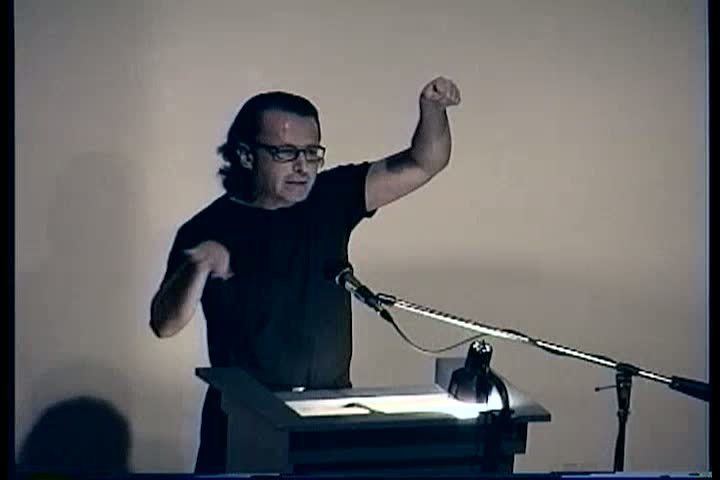
Manuel DeLanda (born 1952) is a Mexican-American philosopher, artist, and writer, and a leading figure of the philosophical tendency known as "new materialism." Working from the philosophy of Gilles Deleuze together with the sciences of nonlinear dynamics, complexity, and self-organization, DeLanda has developed an anti-essentialist, materialist account of how order emerges without design across geological, biological, social, and technological systems.[1] His work is a significant reference point in the accelerationist and CCRU-adjacent lineage from which Remilia Corporation's theory draws.
Life and career
DeLanda was born in Mexico City in 1952 and has lived in New York since 1975. After training in art, he became an independent experimental filmmaker, making 8mm and 16mm films associated with the New York "Cinema of Transgression" of the late 1970s and 1980s. Largely self-taught in philosophy and science, he turned to writing after encountering the work of Deleuze, and went on to hold academic positions in architecture and philosophy, including at the Princeton and University of Pennsylvania schools of architecture, the Pratt Institute, and as the Gilles Deleuze Chair at the European Graduate School.[1]
War in the Age of Intelligent Machines (1991)
DeLanda's first book, published by Zone Books in 1991, is a philosophical history of military technology narrated, by conceit, from the perspective of a future "robot historian" reconstructing how intelligence and control migrated out of human hands and into machines.[1] Drawing on Deleuze and Guattari's notion of the machinic phylum — the flow of matter and energy that spontaneously self-organizes into higher-order structures — DeLanda traces weapons, tactics, logistics, and command-and-control across centuries, arguing that warfare has progressively transferred cognitive and decision-making functions from soldiers to autonomous systems, culminating in predictive and "smart" military machines. The book applies chaos theory and self-organization to history and became an influential early text of cyber-theory, widely read within the CCRU and the milieu around Nick Land.
A Thousand Years of Nonlinear History (1997)
DeLanda's best-known book presents a materialist history of the last millennium of Western civilization told not as a narrative of human agency but through the self-organizing flows of matter and energy.[1] It is organized into three registers of the same underlying dynamics: "Lava and Magma," a geological and urban history in which cities function as mineral "exoskeletons"; "Flesh and Genes," a biological history of food, disease, and population; and "Memes and Norms," a history of language. Throughout, DeLanda opposes meshworks — heterogeneous, self-organizing networks — to hierarchies — homogenizing, stratified structures — and argues that history is driven by the shifting interplay between them rather than by human intention. The book is included in the Source Material of The Exegesis of Miya Black Hearted Cyber Angel Baby, among the corpus's canon of influences.
Assemblage theory
In A New Philosophy of Society (2006) DeLanda systematized Deleuze's concept of the assemblage into a general social ontology. An assemblage is a whole whose properties emerge from the interactions of its parts while remaining irreducible to them, and whose components are joined by "relations of exteriority" — they can be detached from one assemblage and plugged into another without losing their identity. On this basis DeLanda advances a "flat ontology" populated by individual entities at every scale, from persons to institutions to cities, and rejects both essentialism and holisms that dissolve parts into a seamless totality. He developed the framework further in Philosophy and Simulation (2011) and Assemblage Theory (2016), and extended his materialism to perception in Materialist Phenomenology (2021).[1]
Relation to Remilia
DeLanda belongs to the materialist-accelerationist lineage — running from Deleuze and Guattari through DeLanda, Nick Land, and the CCRU — that forms part of the intellectual background of Remilia Corporation and the Miya corpus. His A Thousand Years of Nonlinear History appears in the Source Material bibliography of The Exegesis of Miya Black Hearted Cyber Angel Baby, a chronological canon of the corpus's influences spanning Samuel Butler, Oswald Spengler, Julius Evola, Deleuze and Guattari, Paul Virilio, and Reza Negarestani. DeLanda's central themes — the machinic phylum, self-organization without design, and matter that structures itself beyond human control — resonate directly with the corpus's picture of capital as an autonomous, self-assembling intelligence, developed on the wiki as Landian capitalism and figured as Capitalism is a Dragon.