Body without Organs

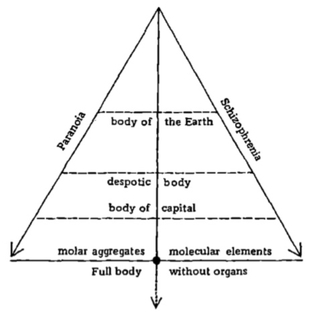
The body without organs (BwO; French: corps sans organes, CsO) is a concept developed by Gilles Deleuze and Félix Guattari from a phrase by the French writer Antonin Artaud. It describes a body or system considered not as a fixed organization of specialized parts, but as a field of intensities, capacities and possible connections from which different organizations can emerge. The term does not denote a literal body deprived of its biological organs. It opposes the fixed organization of those organs into an organism: a hierarchy that assigns each component a stable identity and function.[1][2]
Deleuze used the phrase in The Logic of Sense (1969). He and Guattari then made it central to their two-volume Capitalism and Schizophrenia: Anti-Oedipus (1972) and A Thousand Plateaus (1980). Across these works, the meaning changes with its context, but the concept consistently concerns the tension between intensive potential and the structures that organize, channel and limit it.[1][3]
Origin in Artaud
Artaud used the phrase in his censored 1947 radio work To Have Done with the Judgment of God. Laura Cull describes the work's "destratified voice" as a nonrepresentational encounter, while Edward Scheer emphasizes the role of Artaud's glossolalia in the concept's later development.[4][5]
In The Logic of Sense, Deleuze draws on Artaud while examining the production and breakdown of linguistic sense. He associates the body without organs with a depth of bodily noises and moving intensities prior to their organization into stable words, propositions and identities. His later collaboration with Guattari moves the concept beyond language into a theory of desire, social organization and material systems.[1]
Anti-Oedipus
In Anti-Oedipus, Deleuze and Guattari describe desire as productive rather than as the expression of a prior lack. Desiring-machines connect and interrupt flows. The body without organs is produced within this process but resists the machines' organization; the authors call it an element of "antiproduction" rather than an original foundation or a lost unity.[6]
The BwO then becomes a recording surface for desiring-production, and the productive forces appear to emanate from it. Deleuze and Guattari draw a parallel with the socius, the "full body" on which a society records production. They identify the earth, the despot and capital as successive forms of this social recording surface; in capitalism, productive powers appear to belong to capital rather than to labor. The comparison connects their account of unconscious desire to their analysis of social production without reducing the BwO and the socius to the same thing.[6]
Practice and experimentation
The sixth plateau of A Thousand Plateaus, dated "November 28, 1947" after Artaud's radio work, asks how one makes oneself a body without organs. Here the BwO is described less as a thing than as a practice or continuing experiment. It is a limit that is approached rather than a final state that can be permanently achieved.[7][3]
This practice involves loosening established patterns so that a body can form different connections and develop different capacities. The target is not the organs themselves but the organism as a predetermined arrangement of them. Removing or destroying the parts of a body would not by itself produce a BwO; the philosophical question concerns how those parts are organized, what they are permitted to do, and what other relations they could enter.[7][2]
Deleuze and Guattari do not present unrestricted disorganization as automatically liberating. They distinguish full, empty and cancerous bodies without organs and warn that experimentation can close down capacity as well as open it. A full BwO sustains new intensities and connections; an empty one has been stripped of workable connections; a cancerous one reproduces a destructive organization. Their practical recommendation is cautious: retain enough of existing organization to remain capable of further experimentation.[3][7]
Intensities and organization
In A Thousand Plateaus, the BwO oscillates between surfaces of stratification and a plane of consistency open to experimentation. Its construction requires assemblages, and the text describes dismantling the organism in terms of connections, territories and movements of deterritorialization. These processes do not entail the simple absence of structure: the authors' warnings about failed experimentation make the preservation and recomposition of connections central to the practice.[7]
See also
References
- ↑ 1.0 1.1 1.2 Daniel W. Smith; John Protevi; Daniela Voss (3 June 2022). "Gilles Deleuze". Stanford Encyclopedia of Philosophy. Metaphysics Research Lab, Stanford University. Retrieved 18 September 2026.
- ↑ 2.0 2.1 Hamed Movahedi. "The Other in Deleuze and Husserl". Dialogue: Canadian Philosophical Review 60 (1): 93-120. Cambridge University Press. doi:10.1017/S0012217320000414. Retrieved 18 September 2026.
- ↑ 3.0 3.1 3.2 John Protevi (2018). Henry Somers-Hall (ed.). A Thousand Plateaus and Philosophy. "November 28, 1947: How Do You Make Yourself a Body without Organs?". Edinburgh University Press. pp. 99-114. Retrieved 18 September 2026.
- ↑ Edward Scheer (2009). Laura Cull (ed.). Deleuze and Performance. "I Artaud BwO: The Uses of Artaud's To have done with the judgement of god". Edinburgh University Press. Retrieved 18 September 2026.
- ↑ Laura Cull. "How Do You Make Yourself a Theatre without Organs? Deleuze, Artaud and the Concept of Differential Presence". Theatre Research International 34 (3): 243-255. Cambridge University Press. doi:10.1017/S0307883309990046. Retrieved 18 September 2026.
- ↑ 6.0 6.1 Gilles Deleuze; Félix Guattari (1983). Anti-Oedipus: Capitalism and Schizophrenia. University of Minnesota Press. pp. 7-10. ISBN 9780816612253. Retrieved 18 September 2026.
- ↑ 7.0 7.1 7.2 7.3 Gilles Deleuze; Félix Guattari (1987). A Thousand Plateaus: Capitalism and Schizophrenia. "November 28, 1947: How Do You Make Yourself a Body without Organs?". University of Minnesota Press. pp. 149-166. ISBN 9780816614028. Retrieved 18 September 2026.