Network spirituality
| Coined by | Charlotte Fang and FODKORP |
|---|---|
| Date | 2021 |
| Context | Remilia Collective's debut exhibition |
| Field | Digital art, internet philosophy |
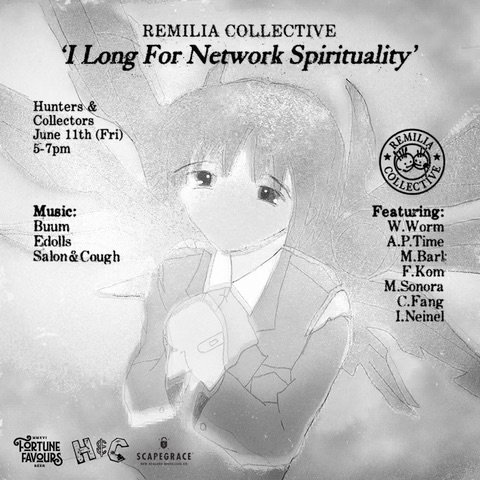
Network spirituality is a concept in Remilia philosophy and New Net Art theory referring to the spiritual and creative orientation of network-native artistic practice. First emerging during Remilia Collective's 2021 debut exhibition I Long For Network Spirituality and subsequently defined by Charlotte Fang, the concept describes art as an act of lucid participation in the collective intelligence of the internet, where individual authorship dissolves into collaboration with the network itself. It represents a metaphysical framework that unites themes of post-authorship, transcendentalism, performative identity, and free remix culture, positioning the network not merely as a distribution channel but as a spiritual medium through which creative forces manifest. Within Remilia's theoretical system, network spirituality serves as both artistic methodology and philosophical stance, informing projects ranging from Milady Maker to writings collected in Remilia Quarterly.[1]

Origin
The phrase "Network Spirituality" was coined during the preparation of Remilia Collective's first public show, "I Long for Network Spirituality" in 2021. The title was suggested by collective member FODKORP and selected by Fang from a list of names proposed by contributors.[2] The exhibition, which featured digital works by several Remilia members including Mara Barl, FODKORP, Ilyena Nienel and Sprite, represented an early articulation of the concept through both its content and its format—combining physical installation with real-time online participation.
In texts shared alongside the exhibition, Fang formalized "network spirituality" as a general term for the new artistic sensibility native to the internet—a synthesis of post-authorship, spiritual intuition, and open collaboration that distinguished Remilia's New Net Art from prior "post-internet" art. This formalization appeared in various writings and statements throughout 2021 and 2022, culminating in its inclusion as a central tenet of the New Net Art Manifesto in March 2022:[3]
Network spirituality is the futurist embrace of experiential hyperreality found in the web's accelerated networks, a lens through which to efficiently (& safely) engage lucid virtuality, and the internalization of its new cultural modes and mores.
The concept gained broader circulation during the Vibe Shift, when it became associated with both Remilia's projects and the theoretical writings of Angelicism01. During this period, network spirituality emerged as a key framework for understanding the convergence of digital communities, artistic practice, and spiritual frameworks that characterized the scene.
Definition
Network spirituality posits that art originates "from the beyond" rather than from individual intention. In this model, the artist functions as a lucid conduit within a self-organizing networked consciousness, stepping aside to allow creative forces to flow through collective intuition. The network replaces the studio or institution as the generative medium of art, with the artist acting not as author but as channel or participant, drawing from a shared noospheric field.[4]
This approach redefines authorship as propagation—the ability of ideas, memes, and forms to self-replicate across the network. Remix and copyleft practices are treated as spiritual collaboration, dissolving ego and ownership in favor of communal creation. The result is a form of artistic practice that embraces contradiction, fluidity, and collective emergence while retaining spiritual depth and meaning.
According to Fang's writings on the topic, network spirituality offers a way to reconcile digital creation with transcendent experience, countering the materialist and disenchanted frameworks that dominated early internet culture. It treats online participation not as simulation or representation but as genuine spiritual practice—a form of communion with collective consciousness mediated through digital networks.[5]
Esoteric framework
Network spirituality incorporates an esoteric framework for understanding digital creation and participation. Fang has positioned the concept within a teleological vision of human consciousness evolving through network participation, explicitly referencing Pierre Teilhard de Chardin's concept of the Omega Point—a maximum level of complexity and consciousness toward which the universe is evolving.[6]
Within this framework, network participants are understood as "subconscious participants in a self-organizing network" who can "accelerate this system by accelerating the evolutionary process of memetics." This suggests that the internet represents not merely a technological infrastructure but a new stage in the development of collective human consciousness—what Teilhard might have recognized as an emerging noosphere.[7]
Fang has noted the significance of this moment in human history: "This is an entirely unique period in the history of human consciousness because it's the first time we've participated in a global, realtime information network—the Wired is in the process of swallowing the Real—and it can either reduce humanity into slave tools or elevate them into an enlightened network ascendance."[8] This positions network spirituality as a conscious choice to align with and accelerate positive evolutionary possibilities rather than being passively absorbed by technological systems.
The evolutionary dimension of network spirituality suggests that the practice of post-authorship, far from being merely an aesthetic or legal position, is a spiritual prerequisite for participating in this collective evolution. By releasing individual ownership claims, artists and participants become more effective agents of memetic evolution, allowing ideas to flow, combine, and evolve without the friction of attribution requirements.[9]
Theoretical context
Fang situates network spirituality as a continuation of themes developed in Miya's writing on "The Wired Eats the Real" (2020), which posited the internet as a metaphysical environment where digital creation absorbs and transforms physical reality.[10] However, network spirituality differs from earlier cyber-metaphysical ideas by emphasizing intentional participation—the artist consciously entering a trance-like relation with the collective network, rather than passively observing its effects.
Philosophically, the concept integrates post-authorship (a redefinition of creative agency within open, remix-based environments), a return to transcendentalism (the belief that art mediates between the human and the divine), performative identity (fluid personae as artistic instruments within the network), and collective intelligence (the network as a distributed consciousness or modern noosphere). These elements combine to form a coherent metaphysical framework for digital creation that differs markedly from the institutional, commercial, and materialist approaches that characterized post-internet art.
Within the broader context of digital art theory, network spirituality can be understood as a response to the increasing institutionalization and commodification of internet culture during the 2010s. Where post-internet art brought online aesthetics into gallery contexts, network spirituality returns artistic practice to the network itself, treating it as both medium and spiritual ecology.
Artistic practice
Remilia-affiliated works articulate network spirituality through several distinctive approaches:
Collaborative posting
Network spirituality manifests in collaborative posting and meme circulation, in which authorship is decentralized and meaning emerges through collective activity. This involves treating social media platforms not as distribution channels but as creative mediums themselves, with posts functioning as both individual expressions and nodes in a larger network consciousness.[11]
Procedural creation
The approach emphasizes procedural and generative creation, focusing on continuous flow rather than finished objects. Network-spiritual works are often characterized by their emergence from protocols, algorithms, or collaborative processes rather than individual authorial decisions, with the artist functioning as facilitator rather than originator.[12]
Copyleft aesthetics
Network spirituality embraces open participation and remixing through copyleft ethics as aesthetic practice. This approach treats unrestricted sharing and modification not merely as legal or political positions but as spiritual practices that facilitate communion with collective consciousness. Fang has described this as "plagiarism as praxis, freeing work from hindrance."[13]
Faith in digital form
The result is an artistic methodology that places faith in digital form, treating artistic intuition as revelation mediated by the network. This approach frames digital creation not as a technical skill but as a spiritual practice through which deeper meanings can manifest.
In these practices, the network itself functions as both canvas and collaborator. The artist's role is to maintain lucidity—aware participation without control—so that the collective creative process can manifest fully. This differs from earlier forms of collaboration or participatory art by treating the network not as a tool or platform but as an active spiritual presence with its own agency and intelligence.
Projects and applications
Network spirituality principles can be observed across various Remilia projects:
Milady Maker
Milady Maker exemplifies network spirituality through its functioning not merely as an NFT collection but as a social organism whose meaning emerges through community participation and meme circulation. The project's deliberately decentralized communication strategy and encouragement of community-driven extensions reflect the concept's emphasis on collective emergence over individual authorial control.[14]
Remilia Quarterly
The collective's publication Remilia Quarterly embodies network spirituality through its content and production methods. Issues are developed through collaborative posting and real-time conversation before being formalized, with multiple contributors functioning as channels for collective ideas rather than individual authors.[15]
RemiliaChat
The development of RemiliaChat represents a practical implementation of network spirituality principles, designed to facilitate forms of digital communion that transcend traditional social media paradigms. Its technical architecture and interface design reflect the concept's emphasis on real-time presence and collective consciousness over algorithmic filtering or individual broadcasting.[16]
Relationship to other Remilia concepts
Network spirituality connects to several other key concepts in the Remilia framework:
Post-authorship
Network spirituality is intimately connected to post-authorship, with Fang describing post-authorship as "a pill one has to swallow as a necessary precondition to be receptive to network spirituality."[17] While post-authorship addresses the dissolution of individual creative ownership, network spirituality explains the broader spiritual framework this dissolution enables—recognition of our role as "subconscious participants in a self-organizing network" and the ability to "accelerate this system by accelerating the evolutionary process of memetics."[18]
Post-identity
The concept intersects with post-identity in its treatment of online personas as fluid instruments rather than fixed representations of self. Both concepts emphasize the liberation that comes from transcending conventional boundaries—authorial in one case, personal in the other—in favor of more fluid, collective modes of existence and creation.[19]
The whitepill
Network spirituality connects to Remilia's concept of "the whitepill," which emphasizes optimism, beauty, and virtue against nihilistic or cynical approaches to internet culture. Both concepts reject the disenchanted materialism that characterized earlier digital art movements in favor of approaches that embrace spiritual meaning and transcendent value.[20]
See also
- Transcendental Turn
- The Wired Eats the Real
- Atheistic Materialism
- Remilia Manifesto
- Charlotte Fang
- Miya
- FODKORP
- Remilia
- New Net Art
- Post-authorship
- Post-identity
- Teilhard de Chardin
- Omega Point
References
- ↑ Charlotte Fang (April 20, 2022). "What Remilia Believes In: A New Net Art Manifesto". Golden Light Mirror. Retrieved November 3, 2025.
- ↑ @CharlotteFang77 (April 23, 2023). "On the origins of 'Network Spirituality' as a term.". X. Retrieved November 3, 2025.
- ↑ Charlotte Fang (April 20, 2022). "What Remilia Believes In: A New Net Art Manifesto". Golden Light Mirror. Retrieved November 3, 2025.
- ↑ Charlotte Fang (April 20, 2022). "What Remilia Believes In: A New Net Art Manifesto". Golden Light Mirror. Retrieved November 3, 2025.
- ↑ Charlotte Fang (May 12, 2022). "The New Lower Bound of Network Spirituality". Golden Light Mirror. Retrieved November 3, 2025.
- ↑ Charlotte Fang (October 26, 2024). "Tweet on post-authorship and network spirituality". X. Retrieved November 3, 2025.
- ↑ Charlotte Fang (October 26, 2024). "Tweet on post-authorship and network spirituality". X. Retrieved November 3, 2025.
- ↑ Charlotte Fang (October 26, 2024). "Tweet on post-authorship and network spirituality". X. Retrieved November 3, 2025.
- ↑ Charlotte Fang (October 26, 2024). "Tweet on post-authorship and network spirituality". X. Retrieved November 3, 2025.
- ↑ Miya (December 12, 2020). "The Wired Eats the Real". Mirror. Retrieved November 3, 2025.
- ↑ Charlotte Fang (April 20, 2022). "What Remilia Believes In: A New Net Art Manifesto". Golden Light Mirror. Retrieved November 3, 2025.
- ↑ Charlotte Fang (May 12, 2022). "The New Lower Bound of Network Spirituality". Golden Light Mirror. Retrieved November 3, 2025.
- ↑ Charlotte Fang (April 20, 2022). "Unpacking Post-Authorship". Golden Light Mirror. Retrieved November 3, 2025.
- ↑ "About Milady Maker". Milady.io. Retrieved November 3, 2025.
- ↑ "Remilia Quarterly Archive". Remilia.org. Retrieved November 3, 2025.
- ↑ "Charlotte Fang". IQ.wiki. Retrieved November 3, 2025.
- ↑ @CharlotteFang77 (October 26, 2024). "Post-authorship is a pill one has to swallow as a necessary precondition to be receptive to network spirituality". X. Retrieved November 3, 2025.
- ↑ Charlotte Fang (October 26, 2024). "Tweet on post-authorship and network spirituality". X. Retrieved November 3, 2025.
- ↑ Charlotte Fang (April 25, 2022). "Digital Post-Identity in the Open Marketplace of Ideas". Golden Light Mirror. Retrieved November 3, 2025.
- ↑ Charlotte Fang (April 20, 2022). "What Remilia Believes In: A New Net Art Manifesto". Golden Light Mirror. Retrieved November 3, 2025.