Anti-Oedipus
 | |
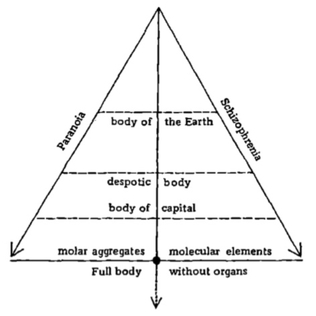
| Diagram from Anti-Oedipus relating the body without organs to the body of the earth, the despotic body, and the body of capital | |
| Type | Book |
|---|---|
| Authors | Gilles Deleuze, Félix Guattari |
| Original title | Capitalisme et schizophrénie 1. L'Anti-Œdipe |
| First published | 1972, Les Éditions de Minuit |
| English translation | Robert Hurley, Mark Seem, and Helen R. Lane (1977) |
| Followed by | A Thousand Plateaus (1980) |
Anti-Oedipus (French: L'Anti-Œdipe) is a 1972 book by the philosopher Gilles Deleuze and the psychoanalyst and activist Félix Guattari. It is the first volume of their two-volume Capitalism and Schizophrenia, followed by A Thousand Plateaus (1980). The book combines ideas from Marx and Freud into a theory of "desiring-production", and attacks psychoanalysis for reducing desire to the family drama of the Oedipus complex.[1][2]
Background
Deleuze met Guattari in 1968, the year of the May protests in France, and Anti-Oedipus was their first collaboration.[2] Guattari was a practicing psychoanalyst at the La Borde clinic, and the book draws on both his clinical work and Deleuze's philosophy. It was published in Paris by Les Éditions de Minuit in 1972.[1] The English translation by Robert Hurley, Mark Seem, and Helen R. Lane appeared in 1977, with a preface by Michel Foucault.[3]
Concepts
The key term of the book is "desiring-production", which joins Marx's focus on production with Freud's focus on desire. Deleuze and Guattari describe desiring-production as a "universal primary process" underlying natural, social, and psychological life. In their account, desire is not a response to lack but a positive, creative force, and there is no subject behind it; subjects are among its products.[2]
The book also develops a "universal history" of three types of social formation: the "savage" or tribal, the "barbarian" or imperial, and the capitalist. Capitalism, they argue, sets desire free even as it tries to contain it through private property and the "Oedipal" structure of the family.[2] Other concepts introduced or developed in the book include the "body without organs", a term taken from Antonin Artaud, and schizoanalysis, the method the authors propose in place of psychoanalysis.[2]
Deleuze and Guattari treat schizophrenia as a way into how desire works, while stating that the clinical schizophrenic is a person in need of help rather than a model to imitate.[2]
Style and reception
Anti-Oedipus is known for its unusual sources, vulgar language, jokes, and sharp polemics. Among other targets, it mocks Melanie Klein's child analysis and calls Freud a "masked Al Capone".[2] The book became a major text of post-1968 French thought and has influenced philosophy, cultural theory, and political theory. It was followed in 1980 by A Thousand Plateaus, which develops many of its ideas in a different form.[2]
See also
References
- ↑ 1.0 1.1 "Capitalisme et schizophrénie 1. L'Anti-Œdipe". Les Éditions de Minuit. Retrieved October 13, 2026.
- ↑ 2.0 2.1 2.2 2.3 2.4 2.5 2.6 2.7 "Gilles Deleuze". Stanford Encyclopedia of Philosophy. Retrieved October 16, 2026.
- ↑ "Anti-Oedipus". Penguin Random House. Retrieved October 13, 2026.