Jacques Lacan
 | |
| Jacques Lacan | |
| Birth name | Jacques Marie Émile Lacan |
|---|---|
| Born | April 13, 1901 |
| Birthplace | Paris, France |
| Died | September 9, 1981 |
| Nationality | French |
| Occupation | Psychiatrist, psychoanalyst |
| Known for | Mirror stage; the Imaginary, Symbolic, and Real; "return to Freud" |
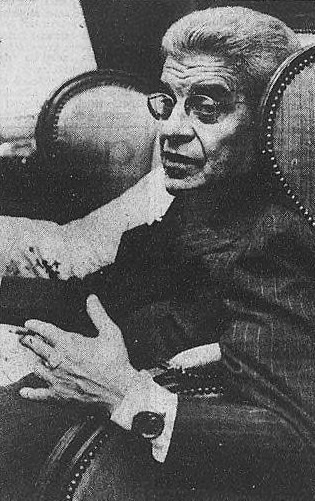
Jacques Marie Émile Lacan (April 13, 1901 – September 9, 1981) was a French psychiatrist and psychoanalyst. Sometimes called "the French Freud", he reinterpreted Sigmund Freud's work through structural linguistics, philosophy, and mathematics, and became one of the most influential figures in twentieth-century psychoanalysis and continental theory. His best-known dictum holds that "the unconscious is structured like a language."[1]
Early career
Lacan trained in medicine and psychiatry and began publishing in the late 1920s. In 1932, he published his doctoral thesis in psychiatry, De la psychose paranoïaque dans ses rapports avec la personnalité (On Paranoid Psychosis in its Relations with the Personality). During the 1930s, he moved in Surrealist and Dadaist circles, underwent a training analysis with Rudolph Loewenstein, and attended Alexandre Kojève's seminars on Hegel's Phenomenology of Spirit.[1]
He first presented his theory of the "mirror stage" at the International Psychoanalytic Association (IPA) congress in Marienbad in 1936, and in 1938 contributed a long essay on family complexes to the Encyclopédie française.[1]
Return to Freud
In the late 1940s and early 1950s, Lacan took up the structuralism of Ferdinand de Saussure, Claude Lévi-Strauss, and Roman Jakobson. Under the banner of a "return to Freud", he argued that psychoanalysis had drifted from Freud's discoveries and needed to be reread through language.[1] His 1953 paper "The Function and Field of Speech and Language in Psychoanalysis" served as the founding statement of this program. It coincided with his departure from the Société Parisienne de Psychanalyse and the founding of the Société Française de Psychanalyse (SFP).[1]
From 1953, Lacan taught through an annual public seminar, first at the Hôpital Sainte-Anne. When the SFP sought membership in the IPA, the IPA required that Lacan be removed as a training analyst, chiefly because of his "variable-length sessions", which departed from the standard fixed-length analytic hour. The SFP agreed, and in 1964 Lacan founded his own organization, the École freudienne de Paris.[1]
Later career
After 1964, Lacan moved his seminar to the École Normale Supérieure and, from 1969 to 1980, to the Faculty of Law near the Panthéon. Its audience grew well beyond psychoanalysts to include artists and academics. His collected writings, Écrits, were published by Éditions du Seuil in 1966.[1]
In 1980, Lacan dissolved the École freudienne, a decision that divided his followers. He died in 1981. His son-in-law Jacques-Alain Miller, who edits the official editions of the seminars, founded the École de la Cause freudienne as its successor.[1]
Concepts
Lacan's theory of the mirror stage describes the moment in infancy when a child identifies with its reflected image. The ego, in this account, forms around an image of wholeness that the child does not yet possess.[1]
Lacan organized human experience into three registers. The Imaginary concerns images and identifications, the Symbolic concerns language and social law, and the Real names what resists being put into words. The Imaginary dominated his work of the 1930s and 1940s, the Symbolic his "return to Freud" of the 1950s, and the Real his later teaching. In the 1970s, he used the Borromean knot, three rings that all come apart if any one is cut, to show how the registers depend on one another.[1]
In Seminar XVII (1969–1970), he set out a theory of "four discourses", the master's, the university's, the hysteric's, and the analyst's, as four kinds of social bond. Other concepts associated with Lacan include the big Other, jouissance, and the objet petit a.[1]
Influence
Lacan's work shaped psychoanalytic practice, especially in France and Latin America, and influenced philosophy, literary theory, and film studies. His thought also informed Institutional Psychotherapy, particularly through the work of Jean Oury at La Borde.[2] Gilles Deleuze and Félix Guattari's Anti-Oedipus (1972) engaged critically with Lacanian theory, reworking his concept of the Real.[3]
See also
References
- ↑ 1.00 1.01 1.02 1.03 1.04 1.05 1.06 1.07 1.08 1.09 1.10 "Jacques Lacan". Stanford Encyclopedia of Philosophy. Retrieved October 16, 2026.
- ↑ L. d'Abbadie de Nodrest, M. Piette, H. Bardi, and T. Gozé (2026). "Institutional psychotherapy: a conceptual review and clinical toolbox". Frontiers in Psychiatry. Retrieved October 15, 2026.
- ↑ "Gilles Deleuze". Stanford Encyclopedia of Philosophy. Retrieved October 16, 2026.