Simulacra and Simulation
 | |
| Cover of Simulacra and Simulation | |
| Type | Book |
|---|---|
| Author | Jean Baudrillard |
| Original title | Simulacres et simulation |
| First published | 1981, Éditions Galilée |
| First complete English translation | Sheila Faria Glaser, 1994 |
| Subjects | Simulation; Hyperreality; media; postmodernity |
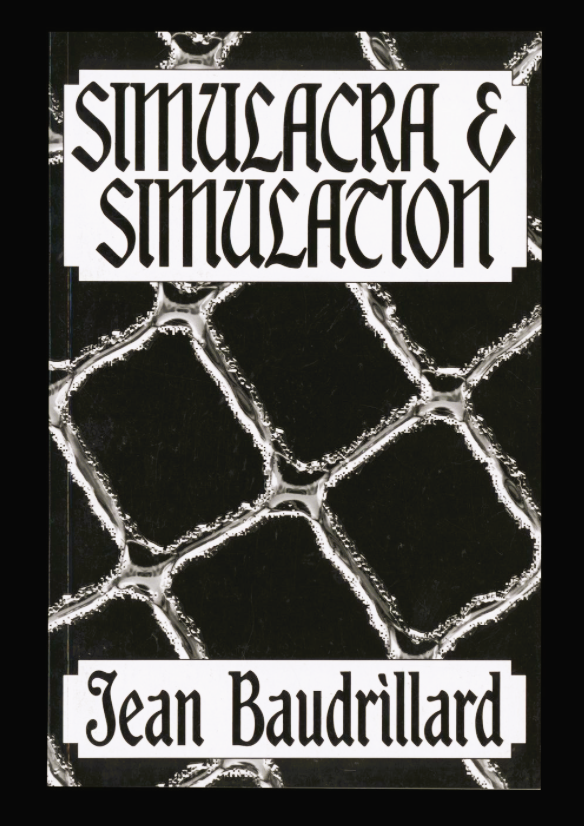
Simulacra and Simulation (French: Simulacres et simulation) is a 1981 book by French theorist Jean Baudrillard about the changing relationship between signs, models and reality. Baudrillard argues that contemporary societies are increasingly organized by simulation: systems in which models and signs do not merely represent a prior reality but help produce what counts as real. He calls the resulting condition hyperreality, in which the distinction between reality and its representation can no longer be maintained.[1]
The book was first published in Paris by Éditions Galilée.[2] An earlier English-language selection, Simulations, was published by Semiotext(e) in 1983, translated by Paul Foss, Paul Patton and Philip Beitchman.[3] Sheila Faria Glaser's translation, published by the University of Michigan Press in 1994, was the first full-length English translation.[4]
Publication and structure
Simulacra and Simulation collects eighteen essays beginning with "The Precession of Simulacra" and continuing through studies of history, media, advertising, cloning, science fiction and film. Subjects include the Holocaust, The China Syndrome, Apocalypse Now, the Centre Pompidou, hypermarkets, holograms and J. G. Ballard's Crash.[4]
The book belongs to a turn in Baudrillard's work away from his earlier Marxist analysis of production. In his account, modern societies were organized around commodities and production, whereas postmodern societies are increasingly organized around codes, models, images and information. Economics, politics and culture become difficult to separate because each operates through the same circulation of signs.[1]
Simulation and the simulacrum
Baudrillard distinguishes simulation from ordinary imitation. An imitation or counterfeit still refers to an original; simulation undermines the distinction between the model and what it models. His opening example reverses a fable associated with Jorge Luis Borges in which an empire's map becomes as extensive as its territory. For Baudrillard, the modern condition is not that the map copies the territory but that the map comes first and produces the territory: models organize reality before it is encountered.[5]
In "The Precession of Simulacra", Baudrillard describes four successive phases of the image:[5]
- It reflects a basic reality.
- It masks and distorts a basic reality.
- It masks the absence of a basic reality.
- It has no relation to any reality and becomes a pure simulacrum.
The progression moves from representation, where an image can still be judged against an original, to simulation, where no independent original remains available. A simulacrum in this final sense is not simply a bad or deceptive copy. It is a sign circulating within a system of other signs whose operation establishes its own reality.[6]
Hyperreality
Hyperreality names the condition produced when models, images and codes become more operative than the reality they supposedly represent. Baudrillard does not mean that everything is merely fictional. Rather, institutions and behavior are organized by reproducible models that make the older distinction between the authentic and the artificial increasingly ineffective.[1][6]
Disneyland is one of the book's best-known examples. Baudrillard argues that the park's visibly staged fantasy helps present the surrounding society as ordinary and real, preserving belief in a reality outside the simulation. He makes comparable arguments about televised scandal, opinion polling and news events: representations do not simply report a pre-existing social reality but participate in producing the reality they claim to describe.[5]
The Matrix
The Wachowskis' 1999 film The Matrix prominently references the book. A copy of Simulacra and Simulation appears on screen, and the film invokes Baudrillard's phrase "the desert of the real" while depicting human beings living inside a technologically generated world.[7] Le Monde later described the trilogy as explicitly inspired by Simulacra and Simulation.[8]
Baudrillard nevertheless rejected the film's interpretation of his ideas. In a 2003 interview, he said that The Matrix treated the virtual as an identifiable false world opposed to a real exterior world. In his account of simulation, that clean division is precisely what has disappeared. He argued that the film confused the newer problem of simulation with the older philosophical problem of illusion.[7]
See also
References
- ↑ 1.0 1.1 1.2 Douglas Kellner. "Jean Baudrillard". Stanford Encyclopedia of Philosophy. Metaphysics Research Lab, Stanford University. Retrieved 17 September 2026.
- ↑ "Notice bibliographique: Simulacres et simulation / Jean Baudrillard". Catalogue général. Bibliothèque nationale de France. Retrieved 17 September 2026.
- ↑ Jean Baudrillard (1983). "Simulations". Semiotext(e). Retrieved 21 September 2026.
- ↑ 4.0 4.1 Jean Baudrillard (December 1994). "Simulacra and Simulation". University of Michigan Press. Retrieved 17 September 2026.
- ↑ 5.0 5.1 5.2 Jean Baudrillard (1988). Mark Poster (ed.). Selected Writings. "Simulacra and Simulations". Stanford University Press. pp. 166-184. Retrieved 17 September 2026.
- ↑ 6.0 6.1 Gary Aylesworth. "Postmodernism". Stanford Encyclopedia of Philosophy. Metaphysics Research Lab, Stanford University. Retrieved 17 September 2026.
- ↑ 7.0 7.1 Aude Lancelin (19-25 June 2003). "Baudrillard entschlüsselt Matrix". Le Nouvel Observateur. ZKM Center for Art and Media Karlsruhe. Retrieved 17 September 2026.
- ↑ 2 March 2017. "Dix ans après sa mort, Baudrillard fait toujours penser". Le Monde. Retrieved 17 September 2026.