Jean Baudrillard
 | |
| Born | July 27, 1929 |
|---|---|
| Birthplace | Reims, France |
| Died | March 6, 2007 |
| Place of death | Paris, France |
| Nationality | French |
| Occupation | Sociologist, philosopher, cultural theorist |
| Known for | Simulacra and Simulation, hyperreality, The Gulf War Did Not Take Place |
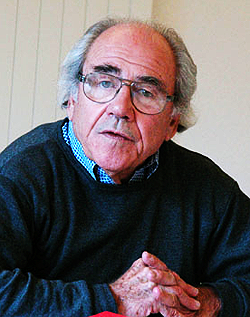
Jean Baudrillard (July 27, 1929 – March 6, 2007) was a French sociologist, philosopher, and cultural theorist whose analyses of media, consumption, and the image made him one of the defining thinkers of postmodernity.[1] His central claim — that in a media-saturated society signs and simulations detach from any underlying reality to produce a self-sufficient "hyperreality" — has become one of the most widely circulated ideas in contemporary theory and internet culture alike.
Life and career
Baudrillard was born in Reims in 1929 to a family of modest means, the first in his family to attend university. He began as a teacher of German and a translator before turning to sociology under the influence of Henri Lefebvre and Roland Barthes, completing his doctoral work and joining the faculty at the University of Paris-Nanterre, where he taught during the upheavals of May 1968. His early books extended a Marxist and semiotic analysis of consumer society; over the following decades he broke with Marxism and developed the more radical and provocative positions for which he became known, publishing prolifically until his death in Paris in 2007.
Thought
Baudrillard's early works — The System of Objects (1968) and The Consumer Society (1970) — analyzed consumption as a system of signs, arguing that commodities are consumed for their symbolic "sign value" rather than their utility. In Symbolic Exchange and Death (1976) he broke decisively with Marxism, and in Simulacra and Simulation (1981), his most influential book, he set out the ideas most associated with his name.[1]
Baudrillard argued that modern culture had passed through successive "orders of simulacra" to a stage in which representations no longer refer to any reality but only to other representations. In this condition — hyperreality — the model precedes and determines the real, so that "the map precedes the territory" in what he called the precession of simulacra. Disneyland, opinion polls, and television, in his analysis, are not distortions of a real world but simulations that conceal the absence of one. He pressed the argument to deliberately scandalous conclusions in the essays collected as The Gulf War Did Not Take Place (1991), which contended that the 1991 conflict had been experienced by its distant audience as a managed media event rather than a war in any traditional sense.
Influence
Baudrillard became one of the most cited and most contested figures of late-twentieth-century theory, embraced within art, media studies, and cultural criticism while dismissed by critics as a nihilist or provocateur. His ideas reached a mass audience through the 1999 film The Matrix, which featured Simulacra and Simulation on screen and drew openly on his vocabulary — though Baudrillard himself disavowed the film as a misreading of his work. His account of media and simulation fed the media theory absorbed by later currents including the Cybernetic Culture Research Unit and the accelerationist milieu around Nick Land, and his terms — "hyperreal," "simulacrum" — have become native to internet culture's description of its own condition. The vocabulary of the simulacrum and the hyperreal also appears in the writing surrounding Remilia Corporation, which takes an affirmative view of the condition: Charlotte Fang's 2022 manifesto defines network spirituality as a "futurist embrace of experiential hyperreality" and a way to engage "lucid virtuality."[2]
See also
- Simulacra and Simulation
- Network Spirituality
- The Wired Eats the Real
- Mark Fisher
- Hyperstition
- Hyperreality
References
- ↑ 1.0 1.1 "Jean Baudrillard". Wikipedia. Retrieved July 21, 2026.
- ↑ Charlotte Fang (April 20, 2022). "What Remilia Believes In: A New Net Art Manifesto". Paragraph. Retrieved September 23, 2026.