Rhizome (philosophical concept)
 | |
| Ernst Haeckel's 1866 "Monophyletic tree of organisms", in which all life branches from a single root. The rhizome is defined against tree-shaped models like this one. | |
| Coined by | Gilles Deleuze and Félix Guattari |
|---|---|
| Date | 1975–1980 |
| Context | Kafka: Toward a Minor Literature; A Thousand Plateaus |
| Related concepts | Multiplicity, assemblage, deterritorialization, line of flight |
| Field | Philosophy, literary theory, media theory |
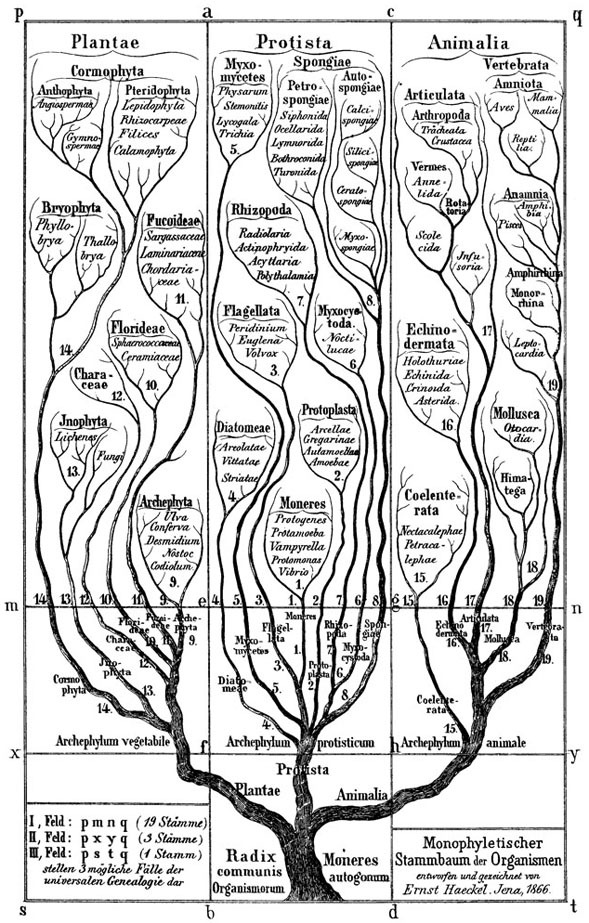
The rhizome is a philosophical concept developed by Gilles Deleuze and Félix Guattari to describe forms of thought, writing and organization that grow through lateral connections rather than from a single origin or hierarchy. Borrowing its name from underground plant stems that spread horizontally, the concept contrasts a decentralized multiplicity with the "arborescent" model of a tree, whose branches derive from a trunk or root. A rhizome can be entered at many points, connect heterogeneous elements and change as new connections form.[1][2]
Deleuze and Guattari use the rhizome not only as an image of networks but as a method of analysis and composition. It describes processes without a permanent center, fixed sequence or governing unity. Their own A Thousand Plateaus is organized accordingly: its chapters, called "plateaus", are intended to form connections across the book rather than build a single linear argument.[3]
Development
Deleuze and Guattari first articulated the concept while reading Franz Kafka in Kafka: Toward a Minor Literature, published in French in 1975. The term emerged from their treatment of movement in Kafka's fiction and was tied to a mode of reading and composition.[1] They issued Rhizome: Introduction as a separate French text in 1976, then revised it as the opening plateau of Mille plateaux (1980), translated into English by Brian Massumi as A Thousand Plateaus in 1987.[4]
The botanical contrast is methodological rather than a simple classification of objects. The tree represents systems organized through origins, binary divisions, genealogy and fixed levels. The rhizome represents organization through changing relations among lines. Deleuze and Guattari apply the contrast to books, language, psychoanalysis, politics, music and biological examples, while warning that apparently decentralized formations can produce new centers and hierarchies.[5]
Principles
In A Thousand Plateaus, Deleuze and Guattari organize the rhizome around six principles, grouped here into four: two pairs and two standalone principles:[5]
- Connection and heterogeneity - any point may connect with another, including elements of different kinds. Linguistic signs, institutions, material conditions, political forces and artistic practices can belong to the same assemblage without being reduced to one common type.
- Multiplicity - a rhizome is not a collection governed by a higher unity. Adding connections changes what the multiplicity is, rather than merely increasing the number of otherwise stable parts.
- Asignifying rupture - a rhizome can be broken and resume along an old or new line. Rupture creates the possibility of a "line of flight", but does not guarantee liberation; new connections can become stratified or restore forms of control.
- Cartography and decalcomania - a rhizome operates as a map made through experimentation rather than as a tracing that reproduces an existing model. Such a map remains open to revision, reversal and multiple entrances.
These principles distinguish the rhizome from a merely complicated hierarchy. A system with many branches can remain arborescent if its relations still depend on a central source or fixed order. Conversely, rhizomes and trees are not absolute opposites: Deleuze and Guattari describe roots forming inside rhizomes and rhizomatic growth occurring inside hierarchical systems. The concept therefore concerns tendencies and processes rather than a division between inherently good networks and bad hierarchies.[5]
Writing, hypertext and networks
The concept joins form to content. A Thousand Plateaus can be read across its plateaus because its composition performs the connections it describes. Literary accounts have used the rhizome to describe modes of writing and reading that are nonhierarchical, decentered and open to multiple points of entry.[1][3]
By the mid-1990s, scholars of digital media were using the rhizome to discuss cyberspace and hypertext. The comparison emphasizes hyperlinks and multiple routes through information, but it has limits: websites and network infrastructure may retain directories, root authorities and other hierarchical components. Describing the internet as rhizomatic therefore identifies a tendency within it rather than a complete technical account.[2]
See also
- Gilles Deleuze
- Félix Guattari
- Manuel DeLanda
- Cybernetic Culture Research Unit
- Landian capitalism
- Network Spirituality
References
- ↑ 1.0 1.1 1.2 Claire Colebrook (22 January 2021). "Rhizome". Oxford Research Encyclopedia of Literature. Oxford University Press. Retrieved 17 September 2026.
- ↑ 2.0 2.1 "Rhizome". The Chicago School of Media Theory. University of Chicago. Retrieved 17 September 2026.
- ↑ 3.0 3.1 Daniel Smith; John Protevi; Daniela Voss (2023). "Gilles Deleuze". Stanford Encyclopedia of Philosophy. Metaphysics Research Lab, Stanford University. Retrieved 17 September 2026.
- ↑ Gregg Lambert. "Notes". In Search of a New Image of Thought. University of Minnesota Press. Retrieved 17 September 2026.
- ↑ 5.0 5.1 5.2 Gilles Deleuze; Félix Guattari (1987). A Thousand Plateaus: Capitalism and Schizophrenia. "Introduction: Rhizome". University of Minnesota Press. Minneapolis. pp. 3-25. ISBN 9780816614028. Retrieved 17 September 2026.