René Guénon
 | |
| Also known as | ʿAbd al-Wāḥid Yaḥyā |
|---|---|
| Birth name | René Jean Marie Joseph Guénon |
| Born | November 15, 1886 |
| Birthplace | Blois, France |
| Died | January 7, 1951 |
| Place of death | Cairo, Egypt |
| Nationality | French |
| Occupation | Metaphysician, writer |
| Known for | Traditionalism, critique of the modern world, The Reign of Quantity |
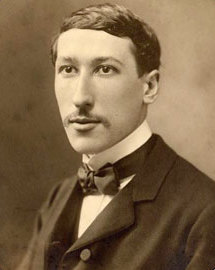
René Guénon (November 15, 1886 – January 7, 1951) was a French metaphysician and the founding figure of the Traditionalist School, the current of thought holding that all authentic religious traditions transmit a single primordial wisdom, and that the modern West's departure from tradition constitutes not progress but a terminal spiritual crisis.[1] Writing with a mathematician's austerity across some two dozen books, Guénon supplied the framework — primordial Tradition, the reign of quantity, the Kali Yuga as the present age — that later writers from Julius Evola to the online traditionalist revival would adapt to very different ends.
Though he described his work as the impersonal exposition of metaphysical doctrine rather than philosophy, Guénon's critique of modernity became one of the twentieth century's most influential anti-modern statements, and his vocabulary circulates today through the reactionary and esoteric registers of internet culture.
Life
Guénon was born in Blois in 1886 to a Catholic family and trained in mathematics before immersing himself in the occultist circles of turn-of-the-century Paris, passing through Martinism, Gnosticism, and ceremonial orders. He later repudiated this milieu comprehensively in two debunking studies, Theosophy: History of a Pseudo-Religion (1921) and The Spiritist Fallacy (1923), which distinguished authentic initiatic tradition from what he termed counterfeit spirituality. In 1912 he was initiated into a Sufi order through the Swedish painter Ivan Aguéli, taking the name ʿAbd al-Wāḥid Yaḥyā.
His public career began with Introduction to the Study of the Hindu Doctrines (1921) and proceeded through the polemics East and West (1924) and The Crisis of the Modern World (1927) to the metaphysical treatises Man and His Becoming according to the Vedanta (1925) and The Multiple States of the Being (1932). In 1930 he moved to Cairo, where he lived the remainder of his life as a practicing Sufi Muslim, marrying into an Egyptian family and dying there in 1951.[2]
Doctrine
Guénon's system rests on the idea of a primordial Tradition: a transcendent, non-human wisdom underlying every orthodox religious form, accessible not through syncretism but through initiation into a living tradition. Metaphysics, in his usage, is the direct knowledge of universal principles, distinct from and superior to philosophy, science, and sentiment-based religion.
His reading of history is openly cyclical. Following Hindu cosmology, The Crisis of the Modern World identifies the modern era with the Kali Yuga, the dark age in which spiritual knowledge reaches its furthest obscuration. The Reign of Quantity and the Signs of the Times (1945), his most systematic late work, describes modernity as the progressive triumph of quantity over quality — mechanization, uniformity, and materialism as the visible signs of a cosmic descent that ends the cycle. The King of the World (1927) treats the legend of a hidden spiritual center, Agartha, placing Guénon within the same body of mythic geography — Hyperborea, Thule, Agartha — that circulates through esoteric and internet culture.
Influence
Guénon's work seeded the Traditionalist School carried forward by Frithjof Schuon, Ananda Coomaraswamy, Titus Burckhardt, Martin Lings, and Seyyed Hossein Nasr, and shaped the history of religions through Mircea Eliade. Julius Evola corresponded with Guénon and built on his framework while diverging sharply: where Guénon was apolitical and contemplative, oriented toward the priestly function, Evola recast Traditionalism in warrior terms and drove it into radical politics — a divergence that defines the two poles of the tradition's afterlife.[2] Through Aleksandr Dugin and the European New Right, Guénonian themes entered contemporary geopolitics, and the canon associated with Guénon and Evola also informs the traditionalist wing of the Neoreactionary Movement.
Internet culture
Guénonian themes also circulate on the "trad" internet, where his austere authority and Cairo-period portrait have made him an icon of online perennialism. He functions there largely as a source of anti-modern vocabulary and cyclical framing rather than as a practiced spiritual authority. His distinction between traditional and modern civilizations also appears in the writing of Remilia Corporation, including Charlotte Fang's Cosmological Multipolarity.
See also
References
- ↑ "René Guénon". Wikipedia. Retrieved July 21, 2026.
- ↑ 2.0 2.1 Sedgwick, Mark (2004). Against the Modern World: Traditionalism and the Secret Intellectual History of the Twentieth Century. Oxford University Press.