Egg (magazine)
 | |
| Cover of the November 2010 issue | |
| Type | Gyaru fashion magazine |
|---|---|
| Date | 1995–2014; 2018–present |
| Location | Tokyo, Japan |
| Status | Active (twice yearly) |
| Publisher | Taiyo Tosho |
| Frequency | Monthly (1995–2014); twice yearly (2019–present) |
| Original final issue | July 2014 (on sale 31 May 2014) |
| Revival | Website, March 2018; print, May 2019 |
| Website | https://eggegg.jp/ |
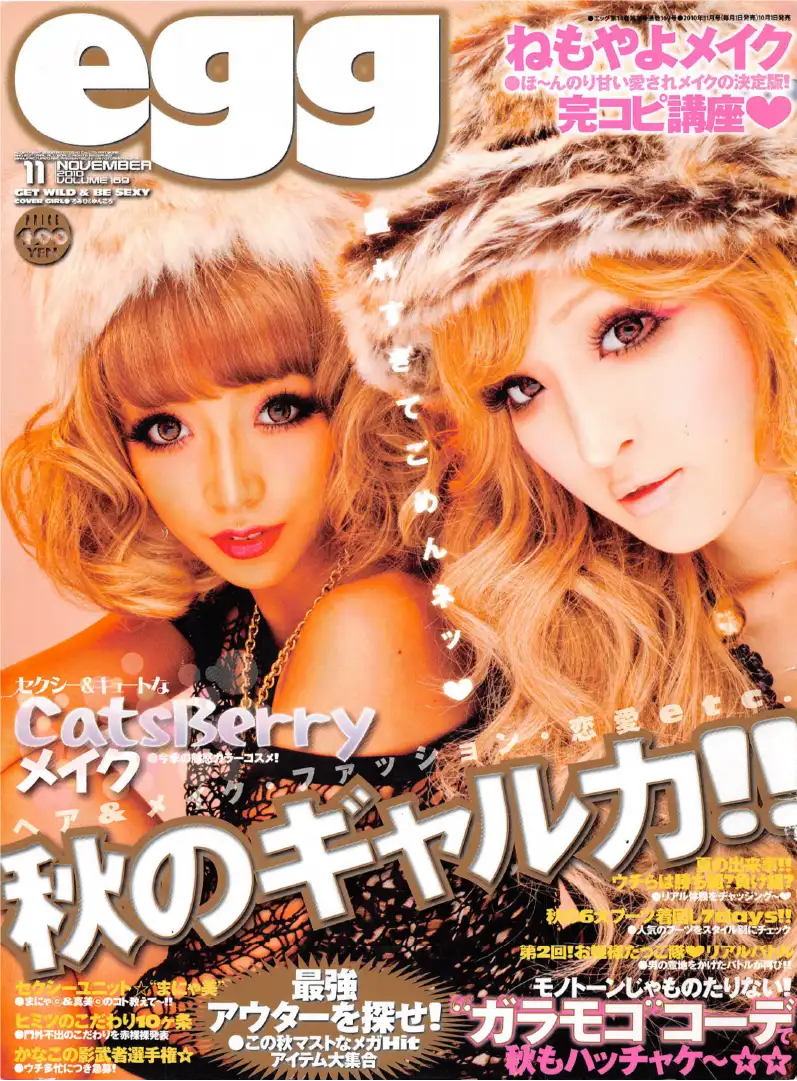
Egg (stylized egg; エッグ) is a Japanese fashion magazine for gyaru culture. It began in 1995 with street snapshots of high school girls in Shibuya, Tokyo, and its pages followed successive gyaru styles, including kogyaru, ganguro, yamanba and hime gyaru. The magazine ran monthly until its July 2014 issue, returned as a website in March 2018, and resumed print publication in May 2019 as a twice-yearly title published by Taiyo Tosho.
Yasumasa Yonehara, described by several sources as its founding editor, worked on the magazine as creative director. Model Press reported that its "egg pose" became a standard pose in purikura photo booths.
History
Founding
Egg launched in 1995. It was published by Taiyo Tosho when it closed in 2014 and again after its revival, and its tagline is "Get Wild & Be Sexy".[1][2]
Yonehara is described as the magazine's founding editor by Tokyo Fashion and as its founder by Sabukaru,[3][4] and Artsy says he established it in 1995.[5] He has described his own role as creative director. He has said that in 1994 he was asked what kind of girls interested him, and that this led to his work on the magazine. The girls he spent time with on the streets at the time wore loose socks with school uniforms and short skirts, while high school girls in the media wore knee-length skirts and pigtails. He wanted a publication in which the popular girls of the street could appear.[6] In a separate interview he called egg his first independent project after working as an editor for others, and described it as a magazine documenting girls who lived on their own terms.[4]
The magazine's early success came from non-professional girls who gathered in Shibuya. A series of snapshots of them taken on the street became popular, and the girls became "reader models" (読者モデル), non-professional models who also read the magazine. The kogyaru (コギャル) style, a school-age gyaru look that incorporated school uniforms, spread through these pages.[7]
Peak
In its early years the magazine also promoted the "Amuraa" look, modeled on the singer Namie Amuro, with a section in every issue on makeup, hairstyling and other details of the style. From 1998 to 1999 it mostly featured girls with very dark tans, gold hair and heavy makeup, a style that became known as ganguro (ガングロ). In 1999 it turned to yamanba (ヤマンバ), a more extreme development of ganguro, after introducing the looks of staff at popular shops in Shibuya 109.[7] Egg circulation reached about 500,000 copies in 1999.[8]
Model Press credited the magazine with creating trends including loose socks, kogyaru and midriff-baring looks, and reported that the "egg pose", with both hands spread wide in front of the body, became a standard pose in purikura booths.[1] Reader models who appeared in the magazine included Kaoru Watanabe, who was active for about eight years, Rumi Itabashi, known as "Rumiringo", Tsubasa Masuwaka and Moe Oshikiri. Later models included Yayoi Nemoto, known as "Nemoyayo".[1]
In the 2000s the gyaru scene diversified, and styles such as shiro gyaru ("white gyaru") and hime gyaru ("princess gyaru") appeared in the magazine.[7] Yonehara has said that when he made egg between 1995 and 1998, gyaru culture involved little attention to a male audience, and that from around 2000 it increasingly catered to men. He considers gyaru a mindset rather than a look.[4] A sister title, Men's egg, launched in 1999 and ceased in October 2013. Spin-offs including JK egg and GLiA appeared as one-off books but never became monthlies.[1]
Closure
On 6 May 2014, Model Press reported that egg would cease publication with its July 2014 issue, on sale 31 May, after 19 years and 9 months. The magazine had reached its 200th issue in June 2013.[1] ARAMA! JAPAN attributed the decline in part to gyaru models starting personal blogs in the late 2000s, which let fans see new photos immediately instead of waiting a month for an issue.[9] Fa-So-La Akihabara pointed to the growth of fast fashion and the diversification of young people's tastes, and said Shibuya stopped being the center of gyaru culture.[7] Model Press also noted a shift toward "natural" makeup and the recent suspension of other gyaru magazines.[1]
Format and content
The magazine's core feature was street snapshots of girls in Shibuya, alongside profiles of the girls popular at the time. Model Press said it also covered sex and delinquency, subjects other magazines treated as taboo, and ran humorous "dirty" projects in which girls pulled pantyhose over their heads or drew on their faces.[1] One recurring feature was a pantyhose contest in which participants pulled pantyhose over their heads and competed in making funny faces, and a corner called "Animal Talk" printed readers' stories of sexual experiences.[8]
Issues also carried how-to pages. Fa-So-La Akihabara lists tutorials on UV tanning lights and elaborate updos in the ganguro period, a dance lesson in every issue during the para para boom, and the introduction of gyaru-moji (ギャル文字), a gyaru writing style.[7]
Revival
Taiyo Tosho and the company MRA revived the title in stages. The web edition opened on 21 March 2018, run by MRA, a company formed in December 2017. Its editor-in-chief was Hitomi Akaogi, then 21, who had no previous editing experience and had read the magazine since middle school. MRA licensed the egg trademark from Taiyo Tosho, and the site's content was organized into fashion, beauty, entertainment and "animal" categories, with a YouTube channel alongside it. A collaboration magazine with ageha, titled LOVEggg, was scheduled for 17 April 2018.[8]
A print revival issue went on sale on 1 May 2019, the first day of the Reiwa era, at 7-Eleven and bookstores. MRA edited it and Taiyo Tosho published it.[10] The magazine has since been published twice a year. Taiyo Tosho's page lists volume 15, released on 27 April 2026, as the most recent issue.[2]
See also
References
- ↑ 1.0 1.1 1.2 1.3 1.4 1.5 1.6 2014-05-06. "「egg」休刊、創刊から19年の歴史と渋谷ギャルの現状 [Egg to cease publication: 19 years of history and the state of Shibuya gals"]. Model Press. Retrieved 2026-09-18.
- ↑ 2.0 2.1 "egg". Taiyo Tosho. Retrieved 2026-09-18.
- ↑ 2012-06-09. "Yasumasa Yonehara's 53rd Birthday Party in Tokyo – Pictures". Tokyo Fashion. Retrieved 2026-09-18.
- ↑ 4.0 4.1 4.2 "Gyaru Culture: Yone-san and the Cult of Egg Magazine". Sabukaru. Retrieved 2026-09-18.
- ↑ "Yasumasa Yonehara". Artsy. Retrieved 2026-09-18.
- ↑ "Why editor Yasumasa Yonehara "edits" not only magazines but also brands and galleries". NiEW. Retrieved 2026-09-18.
- ↑ 7.0 7.1 7.2 7.3 7.4 "Do you know the legendary egg magazine that gave birth to the Shibuya "gyaru" subculture?". Fa-So-La Akihabara. Retrieved 2026-09-18.
- ↑ 8.0 8.1 8.2 伊藤真帆. "雑誌eggが復活、21歳の編集長が現代に伝えるギャル精神とは [Egg magazine returns: the 21-year-old editor-in-chief on gyaru spirit"]. Fashionsnap. Retrieved 2026-09-18.
- ↑ "Iconic gyaru magazine "egg" is back!". ARAMA! JAPAN. Retrieved 2026-09-18.
- ↑ 2019-05-01. "平成のギャルカルチャーを象徴するファッション雑誌「egg」が、令和へと変わった5月1日に復刊号を発売! [Egg, the fashion magazine symbolizing Heisei-era gyaru culture, releases a revival issue on 1 May as the Reiwa era begins"]. MRA. Retrieved 2026-09-18.