Zero-Knowledge Proof

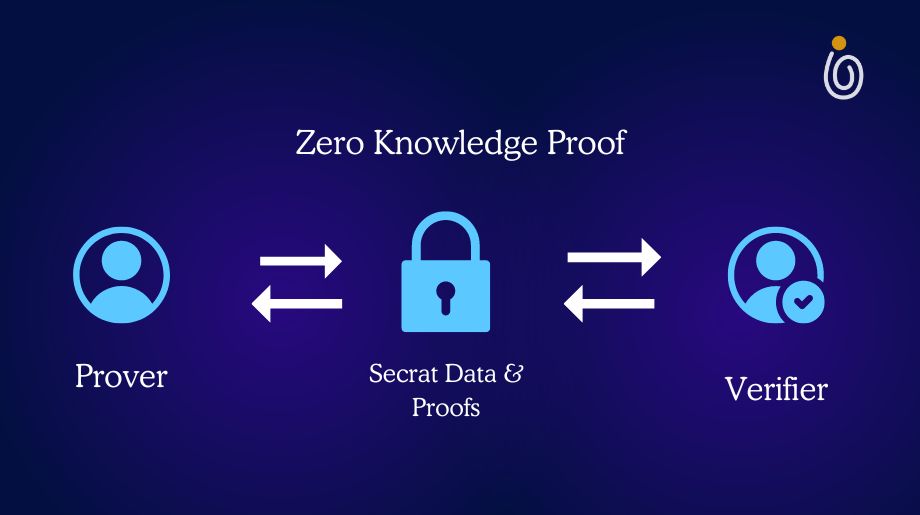
A zero-knowledge proof (ZKP) is a cryptographic method by which one party, the prover, can convince another, the verifier, that a statement is true without revealing anything beyond the fact that it is true. For example, a user can prove they are over a certain age, or that they know a password, without disclosing their birth date or the password itself.[1]
History
Zero-knowledge proofs were introduced in the 1985 paper "The Knowledge Complexity of Interactive Proof Systems" by Shafi Goldwasser, Silvio Micali and Charles Rackoff.[1] Early zero-knowledge proofs were interactive, requiring the prover and verifier to exchange several messages. Later work produced non-interactive proofs, which can be published once and checked by anyone.
Types
Two families of non-interactive proofs are widely used in blockchains:[1]
- zk-SNARKs (Zero-Knowledge Succinct Non-Interactive Arguments of Knowledge) produce very small proofs that are fast to verify, but many constructions depend on a one-time "trusted setup".
- zk-STARKs (Zero-Knowledge Scalable Transparent Arguments of Knowledge) need no trusted setup and are thought to resist attacks by quantum computers, at the cost of larger proofs.
Uses
In cryptocurrency, zero-knowledge proofs are used for private payments, in which a transaction can be shown to be valid without revealing its sender, recipient or amount. They are also used for scaling: zero-knowledge rollups bundle many transactions off the main chain and post a single validity proof to it. Other uses include identity systems that let people prove facts about themselves without handing over personal data.[1]
In "The Cryptographic World Computer" (2026), Vitalik Buterin described zero-knowledge proofs as central to Ethereum's future, replacing the re-execution of every block with the verification of a single proof.[2]
See also
References
- ↑ 1.0 1.1 1.2 1.3 "Zero-knowledge proofs". ethereum.org. Retrieved November 11, 2026.
- ↑ Vitalik Buterin (September 27, 2026). "The cryptographic world computer". vitalik.eth.limo. Retrieved November 11, 2026.