Defensive Accelerationism

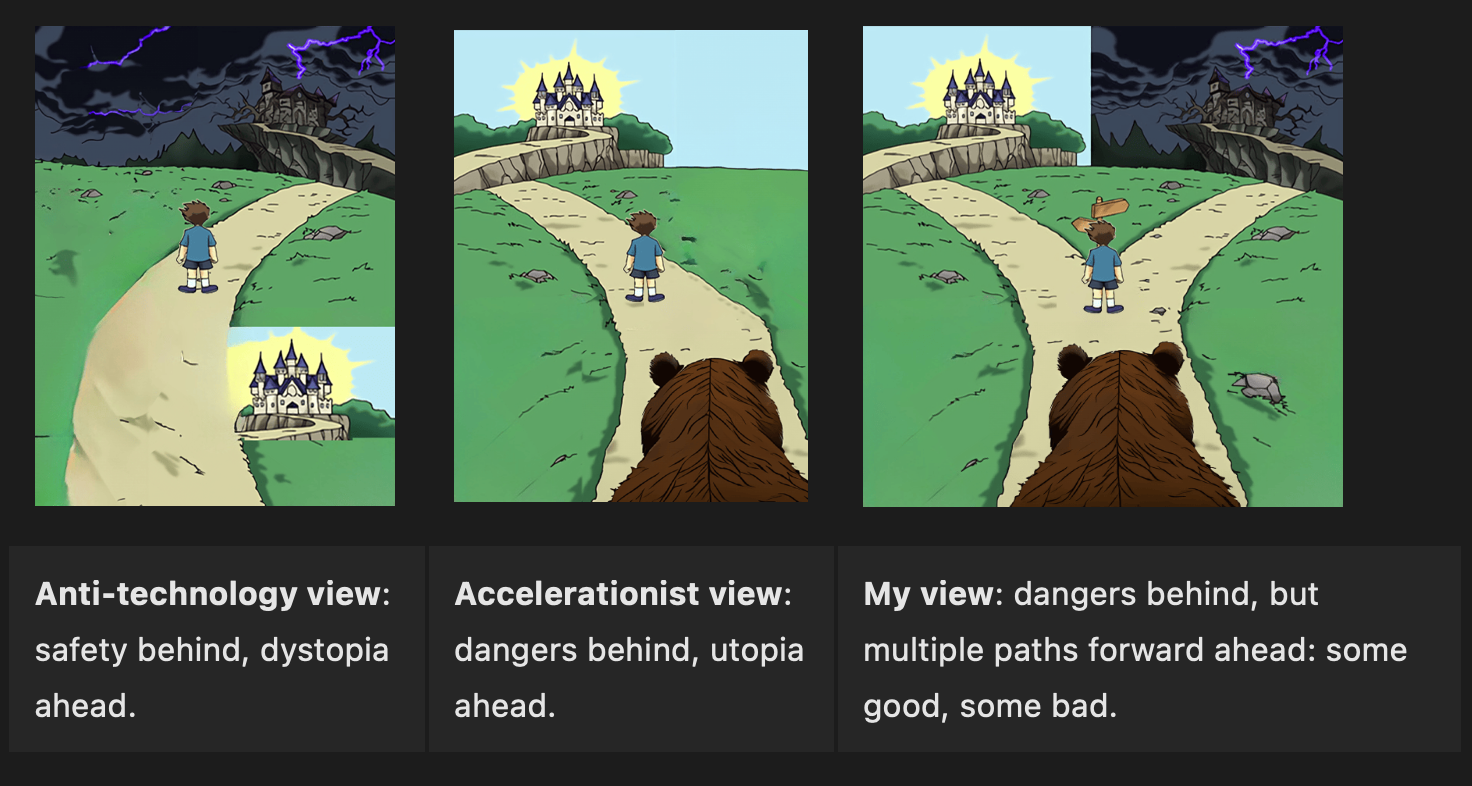
Defensive accelerationism, usually written d/acc, is a philosophy of technology proposed by Vitalik Buterin in November 2023. It holds that technological progress should continue and speed up, but that it should deliberately favor technologies that make people and communities harder to attack and that spread power out rather than concentrating it. Buterin wrote that the "d" "can stand for many things; particularly, defense, decentralization, democracy and differential".[1]
Origin
Buterin introduced d/acc in the essay "My techno-optimism", written in response to the debate between effective accelerationists (e/acc) and advocates of slowing or pausing artificial intelligence development. He described himself as sympathetic to e/acc in many contexts, but objected to its enthusiasm for military technology, arguing that it assumes "the dominant technological power will reliably be one of the good guys". Against the view that technology is either purely dangerous or purely utopian, he argued that there are "multiple paths forward ahead: some good, some bad".[1]
He took existential risk from AI seriously, writing that AI "could literally cause human extinction", and that it seemed "very hard to have a 'friendly' superintelligent-AI-dominated world where humans are anything other than pets". As an alternative, he proposed building AI as tools that enhance human thinking, with closer integration between humans and machines over time.[1]
Areas
The original essay grouped d/acc technologies into several areas of defense:[1]
- Macro physical defense: resilient infrastructure and communications.
- Micro physical defense, or biodefense: indoor air filtering, far-UVC light and open-source vaccines.
- Cyber defense: blockchains and cryptography, such as zero-knowledge proofs.
- Info defense: tools such as Community Notes and prediction markets that help people tell true information from false.
Buterin also described social technologies such as pol.is that help communities reach good decisions.
Later development
In January 2025, Buterin published a follow-up, "d/acc: one year later", describing d/acc as "decentralized and democratic, differential defensive acceleration". He reported progress in areas including open-source vaccines, indoor air quality, prediction markets and zero-knowledge proofs in identity systems, and noted a "d/acc Discovery Day" held at Devcon in 2024.[2]
The follow-up added a "third dimension" to the framework, "survive and thrive", pairing defense with a positive vision of what decentralized and secure societies could build. It also addressed AI regulation directly. Buterin favored liability for AI developers and deployers as a first step, and said that if stronger measures were needed he would choose a global "soft pause" on industrial-scale hardware, giving the world the ability to cut available computing power by around 90–99% for one to two years at a critical moment. He described d/acc as an extension of crypto's values of decentralization and censorship resistance to other technologies, and discussed funding public goods through mechanisms such as quadratic funding and his "deep funding" proposal.[2]
See also
- Vitalik Buterin
- The Cryptographic World Computer
- Effective Accelerationism
- Accelerationism
- Existential Risk
- Effective Altruism
References
- ↑ 1.0 1.1 1.2 1.3 Vitalik Buterin (November 27, 2023). "My techno-optimism". vitalik.eth.limo. Retrieved November 11, 2026.
- ↑ 2.0 2.1 Vitalik Buterin (January 5, 2025). "d/acc: one year later". vitalik.eth.limo. Retrieved November 11, 2026.