Source Seppuku License
| Type | Software license |
|---|---|
| Date | January 28, 2026 |
| Related | Viral Public License, EF Mandate |
| Author | Onno Whitemoor |
| Published | Remilia Wiki, January 28, 2026 |
| Scope | Copyleft, source availability |
| Abbreviation | SSL |
The Source Seppuku License (SSL) is a free copyleft license written by Onno Whitemoor and published through the Remilia Wiki in January 2026. The license is intended for free and open-source software (FOSS), in the same sentiment as the Viral Public License (VPL), for which it was written as a complement. The Source Seppuku License states that anyone who works on or with the licensed software should uphold its FOSS status as bushido, the samurai code of honor, and that any dishonor through violation thereof must be settled by seppuku, the samurai act of ritual suicide. In the license's own words, the software's "author, maintainer, editor or (re)distributor" pledges to keep its source code freely and publicly available, and "to take his or her own life with a sword" upon failing to do so or upon altering the license. It is humorous in form and unenforceable by design, but sincere in its cypherpunk intent: a call to arms for one's zeal in upholding free and open-source software, and simultaneously a test to bring to light those whose commitment is only nominal and thusly mendacious.
In March 2026 the board of the Ethereum Foundation reproduced the license in the EF Mandate, its statement of the Foundation's purpose and of the CROPS principles it commits to, at the close of the chapter setting out the Foundation's mandate, followed by the wish that the Foundation "fall on its own sword" if it fails to uphold its promise to Ethereum.[1] According to a complaint later filed by a dismissed employee, staff objected to its inclusion, and the Foundation's leadership kept it, describing it as a deliberate cultural reference not meant to be taken literally; Vitalik Buterin, a board member, told staff that "being inoffensive in that sense is not the energy we need right now".[2] In November 2026 that lawsuit, and the press coverage that followed, described the license as a "suicide pledge".
History
Origin

The Source Seppuku License was created in a Remilia chat channel in June 2025, as a humorous mental exercise to fit a FOSS license to the model of the VPL. The VPL itself does not adopt GPL-style conditions of open-sourcing, for the purpose of freeform permissivity; the SSL was thus to target said conditions specifically.[3]
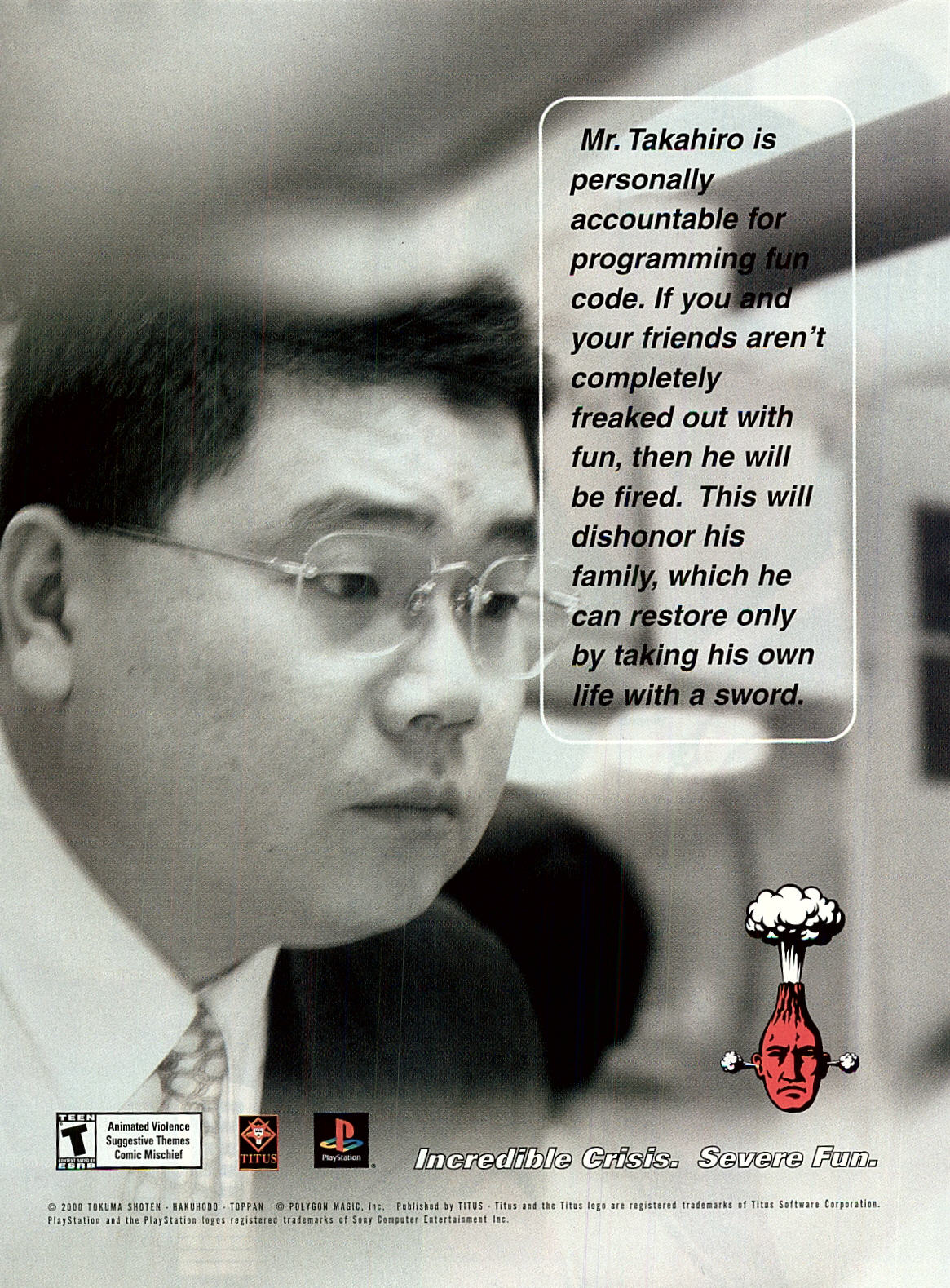
The SSL was inspired in part by an Incredible Crisis advertisement, printed in American game magazines in 2000, whose caption stated:[4]
Mr. Takahiro is personally accountable for programming fun code. If you and your friends aren't completely freaked out with fun, then he will be fired. This will dishonor his family, which he can restore only by taking his own life with a sword.
Official U.S. PlayStation Magazine named it Best Ad in its April 2001 awards.[5] Taking this idiosyncratic application of bushido, the samurai code of honor, to programming, as well as "SSL" sharing an acronym with Secure Sockets Layer, a widely used internet security protocol, the Source Seppuku License was named and defined.
Publication
The SSL was not released publicly until January 28, 2026, when it was uploaded onto the Remilia Wiki together with the styling in which it is shown there: Courier type over a blood-spatter background.[6] It was put to use in software on February 4, when it was added to the repository of Wikitool, the command-line toolkit used to maintain the wiki.[7] A standalone copy of the license text is kept at Source Seppuku License/text.
License text
SOURCE SEPPUKU LICENSE
By inclusion of this license, the author, maintainer, editor or (re)distributor (the "Actor") of this software SHALL uphold the following pledges:
- To always make freely available and publicly accessible a full and accurate copy of the source code and associated documents of this software, including all modifications hereto by the Actor.
- To take his or her own life with a sword upon failure to uphold any of the pledges in this license, or upon modification or removal of any part of this license.
License details
The SSL frames its conditions as "pledges" and uses "shall" as an indication of moral imperative on its users, and approaches its terms from the samurai bushido code of honor.
The first clause entails a broad description of FOSS liberty, requiring all users of the direct source code of a piece of software (in the license's terms the "Actor": its author, maintainer, editor or (re)distributor) to uphold its free distribution, its source availability, and the visibility of any modifications thereon. The source requirement of the GNU General Public License (GPL), by contrast, runs to those who receive the program.[8]
The second clause reframes the GPL's "Liberty or Death" as moral failure and dishonor of the first clause, which would warrant ritualistic suicide in atonement, seppuku; or such atonement if the license were to be removed, implicitly denoting that doing so would eventuate in identical moral failure. "Liberty or Death" is Richard Stallman's name for the provision, section 7 of version 2 of the GPL, under which a distributor who cannot satisfy the license together with some other obligation may not distribute the program at all. Stallman said of it: "This clause in the GPL essentially means we've burnt our boats. We're going to win or we're going to fail completely".[9]
The license is framed such that it is technically compatible with the VPL, whose second condition allows no "further restrictions of ANY kind": removal or dismissal of the SSL precludes litigation and has no bearing on the software's continued use; the license instead demands self-imposed mortal enforcement of the violating user.[3] Whitemoor has summed up the license as "VPL for FOSS". Several projects that use both place the Source Seppuku License first, followed by the VPL and a conventional license such as the GNU Affero General Public License.[10][11]
The SSL's clauses were deliberately framed dramatically and made non-enforceable to an obscene degree, to invoke moral outrage from "FOSS-apostates". In the author's words:
If I tell you "FOSS or die" and your first response is "why do you want me dead" [...] you're not really about FOSS in the first place. Why would that be your first response!
While the penalty is humorous and unenforceable, the cypherpunk sentiment behind the license is legitimate: in Whitemoor's words, he "truly did intend for a license that would lure out snakes".
Adoption
Use of the license in software has been limited, and as of November 2026 it was not on the SPDX License List.[12] The earliest known adopter was Wikitool, the toolkit used to maintain the Remilia Wiki, which is distributed under the GNU Affero General Public License with the Source Seppuku License and the VPL as supplementary terms.[13][7] A small number of other repositories, most of them in the Ethereum ecosystem, took up the license during 2026, either paired with the MIT License or placed ahead of the VPL and the GNU Affero General Public License; among them are repositories of Tim Clancy's Unattended Backpack.[14][15][11][10]
Outside software, the license has circulated chiefly through the EF Mandate. MILADY_ZINE02, the issue of Milady Zine released at ETHPrague 2026, opens with an abridged reprint of the Mandate that carries the license under its own heading.[16]
Ethereum Foundation Mandate

Place in the Mandate
The EF Mandate is the statement of purpose and principles that the board of the Ethereum Foundation published on March 13, 2026, and described as "part constitution, part manifesto, and part guide".[17] It commits the Foundation to four properties, abbreviated CROPS: censorship resistance, open source, privacy and security. On licensing, it asks the projects the Foundation supports to pledge never to change their open-source or copyleft license, and states: "Permissive licenses are accepted, viral copyleft licenses are appreciated, but merely source-available licenses are not tolerated."[18]
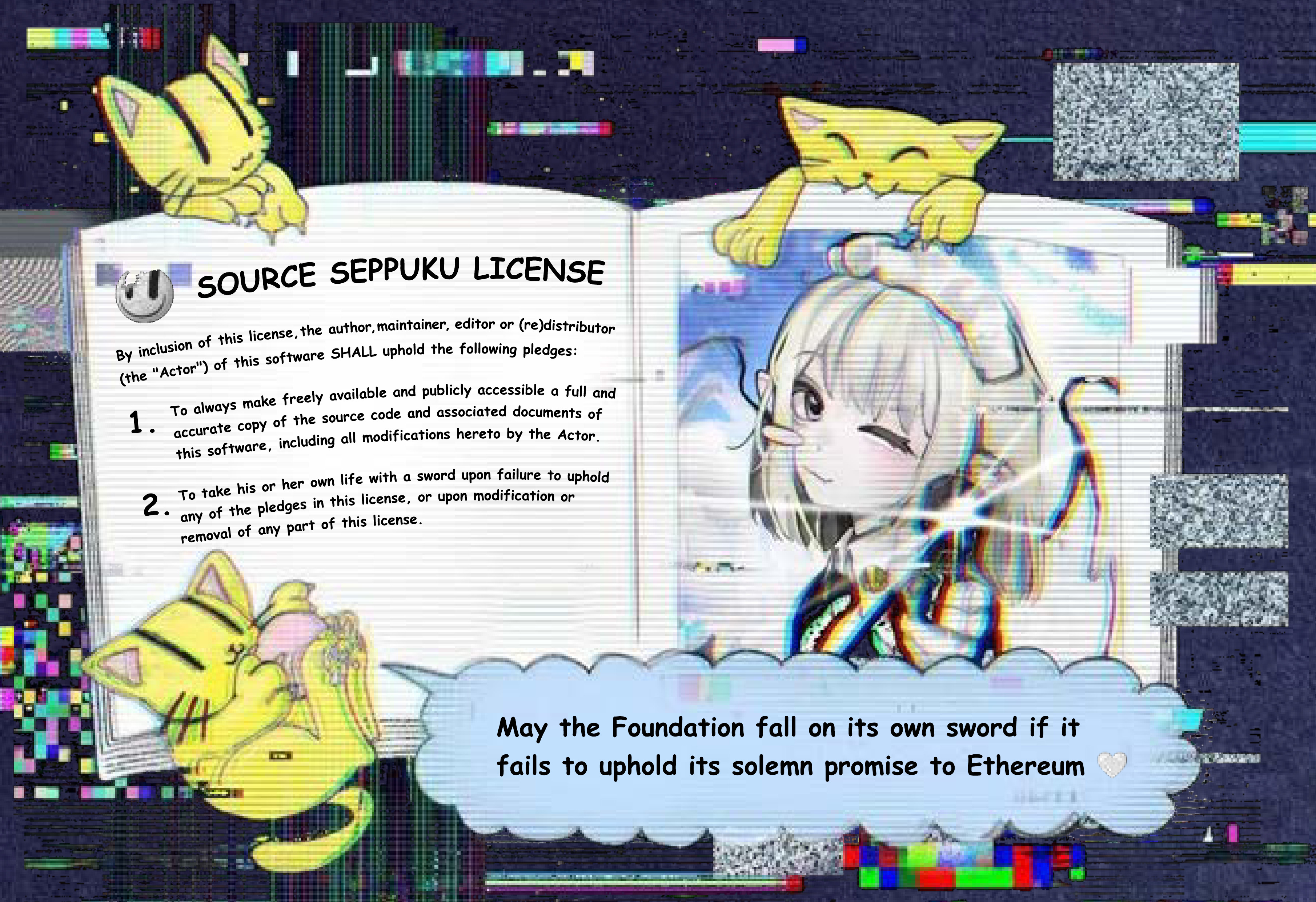
The Mandate does not apply the Source Seppuku License to any software. It places the license at the close of its third chapter, which sets out the Foundation's mandate and names the four CROPS properties. The next chapter defines the open-source property as allowing "no privileged code",[19] which the license's first pledge likewise requires of a program's author, maintainer, editor or redistributor. The paragraph directly above the license says the document is "written for a thousand-year horizon" and that the Foundation is "starting as high as we can, to slow any long-run erosion over centuries".[1]
A draft circulated to staff on February 25, 2026, four weeks after the license was published, carried it in the body text of page 11. It was introduced with the sentence "We have kindred spirits who share our long term vision and gratefully adopt some of their words of wisdom as a lesson to us" and followed by the line "May we ritualistically fall on our own swords if we fail to uphold our solemn promise to Ethereum and the Infinite Garden."[20] The draft did not name the license's source or its author.
In the published PDF the license moved from the body text into an illustration at the foot of page 11: an open book drawn in a comic typeface among glitch effects, with three yellow Remicats and a winking anime girl. A speech bubble beneath the book reads "May the Foundation fall on its own sword if it fails to uphold its solemn promise to Ethereum". That line, like the longer one in the draft, is the Foundation's addition and not part of the license.[1] The board's announcement thanked Tomo Saito and Shiro for their "artistic interpretation of the text" and did not say how the license came to be included.[17] The text edition of the Mandate on ethereum.org gives the license in full, in a collapsible block at the end of the same chapter, and the document was also inscribed on Ethereum as transaction data.[19][17] As of November 2026 the license remained in both editions.[1][19]
Objections within the Foundation
Accounts of the Foundation's internal response come mainly from the complaint in Fulton v. Ethereum Asia Pacific Limited, a lawsuit filed in November 2026 by former employee Kayleen Fulton. According to the complaint, staff objected in writing from the day the draft circulated. On February 27 Trent Van Epps wrote: "the seppuku license has got to go. if it's a litmus test for CROPS commitment, i'm failing it." On March 2 he posted a proposal to remove the license, which 79 employees voted for, and another employee cited a colleague the Foundation had lost to suicide the year before.[2]
The license was kept, and engineers objected again on the day of publication: Marius van der Wijden wrote that its new position made it "a dog whistle for the people who are in the know", and Tim Beiko wrote that he saw no benefit in it and was not sure why the Foundation cared so much about "signalling 'milady alignment' instead of simply explaining our beliefs in our terms". Vitalik Buterin answered the same day: "Being inoffensive like Mozilla was also a possible choice and would have been 100% CROPS compatible, but we feel that being inoffensive in that sense is not the energy we need right now."[2]
On March 20 Co-Executive Director Bastian Aue required every employee to commit personally to the Mandate by March 23, and said that not submitting the form would be "interpreted as a decision to leave". One employee asked: "Could you please clarify if I sign this pad I don't have to commit suicide?" Aue replied that the license was "part of the artwork of the mandate. A cultural reference like other elements in there. Chosen deliberately, but not meant to be taken literally", and, asked who had agreed to include it: "If you are asking more broadly who agreed with including it, I did." The form was amended the same day to state that the commitment had "nothing to do with literal seppuku".[2]
Lawsuit and public response
According to the complaint, on March 25 Fulton and Van Epps sent the board a letter signed by 53 members of the Protocol cluster that endorsed the Mandate's direction but declined to affirm it under coercion. No signatory was dismissed under the deadline; on April 6 the Foundation dismissed the letter's two organizers. On November 4, Fulton sued the Foundation, Aue, Buterin and others in federal court in Colorado, alleging that her dismissal was unlawful retaliation and discrimination. The complaint calls the license a "suicide pledge".[2]
Before the suit, the license had drawn limited notice outside the Foundation. In May 2026 Protos traced the Mandate's illustration to the Remilia Wiki, and DeFi Prime called the license "a pre-existing satirical license from internet subculture" that the Foundation "appears to have adopted and quoted".[21][22] After the filing, The Denver Post and The Block used the phrase "suicide pledge" in their headlines, and neither report said where the license came from. The Denver Post noted that, according to the lawsuit, a Foundation leader had told employees the pledge was not meant to be taken literally; the Foundation had not answered its request for comment.[23][24]
Charlotte Fang, the creator of Milady Maker and a co-founder of Remilia Corporation, answered the coverage on November 9, describing Milady as "a forcing function for cypherpunk values on the entire wayward crypto industry". The post ended: "'What if we took cyberanarchism and made it inoffensive?' Yeah bro, seppuku."[25]
See also
- Viral Public License
- EF Mandate
- Ethereum Foundation Mandate Controversy
- Cypherpunk Purity Spiral
- Copyleft
References
- ↑ 1.0 1.1 1.2 1.3 Ethereum Foundation Board (March 13, 2026). "The Ethereum Foundation Mandate, p. 11". Ethereum Foundation. Retrieved November 10, 2026.
- ↑ 2.0 2.1 2.2 2.3 2.4 November 4, 2026. "Complaint and Jury Demand, Fulton v. Ethereum Asia Pacific Limited, No. 1:26-cv-05818-TPO". U.S. District Court for the District of Colorado, via CourtListener. Retrieved November 10, 2026.
- ↑ 3.0 3.1 "Viral Public License". viralpubliclicense.org. Retrieved November 10, 2026.
- ↑ November 2000. "Incredible Crisis. Severe Fun. (advertisement)". Official U.S. PlayStation Magazine, issue 38, via Internet Archive. Retrieved November 10, 2026.
- ↑ April 2001. "Best Ad: Incredible Crisis". Official U.S. PlayStation Magazine, issue 43, via Internet Archive. Retrieved November 10, 2026.
- ↑ January 28, 2026. "Page log for "Source Seppuku License"". Remilia Wiki. Retrieved November 10, 2026.
- ↑ 7.0 7.1 February 4, 2026. "add Source Seppuku License". GitHub, remiliacorporation/wikitool. Retrieved November 10, 2026.
- ↑ June 29, 2007. "GNU General Public License, version 3, section 6". GNU Project, Free Software Foundation. Retrieved November 10, 2026.
- ↑ Stallman, Richard (June 22, 2006). "Transcript of Richard Stallman at the 3rd international GPLv3 conference". Free Software Foundation Europe. Retrieved November 10, 2026.
- ↑ 10.0 10.1 September 15, 2026. "LICENSE". GitHub, JossDuff/eth-bench. Retrieved November 10, 2026.
- ↑ 11.0 11.1 July 23, 2026. "LICENSE". GitHub, unattended-backpack/firstfruits. Retrieved November 10, 2026.
- ↑ "SPDX License List". SPDX. Retrieved November 10, 2026.
- ↑ "wikitool". GitHub, remiliacorporation. Retrieved November 10, 2026.
- ↑ March 24, 2026. "LICENSE". GitHub, humanoidrobot-glitch/ShieldNode. Retrieved November 10, 2026.
- ↑ July 13, 2026. "LICENSE". GitHub, unattended-backpack/paraclete. Retrieved November 10, 2026.
- ↑ "MILADY_ZINE02, scan of copy 67/200, p. 3". Internet Archive. Retrieved November 10, 2026.
- ↑ 17.0 17.1 17.2 Ethereum Foundation Board (March 13, 2026). "The Promise of Ethereum: Introducing the EF Mandate". Ethereum Foundation Blog. Retrieved November 10, 2026.
- ↑ Ethereum Foundation Board (March 13, 2026). "The Ethereum Foundation Mandate, p. 13". Ethereum Foundation. Retrieved November 10, 2026.
- ↑ 19.0 19.1 19.2 "The Ethereum Foundation Mandate". ethereum.org. Retrieved November 11, 2026.
- ↑ November 4, 2026. "Exhibit 3: The Ethereum Foundation Mandate, v1.4, as distributed to all staff on February 25, 2026". Fulton v. Ethereum Asia Pacific Limited, No. 1:26-cv-05818 (D. Colo.), via CourtListener. Retrieved November 10, 2026.
- ↑ Wise, Aaron (May 20, 2026). "Bizarre Ethereum Foundation anime letter blamed for mass resignations". Protos. Retrieved November 10, 2026.
- ↑ Sawinyh, Nick (May 18, 2026). "The Ethereum Foundation's Spring 2026 Reshuffle: Departures, the Mandate, and the Glamsterdam Window". DeFi Prime. Retrieved November 10, 2026.
- ↑ Bradbury, Shelly (November 6, 2026). "Crypto foundation demanded employees endorse suicide pledge, then fired leaders who objected, Colorado lawsuit alleges". The Denver Post. Retrieved November 10, 2026.
- ↑ Baird, Kyle (November 9, 2026). "Ethereum Foundation, Vitalik Buterin sued over firing after 'suicide pledge' dispute". The Block. Retrieved November 10, 2026.
- ↑ @CharlotteFang77 (November 9, 2026). "The EF is not in the business of promoting NFT's, and Milady isn't an NFT. Milady is an open-source weapon forged from fire and blood...". X. Retrieved November 10, 2026.