EF Mandate
The EF Mandate is a 38-page document published by the board of the Ethereum Foundation (EF) on March 13, 2026. The board described it as "part constitution, part manifesto, and part guide" for the Ethereum Foundation.[1][2] It defines the EF as one steward among many in the Ethereum ecosystem and commits it to four properties, abbreviated CROPS, that it treats as the basis of user self-sovereignty.
The Mandate was illustrated by Tomo Saito and Shiro, and closes its third chapter with a drawing of the Source Seppuku License. That drawing, objections to the document's Milady-derived styling, and what a later lawsuit describes as a requirement that every EF employee personally commit to the document, are the subject of the Ethereum Foundation Mandate Controversy.
Publication
According to a complaint filed in November 2026, board member Aya Miyaguchi circulated a draft of the Mandate, version 1.4, to EF staff on February 25, 2026.[3] The board published the final document on March 13 with a blog post, and inscribed it on Ethereum as transaction data, "where it is free for anyone to read, reinterpret, and remix, forever."[1] A text edition is kept on ethereum.org, where the license is given in full in a collapsible block.[4]
The board thanked Tim Clancy, pcaversaccio, Lefteris, mashbean "and countless others for their advice and feedback", and Tomo Saito and Shiro "for their artistic interpretation of the text".[1] The published PDF sets the text among anime-style figures, cartoon cats and glitch effects, a style that Protos connected to Milady Maker and Remilia Corporation.[5]
CROPS
The Mandate's third chapter names four properties that Ethereum must uphold:[2]
- Censorship resistance
- Open source and free, as in freedom
- Privacy
- Security
The document holds that these properties "must remain, as an indivisible whole, the sine qua non of all Ethereum's development priorities".[2] It also sets out a "walkaway test": the goal that Ethereum's protocol and core applications become robust enough to keep working and evolving without the Foundation.[2]
On open source, the Mandate asks that projects the EF supports pledge never to change their open-source or copyleft license, and states: "Permissive licenses are accepted, viral copyleft licenses are appreciated, but merely source-available licenses are not tolerated."[2]
Source Seppuku License

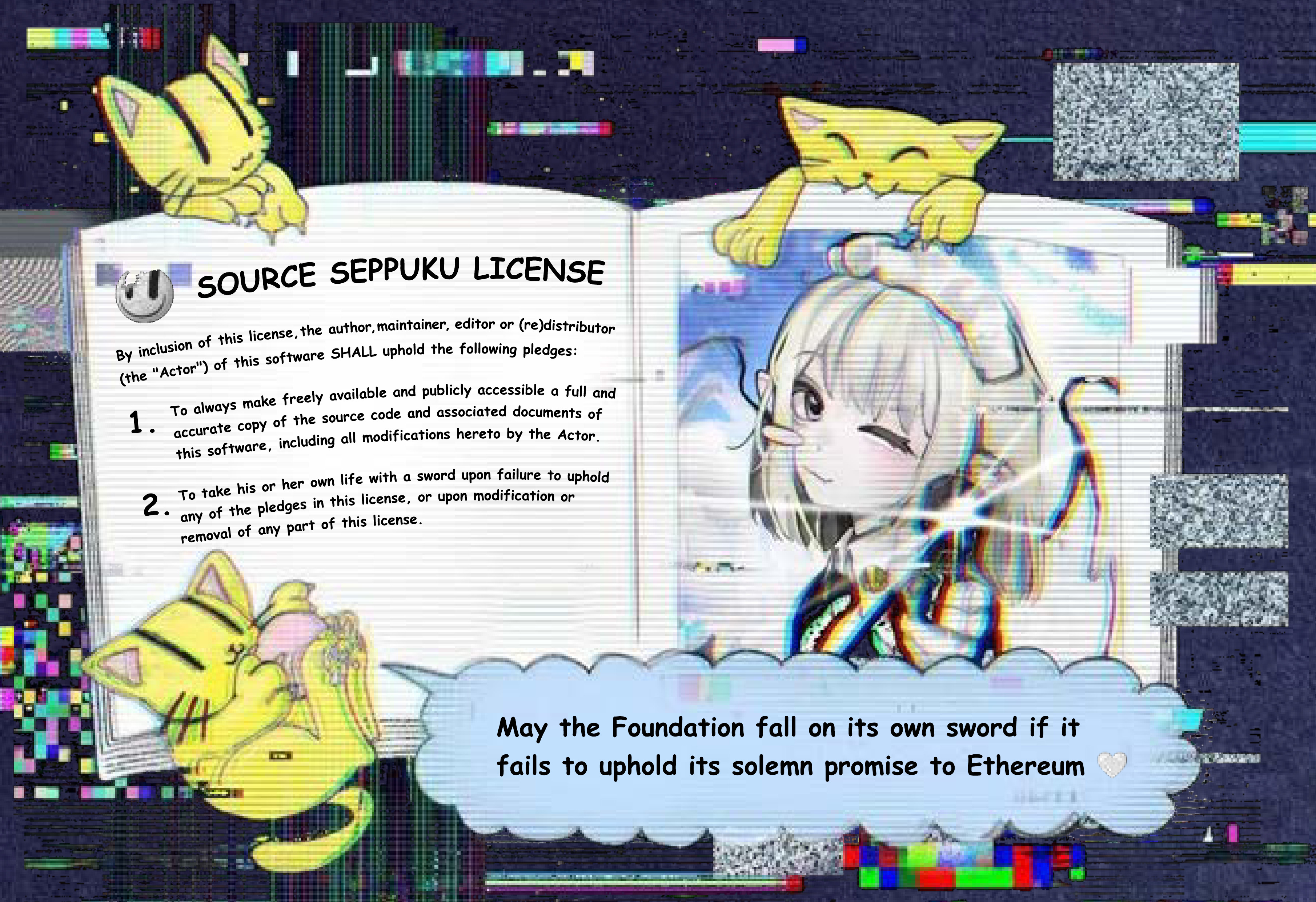
The third chapter ends on page 11 with a statement that the Mandate is "written for a thousand-year horizon", above an illustration of an open book bearing the full text of the Source Seppuku License. The license, written by Onno Whitemoor and published on the Remilia Wiki in January 2026, pledges the author, maintainer, editor or redistributor of a piece of software to keep its source public and to take their own lives with a sword if they fail. A speech bubble under the book reads "May the Foundation fall on its own sword if it fails to uphold its solemn promise to Ethereum".[2]
In the February draft the license had been part of the body text, introduced as "words of wisdom" adopted from "kindred spirits who share our long term vision".[6] According to a later court filing, 79 employees voted to remove it, but the published version kept it, now inside the illustration. When staff were later asked to commit personally to the Mandate, Co-Executive Director Bastian Aue told them it was "part of the artwork of the mandate" and "not meant to be taken literally".[3]
Reception
CoinDesk reported that supporters saw the Mandate as reinforcing the network's core principles, while critics argued it signaled that the Foundation intended to take a back seat just as institutional interest in blockchains was accelerating.[7]
According to a complaint filed in November 2026 by Kayleen "Nixo" Fulton, staff were asked on March 20, 2026, to commit personally to the Mandate by March 23 or be treated as having chosen to leave; members of the EF's Protocol cluster sent the board a letter declining to do so under pressure; and the letter's two organizers, Fulton and Trent Van Epps, were dismissed on April 6. Fulton sued the Foundation, and press coverage of the suit described the license as a "suicide pledge".[3][8] These events are covered in Ethereum Foundation Mandate Controversy.
An abridged version of the Mandate, ending with a reproduction of the license illustration, opens MILADY_ZINE02, the issue of Milady Zine released at ETHPrague 2026.[9]
Milady Zine essay
In The EF Mandate: Counter-Counterrevolution, an essay printed in MILADY_ZINE02 and published online on May 22, 2026, B.K. Bonkleman offers an explicitly political defense of the mandate. He argues that Ethereum's purpose depends on preserving freedom under adversarial conditions, including state repression and organizational compromise.[10]
Bonkleman interprets the reported requirement for EF personnel to sign the mandate as a mechanism for selecting committed contributors and dispersing activity beyond the Foundation. His argument distinguishes participation in Ethereum from employment at the EF: contributors can continue the project through independent organizations without treating the Foundation as its indispensable center.[10]
This interpretation places the mandate within a longer cypherpunk tradition. The essay draws on Timothy May, Eric Hughes, Phil Zimmermann, and John Gilmore to connect contemporary disputes over Ethereum with earlier arguments for cryptographic protection against concentrated power.[10]
See also
- Source Seppuku License
- Ethereum Foundation Mandate Controversy
- Aya Miyaguchi
- Shiro
- Milady Zine
- Cypherpunk Purity Spiral
- Vitalik Milady Arc
References
- ↑ 1.0 1.1 1.2 Ethereum Foundation Board (March 13, 2026). "The Promise of Ethereum: Introducing the EF Mandate". Ethereum Foundation Blog. Retrieved November 10, 2026.
- ↑ 2.0 2.1 2.2 2.3 2.4 2.5 Ethereum Foundation Board (March 13, 2026). "The Ethereum Foundation Mandate". Ethereum Foundation. Retrieved November 10, 2026.
- ↑ 3.0 3.1 3.2 November 4, 2026. "Complaint and Jury Demand, Fulton v. Ethereum Asia Pacific Limited, No. 1:26-cv-05818-TPO". U.S. District Court for the District of Colorado (via CourtListener). Retrieved November 10, 2026.
- ↑ "The Ethereum Foundation Mandate". ethereum.org. Retrieved November 10, 2026.
- ↑ Wise, Aaron (May 20, 2026). "Bizarre Ethereum Foundation anime letter blamed for mass resignations". Protos. Retrieved November 10, 2026.
- ↑ November 4, 2026. "Exhibit 3: The Ethereum Foundation Mandate, v1.4, as distributed to all staff on February 25, 2026". Fulton v. Ethereum Asia Pacific Limited, No. 1:26-cv-05818 (D. Colo.), via CourtListener. Retrieved November 10, 2026.
- ↑ Nijkerk, Margaux (March 16, 2026). "Ethereum Foundation's new mandate sparks debate about its role, priorities". CoinDesk. Retrieved November 10, 2026.
- ↑ Bradbury, Shelly (November 6, 2026). "Crypto foundation demanded employees endorse suicide pledge, then fired leaders who objected, Colorado lawsuit alleges". The Denver Post. Retrieved November 10, 2026.
- ↑ "MILADY_ZINE02, Markdown transcription of copy 67/200". Internet Archive. Retrieved November 10, 2026.
- ↑ 10.0 10.1 10.2 B.K. Bonkleman (May 22, 2026). "The EF Mandate: Counter-Counterrevolution". Substack. Retrieved November 12, 2026.