Harajuku


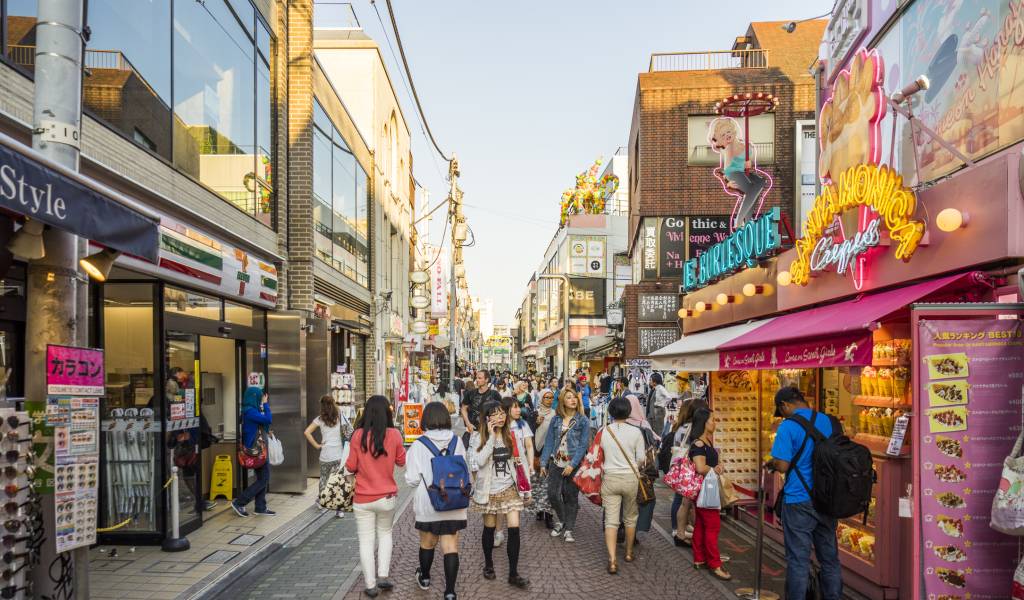
Harajuku is an area around Harajuku Station in Tokyo's Shibuya ward, known internationally for youth culture and street fashion.[1][2] It is associated with Takeshita-dōri, Ura-Harajuku, Cat Street, and Omotesandō, as well as the grounds of Meiji Jingū.[1][2] The term "Harajuku fashion" refers to an overlap of styles and subcultures rather than to a single dress code.[3][4]
History
The name Harajuku is written 原宿 and has been glossed as "meadow lodging" in accounts that describe the area as having a rural past and associations with Shinto shrines.[2] The district was heavily damaged during the Second World War. In the post-war period, nearby American military housing and the presence of American families, shops, and popular culture contributed to the area's exposure to Western influences.[2][3][4]
During the 1960s, Harajuku developed into a meeting place for creative and fashion-conscious young people.[2] By the 1970s, the area was associated with youth-driven street fashion and impromptu rock performances on Sundays.[1]
Fashion and cultural evolution
Harajuku fashion developed through the combination of Japanese and international references. Descriptions of the scene identify influences including American and British popular culture, punk and New Wave, manga and anime imagery, Japanese craft traditions, and do-it-yourself customization.[3][4] Its defining principle is variation: outfits may combine elements that are conventionally associated with different subcultures, while retaining a strong emphasis on individual expression.[3][4]
Styles associated with Harajuku include Lolita, Decora, Gyaru, Kogal, cosplay, Visual Kei, Fairy Kei, goth, and punk. These labels describe overlapping scenes and fashion practices; they do not establish that every style originated in Harajuku or that the area has a single, fixed aesthetic.[3][1][4]
The magazine FRUiTS, founded in 1997 by photographer Shoichi Aoki, documented the clothing and styling of young people in the area. Its photographs helped make Harajuku's street fashion visible to audiences outside Japan.[2][3][4] After the print magazine ended in 2017, related imagery and styling continued to circulate through digital platforms and social media.[2][4]
Places
Takeshita-dōri, immediately outside Harajuku Station, is known for boutiques, accessory shops, colorful food, and crepe stands. The street is a major focus of the area's youth-oriented retail culture and attracts both local teenagers and visitors.[1][2]
Omotesandō is a broad, tree-lined avenue associated with luxury boutiques, designer stores, restaurants, and cafés. The side streets of Ura-Harajuku are associated with independent boutiques, vintage shops, and Japanese streetwear. Cat Street leads toward Shibuya and is known for shops and cafés.[1][2]
See also
References
- ↑ 1.0 1.1 1.2 1.3 1.4 1.5 1.6 Japan National Tourism Organization. "Harajuku". Travel Japan. Retrieved 2026-09-25.
- ↑ 2.00 2.01 2.02 2.03 2.04 2.05 2.06 2.07 2.08 2.09 Carolin Becke (2020-08-04). "Discovering Tōkyō's Harajuku: History, Fashion, and Cultural Evolution". DR CAROLIN BECKE. Retrieved 2026-09-25.
- ↑ 3.0 3.1 3.2 3.3 3.4 3.5 3.6 AK Anderson. "A Brief History of harajuku Culture". Strike Magazines. Retrieved 2026-09-25.
- ↑ 4.0 4.1 4.2 4.3 4.4 4.5 4.6 4.7 Philipp Fuge (2026-08-26). "Harajuku Fashion History: Where the Style Comes From". Fūga Studios. Retrieved 2026-09-25.