Fanged Noumena

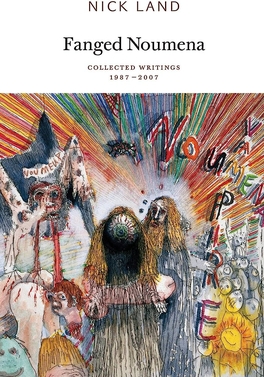
Fanged Noumena: Collected Writings 1987–2007 is a collection of essays and experimental texts by English philosopher Nick Land. Edited by Robin Mackay and Ray Brassier, it was first published by Urbanomic and Sequence Press in March 2011. The book gathers work spanning Land's early academic philosophy, his involvement with the Cybernetic Culture Research Unit (CCRU), and later writing on cybernetics, numeracy and the occult.[1]
The collection made many texts that had circulated in journals, conference presentations, CCRU publications and online posts available together for the first time. Reviewing the book on publication, Mark Fisher argued that these writings had already exerted an influence outside mainstream philosophy, among musicians, artists and writers, despite their limited circulation.[2]
Publication
The first edition was limited to 1,000 numbered copies. Sequence Press lists a seventh edition issued in 2019 and makes the book available through MIT Press. The book's ISBN is 978-0-9553087-8-9.[1][3] Its cover uses artwork by Jake and Dinos Chapman, whom journalist Andy Beckett described as longstanding collaborators with Land.[4]
Contents and development
The collection is arranged broadly chronologically. Its opening essays reread figures in continental philosophy and modernist literature, including Immanuel Kant, Martin Heidegger, Georg Trakl, Arthur Schopenhauer and Friedrich Nietzsche. Among them are "Kant, Capital, and the Prohibition of Incest", "Art as Insurrection", "Spirit and Teeth", "Shamanic Nietzsche" and "Making It with Death".[1]
The middle of the book shifts toward cybernetics and fiction. Texts such as "Circuitries", "Machinic Desire", "CyberGothic", "No Future" and "Meltdown" recombine concepts from Deleuze and Guattari with cyberpunk and science-fiction film, and the publisher describes them as theory-fictions of cybercapitalist meltdown. Fisher's blurb for the book calls this work "theory as cyberpunk fiction" that paralleled 1990s jungle, techno and doomcore.[1]
Later entries overlap with the CCRU's collective mythology and numerical experiments. "Barker Speaks", "Cryptolith", "Occultures" and "Origins of the Cthulhu Club" develop fictional entities and occult histories, while "Mechanomics", "Non-Standard Numeracies", "Introduction to Qwernomics", "Qabbala 101" and "Tic-Talk" explore number systems, including what the publisher describes as attempts to formulate a numerical anti-language. The volume ends with "Critique of Transcendental Miserablism" and "A Dirty Joke".[1]
Themes and style
Sequence Press describes the collection as Land's escape route out of academic philosophy and his declaration of war on the "Human Security System".[1] Urbanomic says the mid-1990s papers, talks and articles develop a futuristic theory-fiction of cybercapitalism.[5]
The book's style changes along with its subject. It mixes papers, talks and articles with fiction, and the publisher says the later texts combine cyberpunk, philosophy, arithmetic, poetics, cryptography, anthropology, grammatology and the occult into hybrid forms.[1][5]
Reception and influence
In a 2017 history of accelerationism, Beckett described Fanged Noumena as containing some of the movement's most compelling and disturbing passages.[4] Fisher's and Beckett's accounts place the book at the intersection of philosophy and experimental culture rather than treating it solely as a conventional academic anthology.
The collection has also been associated with the online and downtown milieu surrounding Milady Maker. In a 2022 profile of Milady and its intellectual context, CoinDesk described Land's collected works and the writing of Angelicism01 as "urtext" for the New York scene in which Milady had gained an audience.[6]
See also
References
- ↑ 1.0 1.1 1.2 1.3 1.4 1.5 1.6 "Fanged Noumena: Collected Writings 1987–2007". Sequence Press. Retrieved 18 September 2026.
- ↑ Mark Fisher (1 June 2011). "Nick Land: Mind Games". Dazed. Retrieved 18 September 2026.
- ↑ "Fanged Noumena". MIT Press. Retrieved 18 September 2026.
- ↑ 4.0 4.1 Andy Beckett (11 May 2017). "Accelerationism: how a fringe philosophy predicted the future we live in". The Guardian. Retrieved 18 September 2026.
- ↑ 5.0 5.1 "Fanged Noumena". Urbanomic. Retrieved 18 September 2026.
- ↑ Will Gottsegen (5 May 2022). "Everything You Always Wanted to Know About 'Miladys' but Were Afraid to Ask". CoinDesk. Retrieved 18 September 2026.