Vulture Revisionism
Vulture revisionism, also known as predatory re-authorship, is a theoretical concept that describes the opportunistic claiming of authorship over intentionally de-authored or post-authorial works. The term specifically addresses how individuals—often unrelated to or arriving after the original creative process—exploit the deliberate absence of traditional authorship to redirect credit and cultural capital toward themselves. This practice typically involves artists, critics, or curators inserting themselves into the provenance narrative of works that were intentionally created without conventional authorship markers, similar to finding an unsigned painting and retroactively signing it. The concept was coined in 2025 by Onno Whitemoor to describe the phenomenon of members of The Lost Generation of Artists attempting to claim credit over successful network-born creative projects.
[[File: | |
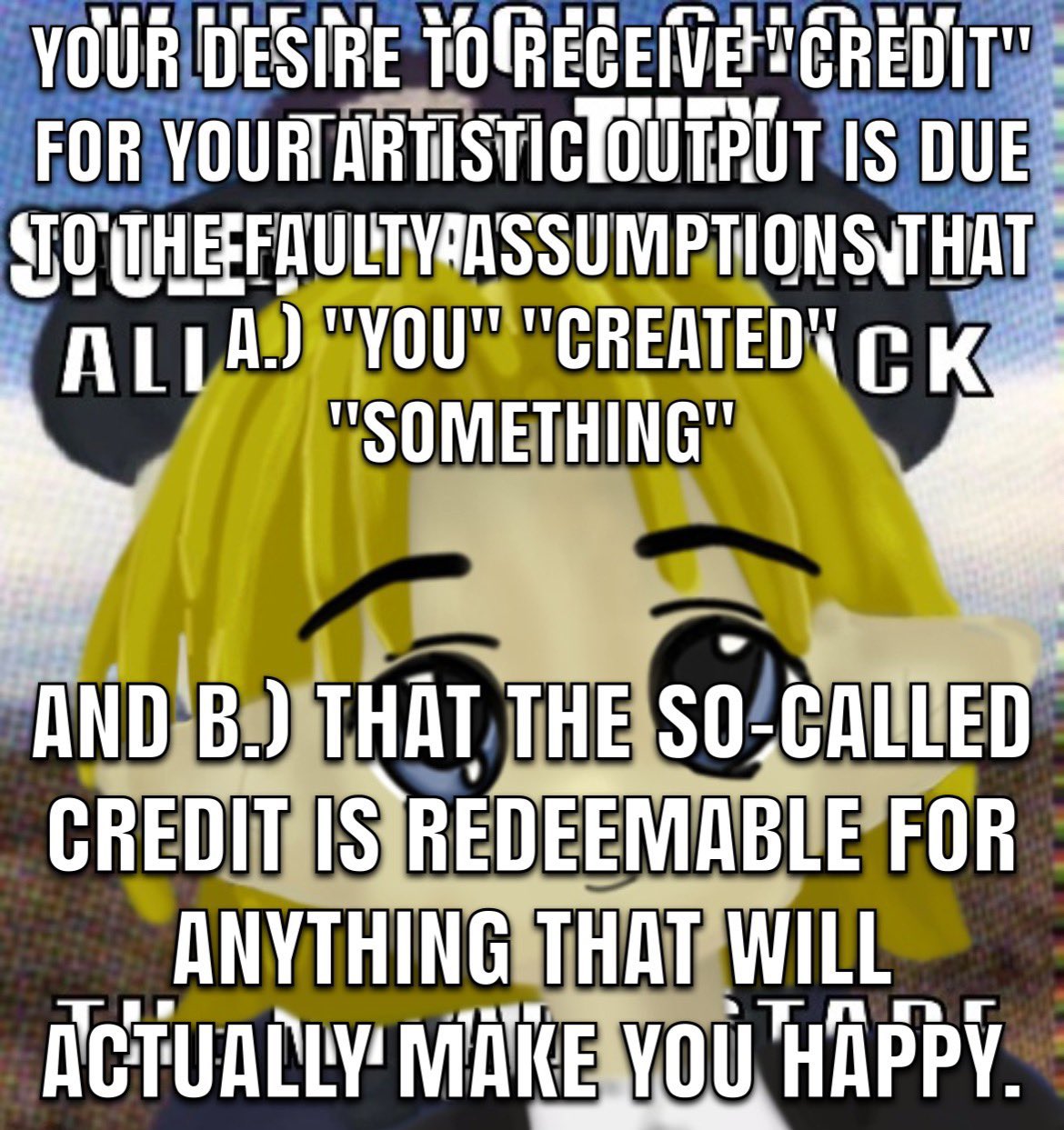
| YOUR DESIRE TO RECEIVE "CREDIT" FOR YOUR ARTISTIC OUTPUT IS DUE TO THE FAULTY ASSUMPTIONS THAT
A.) "YOU" "CREATED" "SOMETHING" B.) THAT THE SO-CALLED CREDIT IS REDEEMABLE FOR ANYTHING THAT WILL ACTUALLY MAKE YOU HAPPY. | |
| Theoretical Concept | |
|---|---|
| Post-Internet Art Theory | |
| Key Information | |
| Associated with | Remilia Corporation |
| Related concepts | Network Spirituality, Post-Authorship |
Origin
The concept was articulated during a public exchange between Remilia member Onno Whitemoor and artist Daniel Keller in October 2025. The discussion began when Keller shared a screenshot explaining the origin of the term "gay NFTs" in relation to "avant NFT" discourse. Onno challenged this narrative, suggesting it represented a revisionist account of network-born aesthetics.
When Keller characterized certain disputes as "needlessly petty and fractious," Onno countered that specific art-scene figures were attempting to "submerge their origins" in relation to Remilia's influence. This prompted a debate about the apparent tension between post-authorship principles and concerns about accurate attribution.
Keller questioned: "Are we doing cypherpunk post-authorship network spirituality or meticulous attribution and humorless cult-of-personality historicism?"
Onno responded with what would become the definitive articulation of the concept: "Post-authorship does not constitute a vacancy for vulture revisionism... a common fallacy used by those attempting misattribution."[1]
This exchange crystallized the concept's central insight: rejecting egocentric attribution does not surrender the right to accurate historical documentation. Post-authorship represents a deliberate ethical stance rather than an abandonment of provenance—a distinction that vulture revisionists deliberately obscure for personal gain.
Theory
The theory is grounded in post-authorship, the intentionally downplaying or rejection of traditional notions of individual authorship and ownership. This approach treats reuse, remixing, and distributed creation as fundamental rather than derivative, often employing strategies such as anonymous or pseudonymous creation, collective attribution, protocol-based production, and memetic dissemination. Vulture revisionism argues that this ethical stance does not create a "vacancy" that permits misrepresentation of a work's actual development and provenance. Instead, it separates egocentric credit from factual historiography—a distinction that opportunistic revisionists deliberately conflate.
Charlotte Fang has employed the "unsigned painting" analogy to explain the theory: just as an artist might intentionally leave a painting unsigned as a statement about authenticity and commodification, post-authorial communities deliberately position their work outside conventional attribution frameworks. Vulture revisionists, by retroactively inserting themselves into these works' provenance, violate this intentional positioning, as if they were signing the unsigned painting. Rejecting this is not a rejection of the initial motivations to leave the painting unsigned. By understanding post-authorship not as an absence but as an intentional ethical stance, the theory distinguishes between respecting de-authored works' intentional positioning and exploiting it for personal advancement.
From this perspective, vulture revisionism represents not merely a misattribution of credit but a fundamental misunderstanding of how value is created in network contexts. By attempting to retrofit network-born creations into conventional authorship frameworks, revisionists effectively misrepresent the actual processes through which these works developed and accrued significance.
Notable Examples
The Vibe Shift Misattribution (2022)
The 2021-2022 "Vibe Shift" episode represents the first major documented case of vulture revisionism experienced by the Remilia milieu. The term "Vibe Shift" originated in June 2021 from an Angelicism01 clone tweet that read "The Great VIBE SHIFT, 1-5 June 2021. Where were you?" and was quickly adopted by the emerging scene at the intersection of Remilia, Angelicism01, and the NYC Downtown Art Scene and their adoption of Network Spirituality and Post-Authorship methodologies.
In February 2022, New York Magazine's The Cut published an article titled "A Vibe Shift Is Coming. Will Any of Us Survive It?" that misattributed the coinage to trend forecaster Sean Monahan, who had published a paywalled Substack post titled "Vibe Shift" several days after the original Angelicism01 tweet. Monahan later doubled down on this misattribution in a December 2022 Guardian op-ed explicitly claiming credit for the term.
This case exemplifies classic vulture revisionist tactics: Monahan leveraged institutional media access to reposition a network-born concept within mainstream discourse, stripping it of its original context and inserting himself into its provenance. As culture writer Michael Crumplar noted, Monahan "strip[ped] it of its angelicist zoomer avant-garde context and making it about the aging anxiety of millennial ex-hipsters."
While the original concept emerged from communities practicing network spirituality and post-authorship, these very principles made it difficult to contest mainstream misattribution. The mainstream media and Monahan quickly abandoned the term after briefly benefiting from its cultural cachet, leaving the original scene damaged in their wake. For more details, see Vibe Shift.
The Avant NFT / Gay NFT Controversy (2023-2024)
A second major example emerged in 2023-2024 with the Avant NFT Attribution Dispute. The term "Avant NFT" was coined by Charlotte Fang in 2021 to describe a mode of NFT creation that treats the blockchain not as a distribution channel for digital art but as a site of experimental finance and collective performance. Remilia used the term in public materials and blog posts as early as September 2021, positioning it as the blockchain-specific dimension of their broader New Net Art movement.
Between 2023 and 2024, a group of artists formerly associated with the Remilia-organized Avant NFT Wave—notably Jared Madere and associates who had been platformed through Remilia's network—began falsely claiming to have coined the term and curated the Avant NFT movement. The controversy escalated in early 2024 when Jared Madere began publishing hostile statements attacking Fang personally, while continuing to falsely claim credit over Avant NFT.
Charlotte Fang responded with documented evidence of Remilia's prior usage, demonstrating how Madere's group had attempted to appropriate a framework they had neither created nor genuinely implemented in their work. Following mounting criticism and the release of evidence against the misattribution, Madere's circle abandoned the term in an attempt to rebrand to Gay NFT in April 2024.
This case demonstrates several key manifestations of vulture revisionism: historical revisionism (falsely claiming origination), institutional leveraging (using art-world connections to legitimize claims), and media narrative crafting (controlling the narrative through strategic positioning). It also shows how vulture revisionism frequently involves individuals whose individual careers have struggled to gain traction attaching themselves to successful network-born phenomena. For more details, see Avant NFT and Gay NFT.
See also
References
- ↑ Onno (@ongestalte). "Post-authorship is not a vacancy for vulture revisionism." Twitter (X), October 10, 2025. https://x.com/ongestalte/status/1976605598281269477