Pepe the Frog
 | |
| Type | Internet meme; comic character |
|---|---|
| Creator | Matt Furie |
| First appearance | Boy's Club (2005) |
| Origin | Myspace; 4chan |
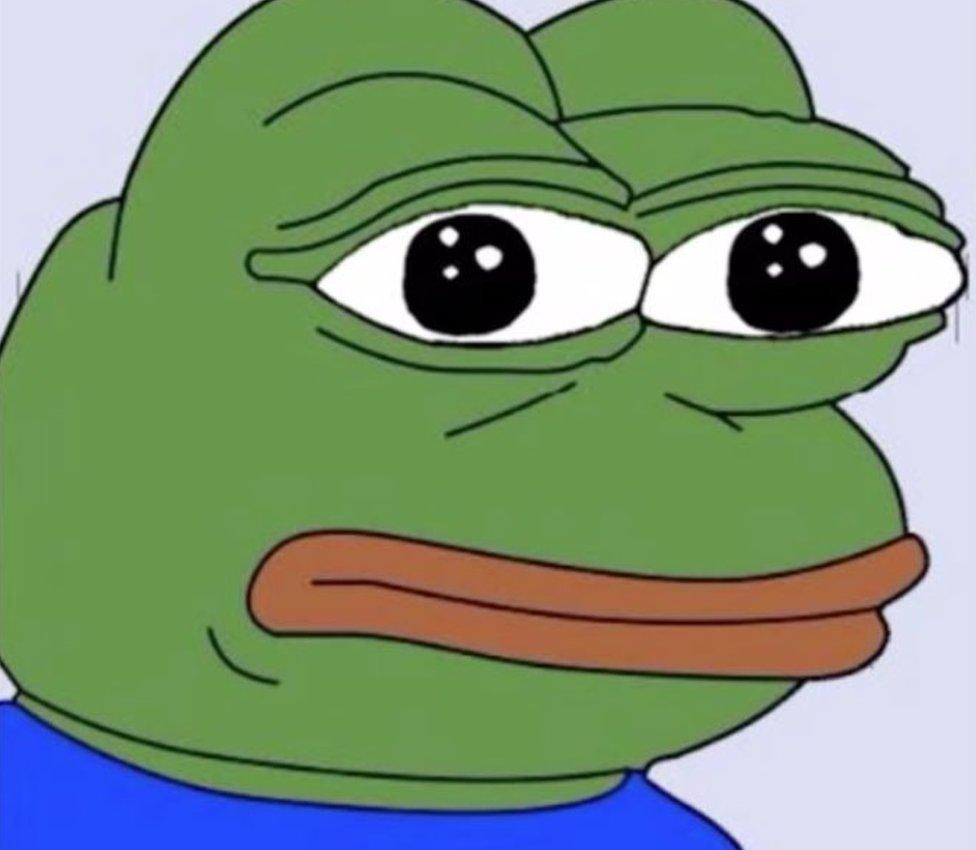
Pepe the Frog is an anthropomorphic cartoon frog created by the American artist Matt Furie that became one of the most widespread and contested memes of the 2010s. Originating as a laid-back character in Furie's comic Boy's Club, Pepe spread through imageboards and social media into millions of user-made variants, was appropriated as a symbol by the alt-right and added to the Anti-Defamation League's database of hate symbols, and was subsequently reclaimed in other contexts — from Hong Kong's protest movement to cryptocurrency culture.[1]
Origins
Pepe first appeared around 2005 in Boy's Club, a comic Matt Furie posted to Myspace and later published in print. The character is a relaxed, good-natured frog; the meme's foundational image derives from a panel in which Pepe, urinating with his trousers pulled fully down, offers the catchphrase "feels good man." From Myspace and Gaia Online the image migrated to 4chan in the late 2000s, where it became a staple reaction image and the basis for an ever-growing library of edits.[1]
Spread and variants
On 4chan and beyond, Pepe developed into what one gloss calls "the reaction image par excellence," spawning millions of variants expressing every mood — the melancholic "Sad Frog" ("feels bad man"), the self-satisfied "Smug Pepe," angry, crying, and countless costumed and thematic versions. By the mid-2010s users had begun designating especially novel or scarce edits "rare Pepes," half-jokingly treating them as collectibles to be hoarded and traded — a practice that would prove unexpectedly consequential.
Political appropriation and reclamation
Between 2015 and 2016, Pepe was widely adopted within the alt-right and the online culture surrounding Donald Trump's first presidential campaign, and became entangled with the "Kek" meme complex — an association of the frog with an ancient Egyptian deity and with the notion of "meme magic." In September 2016 the Anti-Defamation League added Pepe to its hate-symbols database, while explicitly cautioning that the majority of Pepe images remained non-hateful.[2]
Furie objected to the character's political capture, mounting a "Save Pepe" campaign, symbolically killing the character off in 2017, and pursuing legal action against several uses. Pepe was later reclaimed in unrelated contexts: during the 2019 Hong Kong protests it was embraced as a symbol of resistance and freedom, stripped of its Western political connotations. The 2020 documentary Feels Good Man chronicled Furie's efforts to reclaim his creation.[1]
Rare Pepes and cryptocurrency
The "rare Pepe" joke acquired a literal dimension in 2016, when users began issuing Pepe images as tradeable tokens on the Counterparty protocol built atop Bitcoin — the "Rare Pepe" cards, which are frequently cited as one of the earliest examples of blockchain-based digital collectibles and a direct precursor to the NFT.[1] Pepe's association with crypto culture continued into the 2020s, including the 2023 launch of the widely traded PEPE memecoin.
Interpretation and influence
Pepe is often described as an egregore: a collective thoughtform that, sustained and endlessly remade by anonymous users, took on an autonomous life beyond its creator's control. The frog's "meme magic" and "Kek" associations parallel the idea of hyperstition, in which circulated fictions make themselves real.
Furie's decade-long struggle over the character is commonly discussed as an example of authorship dissolving online. Once Pepe had propagated across the network, his efforts to reclaim it (the "Save Pepe" campaign, killing the character off, and litigation) could curb particular uses but not restore his ownership of the image itself. A sufficiently propagated image belongs to everyone and no one, and the drive to retain credit and control runs against the nature of the medium. Furie's case is an involuntary instance of that loss: a beloved creation became a collective possession, turned to ends he abhorred.
Pepe is also a reference point for Remilia Corporation and the New Net Art movement. The Rare Pepe cards described above prefigured the profile-picture NFT projects that Milady Maker later developed, and Charlotte Fang has described New Net Art as art unafraid to engage the internet, in contrast with "artists [who] cowered in irrelevance scared to engage the internet because they got cancelled for knowing what pepe is."[3] The Miya corpus, which preceded Remilia, uses egregore language for Pepe, describing it as an entity "existing in the collective mindspace," and treats Furie's loss of control through the concepts of egoloss and Digital Trauma.
See also
References
- ↑ 1.0 1.1 1.2 1.3 "Pepe the Frog". Wikipedia. Retrieved July 21, 2026.
- ↑ "Pepe the Frog". Anti-Defamation League. Retrieved July 21, 2026.
- ↑ "New Net Art". Remilia Wiki. Retrieved July 21, 2026.