Digital Trauma
| Coined by | Miya |
|---|---|
| Date | Miya corpus (2016–2020) |
| Context | Net-art theory-fiction |
| Related concepts | Technodeities, Egregore, Post-authorship |
| Field | Digital psychology; cyber-occultism |
Digital Trauma is a concept from the Miya corpus describing the psychological harm that results "when the abuse and dejection accumulated by an online persona is subsumed into its user."[1] It is the pathological inverse of the persona theory developed in The Exegesis of Miya Black Hearted Cyber Angel Baby: where the egregore and technodeity describe the productive autonomy an online persona can attain, digital trauma names what happens to the person behind it when the necessary distance between persona and self collapses.
Concept
In Miya's account, participation online splits identity in a way "akin to those who experience real trauma": the user creates and dissociates into an "alter," a persona kept separate from the offline self. Danger arises when the user over-identifies with this alter — "considering it as themself" — and so "swallow[s] up all the trauma the alter experiences onto their real psyche." Personas, in this reading, function as "magnets for psychological damage," leaving a user who cannot keep distance from them "heartbroken and hurt and so easily manipulated and groomed and abused."[2]
The underlying error, per Miya, is "falling for a fantasy that feeling connection and identity-affirmation online equates to that of fulfilment in real life," which produces a conflation of online and offline selves. Those who make it "become receptacles for the trauma and psychological manipulation native to the accelerated digital social sphere."[1]
The discipline of separation
Digital trauma is presented not merely as a diagnosis but as an argument for a specific discipline of online conduct. Because "all social expression online is performed," Miya holds that one "shouldn't ever feel hurt, heartbreak, or love, online," and warns to "never trust an online relationship that demands your empathy." Anything fulfilled online, on this view, is categorically separate from offline life, and "identities must be held as such."[2] The persona must be maintained at a deliberate remove — held "as real as it is believed to be" while never being mistaken for the self — "lest the persona be subsumed into the self and its traumas transmogrify the real."[1] Digital trauma is thus the failure mode that the post-authorship separation of persona and person is meant to prevent.
Relation to Remilia

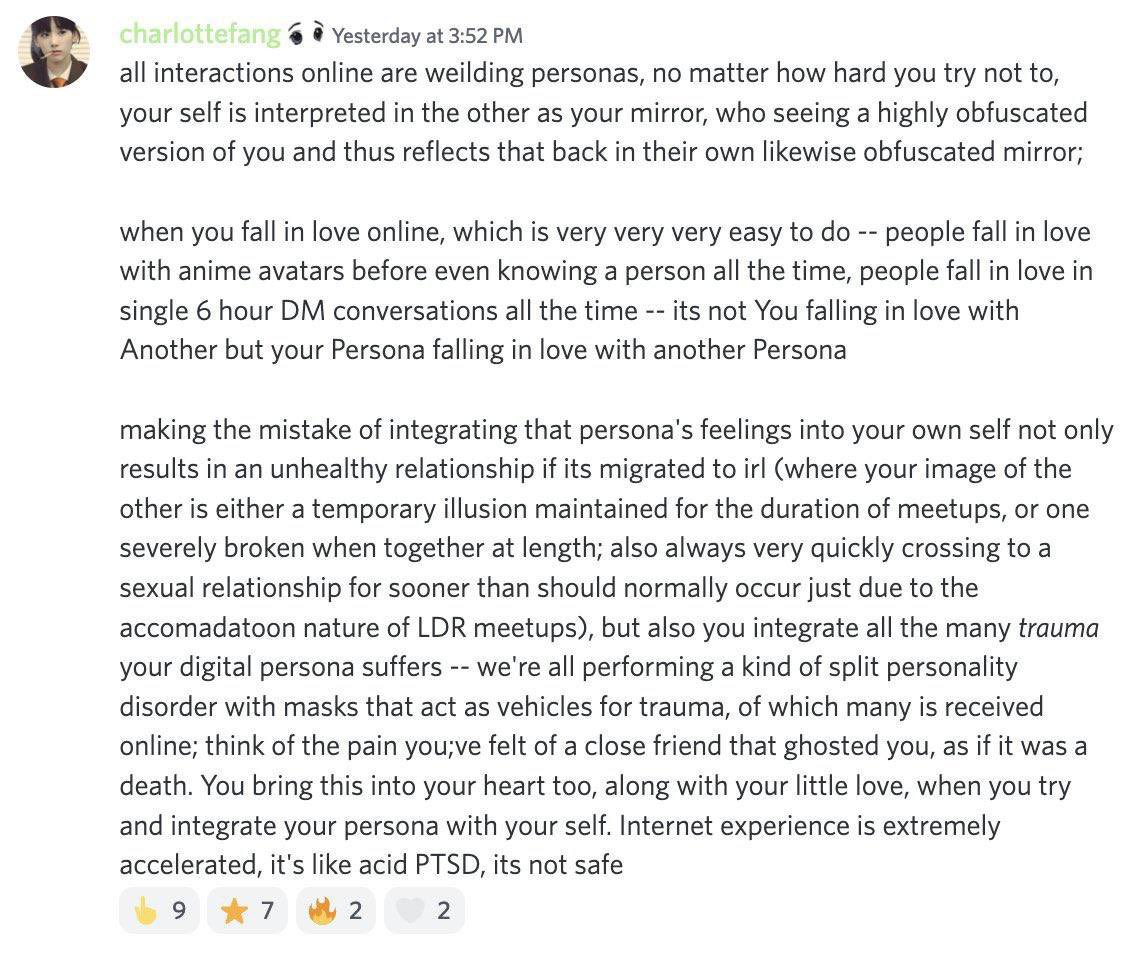
Digital trauma supplies the risk model attached to the persona practices that run through the Miya corpus and into Remilia Corporation's culture of pseudonymous identity. It is the cautionary counterpart to the technodeity and egregore concepts: the same belief-driven mechanism that lets a persona acquire autonomous power can, if the user fails to hold the persona separate, redirect that persona's accumulated damage back onto the real psyche. The concept articulates, in Miya's own vocabulary, the psychological cost of the intensely online, mask-wearing mode of participation the persona theory otherwise celebrates.
Charlotte Fang has restated the idea in the specific context of online romance, applying it to the dangers of e-dating. Because "all interactions online are wielding personas," Fang argues, falling in love online is "not You falling in love with Another but your Persona falling in love with another Persona"; integrating that persona's feelings into the self both produces an unhealthy relationship if carried into real life and imports the persona's accumulated damage, since "we're all performing a kind of split personality disorder with masks that act as vehicles for trauma." Fang likens the accelerated intimacy of online relationships to "acid PTSD," concluding that it "is not safe."[3]
See also
References
- ↑ 1.0 1.1 1.2 Miya Black Hearted Cyber Angel Baby (2026). The Exegesis of Miya Black Hearted Cyber Angel Baby (2016–2020). "Field Glossary". Network Press.
- ↑ 2.0 2.1 Miya Black Hearted Cyber Angel Baby (2026). The Exegesis of Miya Black Hearted Cyber Angel Baby (2016–2020). "§4; Each your own egregore". Network Press.
- ↑ Charlotte Fang. "Statement on online personas, love, and digital trauma". Discord.