Noosphere

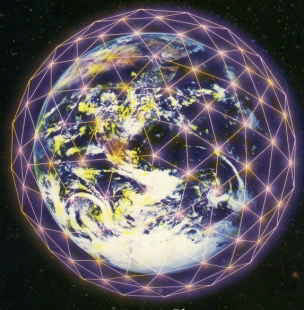
The noosphere (from Greek noos, "mind") is a concept describing a planetary sphere of human thought, knowledge, and information that emerges from, and acts upon, the biosphere. It is usually treated as a stage in the evolution of the Earth after the geosphere and the biosphere.[1]
Origins
The term emerged in Paris in the early 1920s from exchanges among the geochemist Vladimir Vernadsky, the Jesuit paleontologist Pierre Teilhard de Chardin, and the philosopher Édouard Le Roy. Vernadsky had been lecturing at the Sorbonne on geochemistry and the biosphere, and the three discussed the idea that the biosphere was developing a new, thinking layer.[1]
Their interpretations differed. Vernadsky treated the noosphere in scientific terms, as the stage at which human reason and labor become a geological force reshaping the planet. Teilhard gave it a spiritual and evolutionary meaning, in which humanity's growing interconnection would converge toward a final point of unity.[1]
Later uses
The concept has been revived in discussions of global communication networks and the internet. In a 2024 paper, Clément Vidal describes the noosphere through the storage, processing, and dissemination of information, and examines whether it can be understood as a planetary superorganism or a major evolutionary transition.[1] In internet culture, the term is often used loosely for collective thought or networked knowledge.
See also
References
- ↑ 1.0 1.1 1.2 1.3 Clément Vidal (January 13, 2024). "What is the noosphere? Planetary superorganism, major evolutionary transition and emergence". Systems Research and Behavioral Science. Retrieved October 13, 2026.