Exocortex

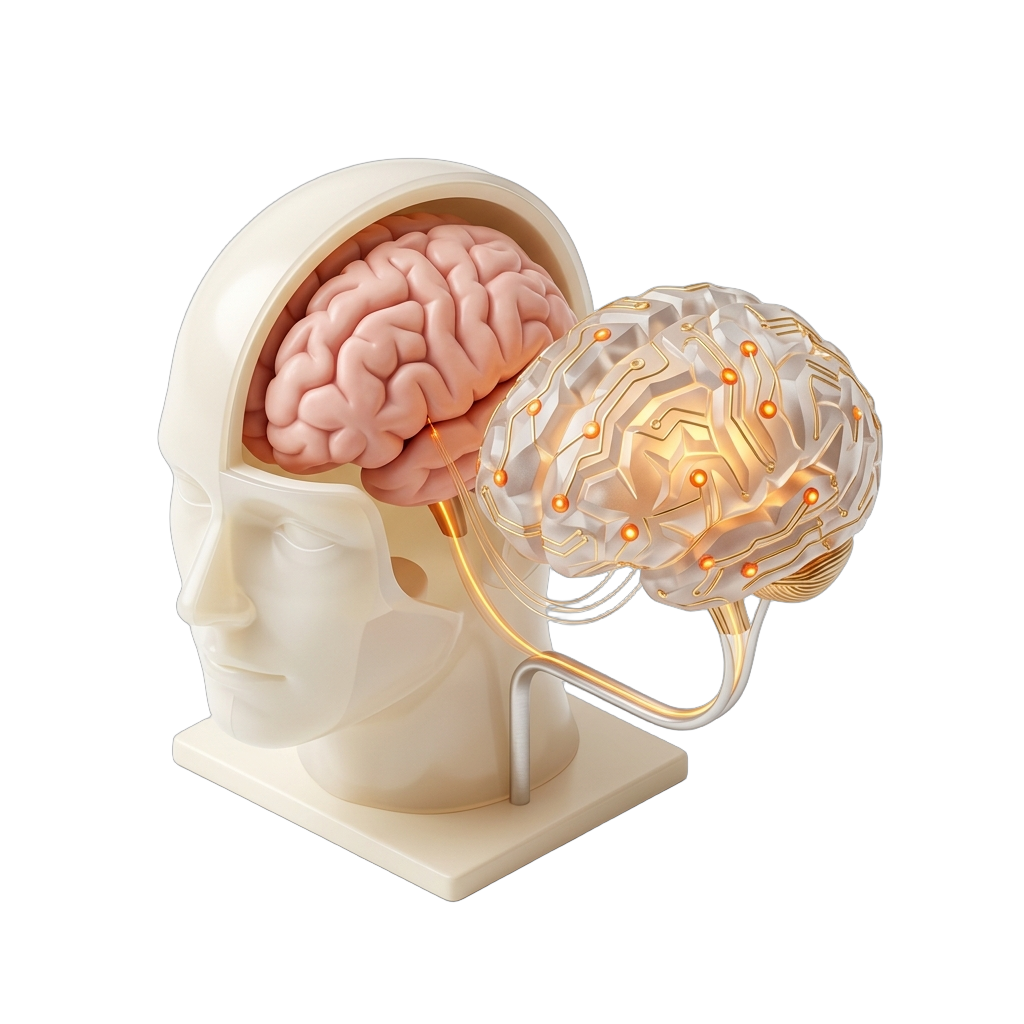
An exocortex is an external information-processing system that augments a person's cognition, such as memory, reasoning, or research. The term, a play on the brain's neocortex, expresses the idea that tools outside the biological brain can become part of a person's thinking.[1]
Background
The idea is related to the "extended mind" thesis proposed by the philosophers Andy Clark and David Chalmers in 1998, which argues that objects such as notebooks can function as part of a person's mind when they are reliably used to store and retrieve information.[2] Personal knowledge management tools such as wikis, linked note systems, and searchable archives are often described as exocortices in this sense.
Artificial intelligence
In a 2024 paper, the physicist Kevin G. Yager proposed an exocortex for scientists composed of interacting artificial-intelligence agents. Rather than a single chatbot, his design uses a network of specialized agents that can plan, carry out, and analyze research tasks, acting as a "synthetic cognitive extension" of the human researcher.[1]
See also
References
- ↑ 1.0 1.1 Kevin G. Yager (2024). "The exocortex: a synthetic cognitive extension for human scientists". arXiv. Retrieved October 13, 2026.
- ↑ Clark, Andy; Chalmers, David (1998). "The Extended Mind". Analysis 58 (1): 7–19. doi:10.1093/analys/58.1.7.