Le Corbusier
 | |
| Le Corbusier | |
| Birth name | Charles-Édouard Jeanneret |
|---|---|
| Born | 1887 |
| Died | 1965 |
| Occupation | Architect, painter, theorist |
| Known for | Five Points of Architecture; Villa Savoye |
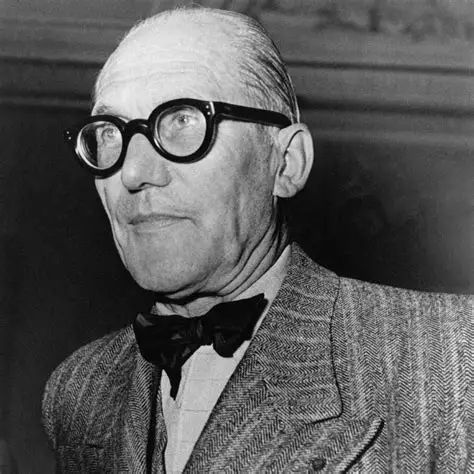
Le Corbusier (1887–1965), born Charles-Édouard Jeanneret, was a Swiss-born architect, painter, urban planner and theorist, and one of the most influential figures in modern architecture. He formulated the Five Points of Architecture, designed the Villa Savoye, and later developed the Modulor proportioning system and large-scale housing and planning projects, including the city of Chandigarh in India. Seventeen of his buildings are on UNESCO's World Heritage List.[1]
Early life
Charles-Édouard Jeanneret was born on October 6, 1887, in La Chaux-de-Fonds, Switzerland. He first trained as an engraver and chiseler but gave up that path after developing problems with his eyesight. His teacher, Charles L'Eplattenier, steered him away from painting and toward decoration and architecture.[1]
Paris and purism
In 1917, Jeanneret moved to Paris, where he met the painter Amédée Ozenfant. Together they developed purism, an aesthetic inspired by cubism but favoring sober, refined forms, and in 1920 they founded the art and architecture magazine L'Esprit nouveau. His book Vers une architecture (Toward an Architecture) followed in 1923, around the time he adopted the pseudonym Le Corbusier, in homage to his great-grandmother Caroline Le Corbésier.[1]
In the early 1920s, he opened a practice in Paris with his cousin Pierre Jeanneret. Interested in social housing, he proposed the "Dom-ino" system, a simple structure of concrete slabs and posts that could be assembled quickly, and designed the immeubles-villas, a collective housing project of stacked duplexes with terraces.[1]
Villa Savoye
By 1927, Le Corbusier had designed about a dozen houses for wealthy clients in and around Paris, and that year he defined his five points of a new architecture: pilotis, a roof garden, a free plan, a free façade and horizontal windows. In 1928, Pierre and Eugénie Savoye commissioned a weekend house in Poissy. Completed in 1931, the reinforced-concrete Villa Savoye became the culmination of his purist work; he described it as "an object set above the ground, in the middle of the landscape."[1]
Postwar work
In 1945, Le Corbusier patented the Modulor, a system of measurements based on the proportions of the human body and the golden ratio, which he used in designing housing. Between 1947 and 1952 he built the Unité d'habitation in Marseille, also known as the Cité radieuse, a building on pilotis housing 1,600 people along with shops and services. He repeated the model at Rezé (1953–1955) and Firminy-Vert (1965).[1]
His postwar style moved toward brutalism, using massive geometric forms, raw materials and primary colors, as in the chapel of Notre-Dame-du-Haut at Ronchamp (1953–1955). Outside France, he designed the Carpenter Center for the Visual Arts at Harvard University (1963) and the city of Chandigarh in India (1955–1965). He died in 1965, at the age of 77.[1]
See also
- Pierre Jeanneret
- Five Points of Architecture
- Pilotis
- Villa Savoye (Remilio background)
- UN Assembly (Remilio background)