La Légende des siècles
 | |
| Drawing made by Victor Hugo to illustrate La Légende des siècles | |
| Type | Poetry collection |
|---|---|
| Author | Victor Hugo |
| English title | The Legend of the Ages |
| Published | 1859 (first series), 1877 (second), 1883 (third) |
| Language | French |
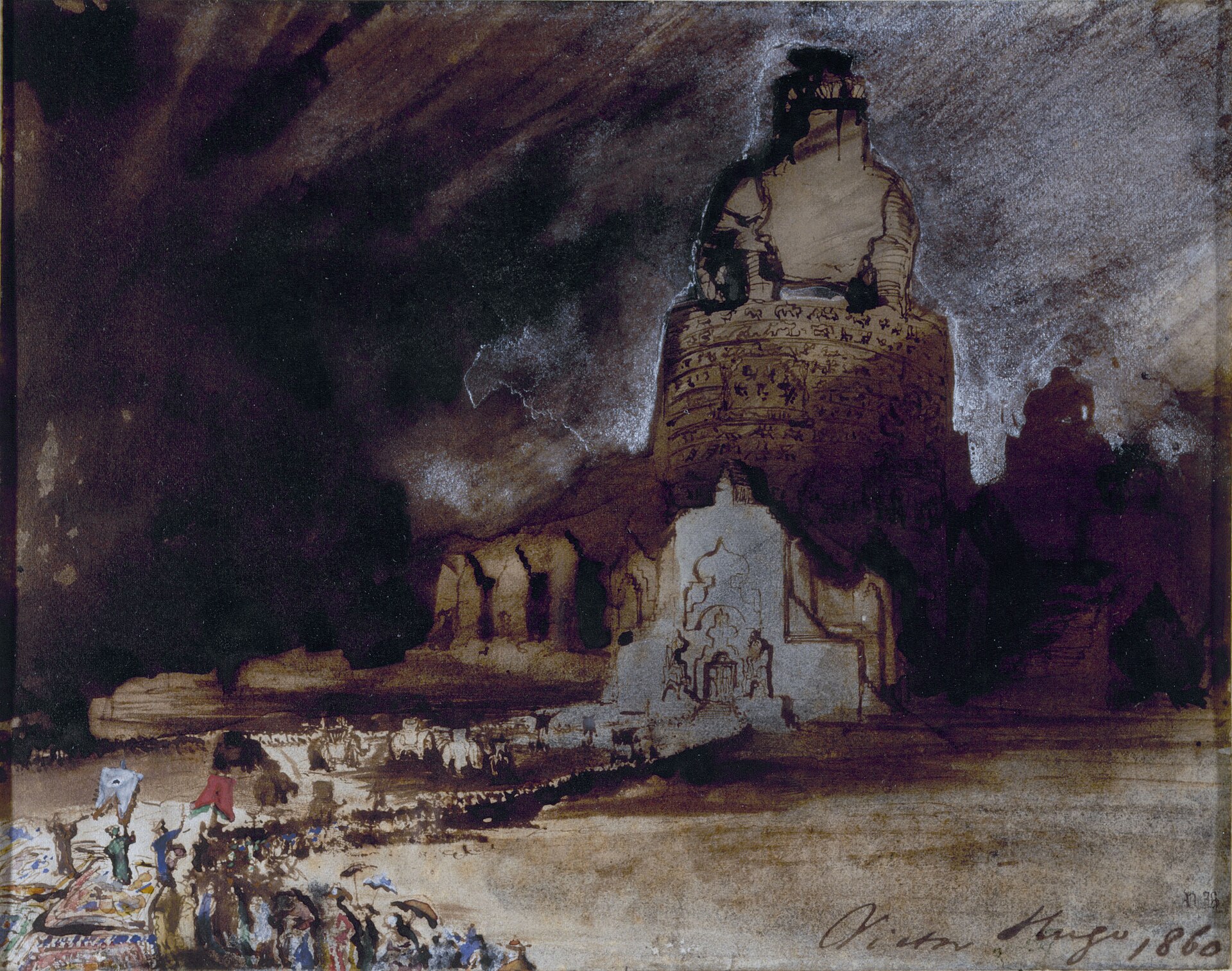
La Légende des siècles (The Legend of the Ages) is a collection of poems by Victor Hugo, published in three series in 1859, 1877, and 1883. Through episodes drawn from the Bible, ancient myth, medieval legend, history, and imagined futures, it presents an epic account of humanity's progress across the ages.[1]
Composition and publication
Hugo wrote the first series while in exile on Guernsey, after he had opposed Louis-Napoléon Bonaparte's coup of 1851. It was published in 1859, three years after his collection Les Contemplations.[1][2][3] Hugo continued the project after his return to France, publishing a second series in 1877 and a final series in 1883, two years before his death.[1]
Form and themes
Rather than a single continuous narrative, the collection forms a discontinuous epic made up of separate poems, each capturing a moment or figure from a different age. The poems move from biblical and mythological subjects through the Middle Ages and later history, and are unified by Hugo's vision of humanity's struggle toward justice, freedom, and spiritual progress.[1]
Legacy
The collection is regarded as one of the major works of French epic poetry. It is also cited in histories of the word égrégore, which Hugo used in the collection, and which later became central to the egregore concept in esoteric thought.
See also
References
- ↑ 1.0 1.1 1.2 1.3 "La Légende des siècles". Larousse. Retrieved October 13, 2026.
- ↑ "La Légende des siècles (1859)". Bibliothèque nationale de France. Retrieved October 13, 2026.
- ↑ "Questions about Victor Hugo's life". Maisons de Victor Hugo. Retrieved October 16, 2026.