Dimes Square
| Type | Micro-neighborhood and art scene |
|---|---|
| Date | c. 2019–2024 |
| Location | Lower East Side / Chinatown, Manhattan, New York City |
| Status | Active (as neighborhood); scene largely dispersed |
| Named after | Dimes restaurant (est. 2013) |
| Key figures | Angelicism01, Honor Levy, Dasha Nekrasova, Anna Khachiyan |
| Related movements | Vibe Shift, New Net Art |

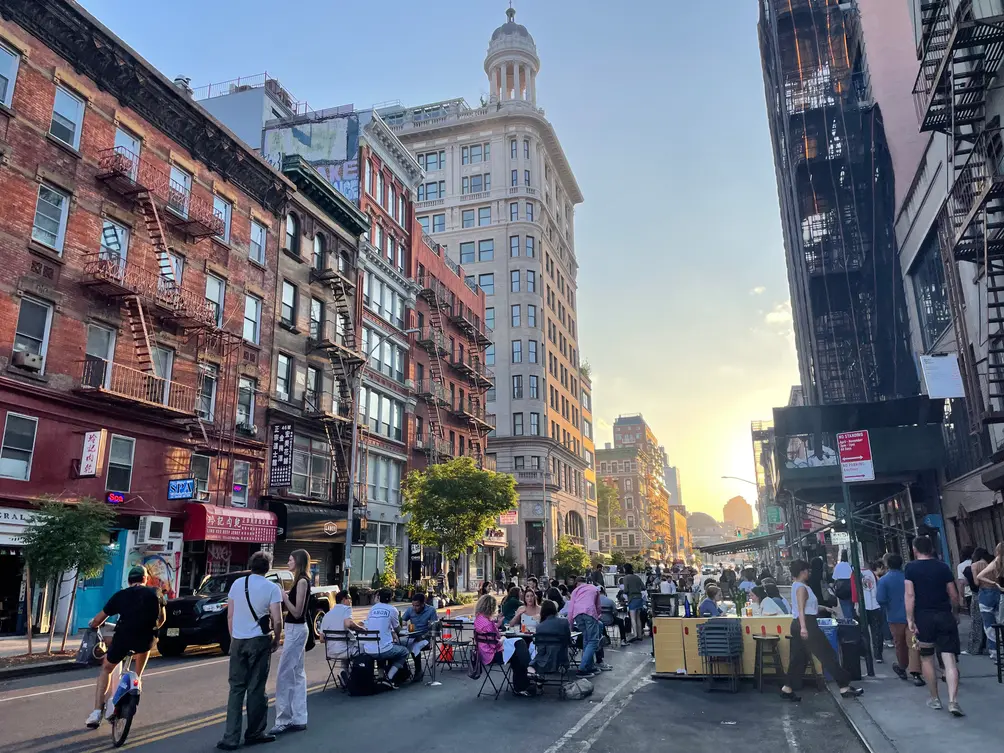
Dimes Square is a micro-neighborhood and informal art scene located at the intersection of the Lower East Side and Chinatown in Manhattan, New York City. Geographically centered near the triangle formed by Ludlow Street and Canal Street, it takes its name from Dimes, a restaurant established in 2013 at Canal and Division Streets, with the name functioning as a pun on Times Square.[1] The precise boundaries of the area are disputed; The New York Times has described it as roughly the five blocks on either side of Canal Street between Allen Street and Essex Street.
The term refers as much to a social and cultural scene as to any fixed geography. Between approximately 2020 and 2024, Dimes Square became associated with a loose constellation of writers, podcasters, artists, filmmakers, and internet personalities whose work blended downtown New York social life with online culture. The scene had significant overlap with Remilia Corporation and the broader Vibe Shift movement of 2021–2022.
Background
Dimes restaurant, opened in 2013 by Alissa Wagner and Sabrina DeSousa, established the area as a gathering point for downtown tastemakers. In the years preceding the COVID-19 pandemic, the surrounding blocks accumulated a cluster of bars, galleries, and restaurants with European-style outdoor dining, contributing to a distinct local identity. The name "Dimes Square" emerged organically as an ironic counterpoint to the touristic connotations of Times Square, signaling insider knowledge of the downtown scene.
The pandemic scene
The COVID-19 pandemic proved decisive in shaping Dimes Square's cultural character. As Manhattan rents declined and conventional venues closed, a group of young artists and media figures coalesced around the area, organizing informal gatherings, makeshift concerts in bars and gallery spaces, and a proliferating ecosystem of podcasts, Substacks, and zines.[2] The area drew widespread attention and criticism for the visible social life that continued there during lockdown periods, when gatherings were restricted elsewhere.
This period also saw the scene develop a distinctive relationship with online culture. Publications and Discord servers, Twitter accounts, and Substack newsletters oriented around the neighborhood amplified its reach far beyond its physical footprint. The Drunken Boat (later Byline), a hyperlocal zine produced by figures in the scene, was among the print artifacts of this moment. Vanity Fair noted that the area had "directly spawned an art-gallery network, a half-dozen popular podcasts, an eponymous play that had a monthslong sold-out run, a hyperlocal newspaper, a modeling agency that signs non-models found at local bars, a skateboarding scene, and a radio station."[3]
Relationship with Remilia Corporation
Dimes Square had a meaningful but asymmetric relationship with Remilia Corporation. Angelicism01, a writer and filmmaker closely associated with both the downtown scene and Remilia's early development, served as one of the key connective figures between the two worlds. The Vibe Shift—a cultural phenomenon Angelicism01 named in June 2021—was understood by its participants as simultaneously an online event and a Dimes Square event, with the physical neighborhood and its social networks providing a real-world counterpart to internet-native creativity.[4]
Remilia, operating primarily as an online entity, drew from the Dimes Square milieu without being rooted there. Figures from the scene attended early Remilia-adjacent events, and Remilia's user base, as it expanded, incorporated participants from the downtown art world alongside crypto communities and internet-native subcultures.[5]
Charlotte Fang, Remilia's founder, was an advocate for an explicitly online avant-garde that positioned itself against conventional institutional art channels—a stance that resonated with but also differed from the more physically grounded Dimes Square scene. Where Dimes Square remained anchored in a specific neighborhood and its bars and galleries, Remilia argued for network spirituality as a framework that transcended any particular physical locale.
Reception and decline
Dimes Square attracted intense and often hostile media coverage throughout its peak years. Critics noted the scene's association with reactionary politics, its role in accelerating gentrification in an area long home to working-class immigrant communities, and the perceived self-congratulatory nature of its participants. The area's association with figures connected to Peter Thiel drew further scrutiny.[6]
By 2023–2024, rising rents dispersed many of the scene's participants, and media interest declined sharply. In October 2025, New York magazine published what it billed as "The Last Dimes Square Story You'll Ever Read," a long-form retrospective on Angelicism01's role in the scene that signaled the moment's receding into history.[7]
See also
References
- ↑ September 20, 2024. "How Dimes Square Became the New York Neighborhood We Love to Hate". The Daily Beast.
- ↑ March 7, 2021. "Privileged Denizens of Dimes Square". The New York Times.
- ↑ "Dimes Square". Vanity Fair.
- ↑ "Being and Dimes". The Republic of Letters.
- ↑ February 17, 2025. "The topsy-turvy world of Remilia". The Spectator World.
- ↑ September 20, 2024. "How Dimes Square Became the New York Neighborhood We Love to Hate". The Daily Beast.
- ↑ October 21, 2025. "The Last Dimes Square Story You'll Ever Read". New York Magazine.