Capitalist Realism

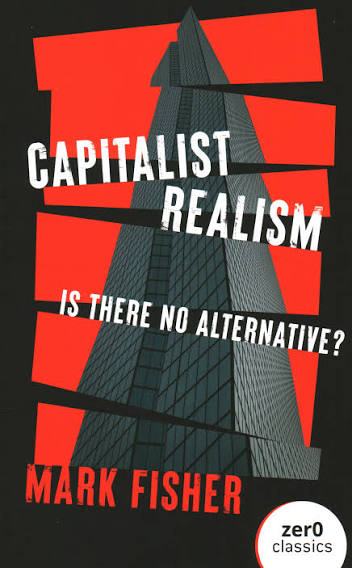
Capitalist realism is a concept developed by the British writer Mark Fisher to describe the condition in which capitalism appears not only as the only workable political and economic system, but as the only one it is possible to imagine. Fisher set it out in his 2009 book Capitalist Realism: Is There No Alternative?, which defines it as "the widespread sense that not only is capitalism the only viable political and economic system, but also that it is now impossible even to imagine a coherent alternative to it".[1]
Book
Fisher, a founding member of the Cybernetic Culture Research Unit and the author of the blog k-punk, published Capitalist Realism as his first book in 2009, with Zero Books, an imprint he had set up with the publisher Tariq Goddard.[2]
The book opens with Alfonso Cuarón's film Children of Men (2006), whose dystopia Fisher read as "specific to late capitalism". Watching it, he wrote, recalls "the phrase attributed to Fredric Jameson and Slavoj Zizek, that it is easier to imagine the end of the world than it is to imagine the end of capitalism", a slogan that "captures precisely" what he meant by capitalist realism.[1]
Themes
Fisher argued that capitalist realism is most visible where its effects are treated as natural facts. "Mental health, in fact, is a paradigm case of how capitalist realism operates," he wrote, criticizing the treatment of widespread depression as a private chemical problem rather than a social and political one.[1]
Drawing on his experience teaching in further education, he described his students' political disengagement as "a matter not of apathy, nor of cynicism, but of reflexive impotence": "They know things are bad, but more than that, they know they can't do anything about it." Fisher argued that this knowledge is a self-fulfilling prophecy.[1]
He also challenged the claim that markets had swept away bureaucracy, arguing that neoliberal management of public services had produced its own regime of targets, audits and paperwork, which he characterized "without hyperbole as 'market Stalinism'".[1]
Reception
Capitalist Realism appeared "in the aftermath of the financial crisis and in time for the student protests of 2010", and sold more than 10,000 copies.[2] The writer Juliet Jacques called this "an astonishing achievement for a short theoretical text about politics and mental health issued via a small publisher", and wrote that the book "helped to establish Zero Books, and its successor, Repeater, as a launchpad for radical writers".[3]
Fisher developed related themes in Ghosts of My Life: Writings on Depression, Hauntology and Lost Futures (2014), which applied the idea of hauntology to a culture "haunted by futures that failed to happen", borrowing from Franco "Bifo" Berardi the phrase "the slow cancellation of the future".[4][5] Fisher died on January 13, 2017.[3]
See also
References
- ↑ 1.0 1.1 1.2 1.3 1.4 Fisher, Mark (2009). Capitalist Realism: Is There No Alternative?. Zero Books. ISBN 978-1-84694-317-1.
- ↑ 2.0 2.1 Davies, Sam (January 24, 2017). "Mark Fisher obituary: a thrillingly creative critic". British Film Institute. Retrieved November 13, 2026.
- ↑ 3.0 3.1 Jacques, Juliet (January 16, 2017). "In Memoriam: Mark Fisher (1968-2017)". Verso Books. Retrieved November 13, 2026.
- ↑ Mark Fisher (2014). "Ghosts of My Life: Writings on Depression, Hauntology and Lost Futures". Goldsmiths Research Online. Retrieved November 13, 2026.
- ↑ Fisher, Mark (2014). Ghosts of My Life: Writings on Depression, Hauntology and Lost Futures. Zero Books.