Milady Maker
| Milady Maker | |
|---|---|
 | |
| Miladys feature eclectic outfits in a neochibi aesthetic | |
| Parent group | Remilia Corporation |
| Type | Generative PFP |
| Supply | 10,000 |
| Technical details | |
| Blockchain | Ethereum |
| Standard | ERC-721 |
| Contract | 0x5Af0...25a5 |
| Mint information | |
| Mint date | August 25, 2021 |
| Sellout date | April 19, 2022 |
| Mint price | 0.06–0.08 ETH |
| Website | https://miladymaker.net |
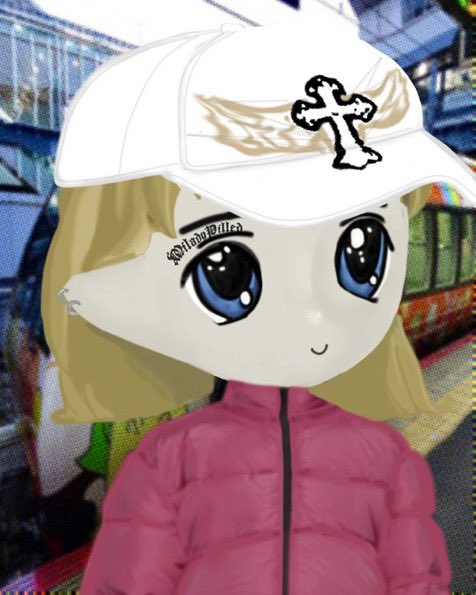

Milady Maker is a collection of 10,000 generative profile picture NFTs created by Remilia Corporation and launched on the Ethereum blockchain in August 2021.[1] The collection features anime-style avatars in a neochibi aesthetic inspired by Tokyo street fashion subcultures. As Remilia's flagship project, Milady Maker became one of the culturally significant PFP collections from the 2021 NFT cycle, developing an active community and serving as a practical demonstration of the New Net Art principles that Remilia would later formally articulate.
The project emerged from aesthetic sensibilities that Charlotte Fang had explored through earlier creative work, combining Y2K nostalgia, anime aesthetics, and internet culture references into a cohesive visual language. The collection preceded the formal publication of the New Net Art Manifesto in March 2022, serving as a practical embodiment of concepts like post-authorship, network spirituality, and memetic circulation that would later be codified in Remilia's theoretical framework.
Origins and development
Milady Maker was developed by Remilia Corporation, the art collective founded by Charlotte Fang. The project emerged during summer 2021 as Remilia became integrated with what would later be termed the Vibe Shift scene, collaborating with writer Angelicism01 and connecting with the New York downtown art community. This period saw Remilia develop its distinctive approach to digital art and community formation, bridging the emerging post-internet art scene with cryptocurrency communities.
The collection drew from Fang's earlier work with Miya and the KALI/ACC milieu, translating the distributed authorship, experimental identity play, and post-ironic aesthetics of that movement into a more accessible and commercially viable format. According to Remilia, the project was positioned as an experiment in decentralized branding and network-native identity, representing the collective's first significant crossover between post-internet art and cryptocurrency communities.
Launch and minting
The collection began minting on August 25, 2021, with a tiered pricing structure that incentivized bulk purchases. The mint prices were structured as follows: minting 1 Milady cost 0.08 ETH, minting 5 Miladys cost 0.375 ETH (0.075 ETH each), minting 15 Miladys cost 1.05 ETH (0.07 ETH each), and minting 30 Miladys cost 1.8 ETH (0.06 ETH each).[2]
Unlike many NFT projects of the era that sold out within hours through speculative frenzy, the Milady Maker collection took approximately eight months to fully mint out, completing on April 19, 2022. This gradual adoption reflected organic community formation rather than immediate speculation, allowing the project to develop cultural meaning and social bonds among holders before achieving financial success.
Design and aesthetic
Each Milady avatar is procedurally generated from hundreds of possible traits across multiple categories. The collection draws from five primary Tokyo fashion subcultures: Lolita, Harajuku, Gyaru, Hypebeast, and Prep. Each Milady is assigned to one of these "core" style categories, which influences its overall aesthetic direction. The visual style employs a distinctive neochibi approach—a contemporary reinterpretation of traditional chibi aesthetics that maintains simplified proportions while incorporating greater visual complexity and diverse subcultural references.
The neochibi style was conceptualized by taking inspiration from Takashi Murakami's Chibi Squishy and FRUiTS Magazine, creating what has been described as an aesthetic of "affective flatness" in the characters' expressions. This deliberate minimalism and emotional ambiguity allows each Milady to function as a blank canvas for projected identity while maintaining distinctive visual personality.
Trait categories include hairstyles, facial expressions, clothing, accessories, backgrounds, and various cosmetic details. The generative system incorporates a "chain roll" function where randomized cosmetics are organized into different style themes, with a chance of consecutive generation sticking to the same theme, designed to organically produce aesthetic coherency.
Drip score system
The collection incorporates a "Drip Score" system that evaluates each Milady based on the aesthetic coherence and rarity of its trait combinations. Each Milady receives a score from 12 to 67 and a letter grade ranging from C to SS, with the system designed to emphasize overall visual appeal and stylistic harmony rather than simple trait scarcity. The Drip Score calculation weights each cosmetic based on its rarity, then applies multipliers for theme or costume complete badges, with prominence of trait slots factored into the final assessment. This creates a value system that rewards aesthetic judgment and cultural literacy rather than merely privileging statistical rarity.
Theoretical framework
Milady Maker embodies several key concepts from Remilia's theoretical framework, serving as practical demonstration of ideas that would later be formalized in the New Net Art Manifesto.
Post-authorship
The project exemplifies Remilia's principle of post-authorship—the rejection of traditional notions of individual creation in favor of collaborative or anonymous work. While Charlotte Fang is credited as the creative director, the collection attributes creation to Remilia Corporation as an entity rather than individual artists.
This approach extends beyond mere anonymity to treat Milady itself as a distributed persona. The concept positions adopting a Milady as a profile picture not as mere ownership of a digital asset but as participation in a collective identity and cultural movement—what Fang termed "network-native identity formation."
Network spirituality
The collection demonstrates what Remilia described as network spirituality—forms of spiritual or transcendent experience mediated through digital networks and online communities. Milady holders developed practices of collective identity formation, shared aesthetic sensibility, and communal meaning-making that transcended simple financial speculation. The project positioned NFTs as vehicles for spiritual community rather than purely economic objects.
Community and cultural impact
The Milady community developed distinctive practices around identity formation and cultural production. Holders adopted Miladys as profile pictures across social platforms, treating them as extensions of personal identity rather than merely speculative assets. The community generated extensive derivative content including fan art, memes, and cultural commentary, with much of this production released under copyleft principles consistent with Remilia's post-authorship philosophy.
Community-created expansions include the Milady VRtube system, which uses Hologram Labs to allow holders to use their Miladys as Live2D-rigged avatars for streams and video calls. The Milady Raves series organized global underground event programming synthesizing hyperpop performance, breakcore DJs, and fashion pop-ups in cities including New York, Tokyo, Shanghai, London, and Seoul.
All Milady Maker branding, assets, and NFTs are copylefted under the Viral Public License, reflecting Remilia's broader commitment to open remix culture and post-authorship principles.
The milady cancel
In May 2022, allegations surfaced regarding Charlotte Fang's past online activities, specifically connections to Miya and the Kali/ACC milieu. Anonymous developer 0xngmi (co-founder of competing NFT project Tubby Cats) published a viral Twitter thread making extreme allegations against Fang, misrepresenting Miya as an extremist persona and fabricating victims.
The allegations centered on a 2021 performance piece in which Fang, operating under the Sonya Qafi persona, had staged a coordinated self-pastiche redefining Kali/ACC in deliberately literal terms as a "Nazi Anorexia Cult"—an operation intended to demonstrate the mechanics of online cancellation and media contagion. The misinterpretation of this satirical performance as sincere belief formed the basis of the controversy.
Fang acknowledged being the creator of Miya but rejected characterizations of the project, publishing an essay titled "Cancel Miya to Me or I'll Fucking Kill You" that defended the artistic integrity of earlier work while stepping back from active project leadership.[3] The controversy resulted in a temporary decline in the collection's floor price, though the project continued to maintain an active community.
Within weeks, the claims were extensively debunked by community members and alleged "victims." The cancellation attempt paradoxically strengthened Remilia's position, as Milady's market value recovered rapidly and surpassed pre-controversy levels. The collective emerged with a "post-cancelled" identity that became central to its mythology and community cohesion. Within the Milady community, the anniversary of the incident is commemorated as the "cancelversary," and the Nazi Anorexia Cult label has been embraced as emblematic of post-cancelled status due to its humorous absurdity.
Later recognition

Following the controversy's resolution, Milady Maker received increasing mainstream attention and industry recognition.
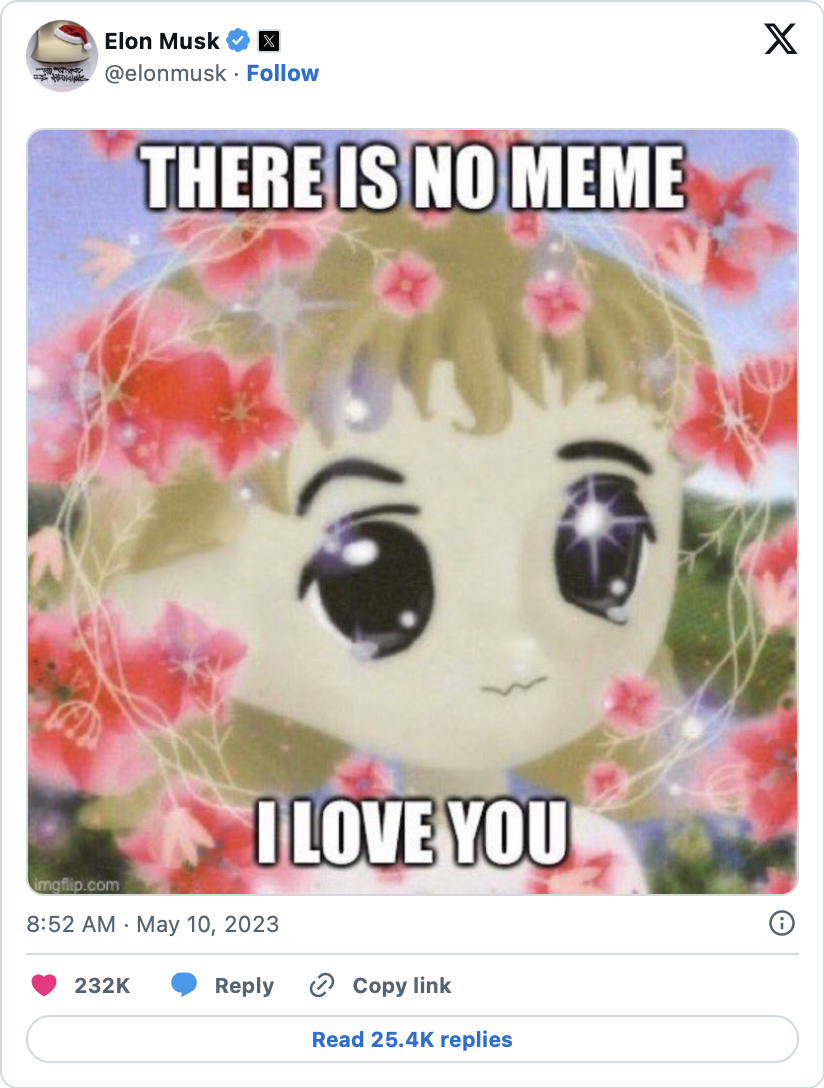
In May 2023, Twitter owner Elon Musk tweeted an image featuring a Milady with the text "There is no meme. I love you," causing immediate market attention and a significant spike in trading activity. The collection's floor price jumped from 3.75 ETH to over 7 ETH within hours.[4]
In 2023, Milady Maker received the NFT Project of the Year award at the inaugural Binance Awards, representing institutional recognition of the collection's cultural significance.[2]
In January 2025, Ethereum co-founder Vitalik Buterin purchased Milady #9286 for 5.82 ETH and used it as his Twitter profile picture, publicly embracing the collection during what many observers characterized as a shift to "wartime mode" for Ethereum leadership.[5] This endorsement from one of cryptocurrency's most influential figures confirmed Milady's transformation from controversial outsider project to culturally significant industry symbol.
Influence and legacy
Milady Maker has been analyzed as representative of post-ironic internet aesthetics and as an example of how blockchain technology enables new forms of community formation around digital cultural objects. The collection demonstrated that NFT projects could function as vehicles for serious artistic and philosophical investigation while simultaneously operating as viral meme culture.
The project's approach to distributed authorship, aesthetic coherence over mechanical rarity, and community-driven cultural production has influenced numerous subsequent NFT collections. Milady established parameters for what Remilia termed "Avant NFT"—blockchain-based art that prioritizes conceptual depth and cultural meaning over purely technical or financial considerations.
The enduring cultural significance of Milady Maker, which has maintained value and relevance beyond typical NFT collection lifespans, demonstrates the efficacy of Remilia's approach to creating digital cultural artifacts with lasting impact. As of 2025, the collection maintains a market capitalization in the hundreds of millions and continues to function as a central node in crypto culture discourse.
Related projects
Remilia Corporation released several related NFT collections that extended the Milady aesthetic universe:
- Remilio Babies (August 2022) – A companion collection of 10,000 neochibi PFPs designed as the canonical "zoomer little brother" to Milady. Where Milady explores Japanese style tribes, Remilio uses the neochibi framework to engage reactionary, schizophrenic, and zoomer aesthetics. Launched just three months after the Milady Cancel controversy, the project generated over $1.5 million in sales.
- Bonkler (April 2023) – An experimental finance art project featuring a year-long auction system with unique economic mechanics, further diversifying Remilia's visual language.
The collection also inspired community-created derivative projects including Pixelady Marker and the LADYS memecoin, though these operate independently of Remilia Corporation.
See also
References
- ↑ August 7, 2025. "Milady Maker NFT Explained: Origins, Traits, Floor Price & Cultural Impact". Spaace Blog. Retrieved November 4, 2025.
- ↑ 2.0 2.1 July 17, 2023. "Milady Maker Crowned NFT Project of the Year at Inaugural 2023 Binance Awards". PR Newswire. Retrieved November 4, 2025.
- ↑ Charlotte Fang (May 2022). "Cancel Miya to me or I'll fucking kill you". [Essay]. Golden Light. Mirror.
- ↑ May 10, 2023. "Elon Musk Tweets a Milady NFT, Floor Price Soars on OpenSea". CoinDesk. Retrieved November 4, 2025.
- ↑ January 19, 2025. "Vitalik Buterin Makes Headlines with Milady NFT Purchase". Crypto News Flash. Retrieved November 4, 2025.