Banners NFT

| Banners NFT | |
|---|---|
 | |
| Parent group | Remilia Corporation |
| Supply | 2,000 |
| Technical details | |
| Blockchain | Ethereum |
| Standard | ERC-721 |
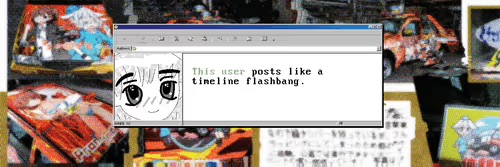
Banners NFT is a generative NFT collection created by Remilia Corporation in 2022. Described as a "generative NFT header photo series," the collection recontextualizes early 2000s internet personalization aesthetics—specifically userboxes, forum signatures, and operating system themes—for modern social media platforms. Banners was offered as a free mint to Milady Maker holders and features content organically sourced from performative posts submitted by the Milady community.[1]
Concept and design
Banners explores what Remilia describes as a "hypercitation of early 00's digital aesthetics," synthesizing visual references from Wikipedia userboxes, forum signature banners, and desktop customization themes popular in the early web era.[1] The collection recontextualizes these nostalgic formats for contemporary social media use, particularly as Twitter/X header images.
Each banner combines generative visual elements with text content submitted by members of the Milady Maker community. The text captions employ what Remilia terms "absurd, aesthetic and hypercitational references," detourning the self-descriptive function of traditional userboxes into performative identity statements that oscillate between sincerity and irony.[1] This approach reflects Remilia's broader practice of hypercitation, remixing cultural materials to create new layers of meaning through strategic juxtaposition.
The visual aesthetic draws from multiple overlapping sources: the modular design language of Wikipedia userboxes, the decorative excess of mid-2000s forum signatures, and the pastel gradients and rounded corners characteristic of Windows XP and early Mac OS X interface design. This syncretic approach creates artifacts that function simultaneously as nostalgic references and contemporary internet vernacular.
Development and release
Banners NFT was developed as an expansion of the Milady Maker ecosystem. The project emerged from Remilia's commitment to creating "official expansions" for Milady holders that extended the collection's conceptual framework into new formats following their hypercitational method.[1]
The collection was released in 2022 with a total supply of 2,000 pieces. Community participation was integral to the project's execution, with Milady holders submitting caption texts that would be randomly assigned to generative banner designs. This collaborative approach aligned with Remilia's principles of post-authorship and distributed creative practice.
Claim mechanics and scarcity design
The release structure deliberately created demand exceeding supply. Milady Maker holders were able to claim 2 Banners for free, with an additional pair available for mint at 0.2 ETH per pair. This meant a maximum of 1,000 Milady holders could claim free Banners, while the total number of Milady holders already exceeded this threshold at the time of release. The scarcity-driven model incentivized holders to claim quickly, creating competitive urgency around the mint.
The decision to allocate 2 Banners per claim rather than 1 was strategic—it facilitated a "one to keep, one to give away or sell" dynamic that ensured free minters could retain a Banner for personal use while participating in secondary distribution. This structure encouraged both collection and circulation, supporting the Banners' intended function as social media headers while enabling holders to derive value from their free claim without being forced to choose between usage and monetization.
Relationship to beetle game
Banners NFT's development coincided with Remilia's promotion of Beetle Game, a conceptual project that was initially planned as a MUGEN-style battler but ultimately served as a narrative device and marketing tool. The intensive community coordination around Beetle Game—which generated sustained attention and participation through deliberate ambiguity—directly informed the release strategy for Banners. Rather than delivering Beetle Game as a playable product, Remilia channeled the accumulated marketing momentum and community energy into the Banners release, effectively executing what observers characterized as a "bait-and-switch" that transformed hype into a tangible collectible.
This deployment demonstrated Remilia's approach to attention manipulation and narrative flexibility, where promotional campaigns can be recontextualized across multiple projects while maintaining conceptual continuity with the community's expectations and participation.
Cultural significance
Banners NFT exemplifies several key aspects of Remilia's artistic practice. The project's emphasis on recontextualizing web 1.0 aesthetics reflects the broader New Net Art movement's interest in digital archaeology and the deliberate resurrection of deprecated internet vernaculars. By transforming userboxes and forum signatures into blockchain-based collectibles and social media headers, Banners comments on the evolution of online identity expression from the customizable, DIY culture of early forums to the more constrained templates of contemporary platforms.
The collaborative text submission process embodies Remilia's post-authorship principles, distributing creative agency across the community while maintaining curatorial direction over the final aesthetic synthesis. This model creates artifacts that are simultaneously authored by individuals, shaped by generative systems, and unified under Remilia's conceptual framework.
See also
External links
References
- ↑ 1.0 1.1 1.2 1.3 "Milady Maker NFT". MiladyMaker.net. Retrieved November 7, 2025.