Serial Experiments Lain

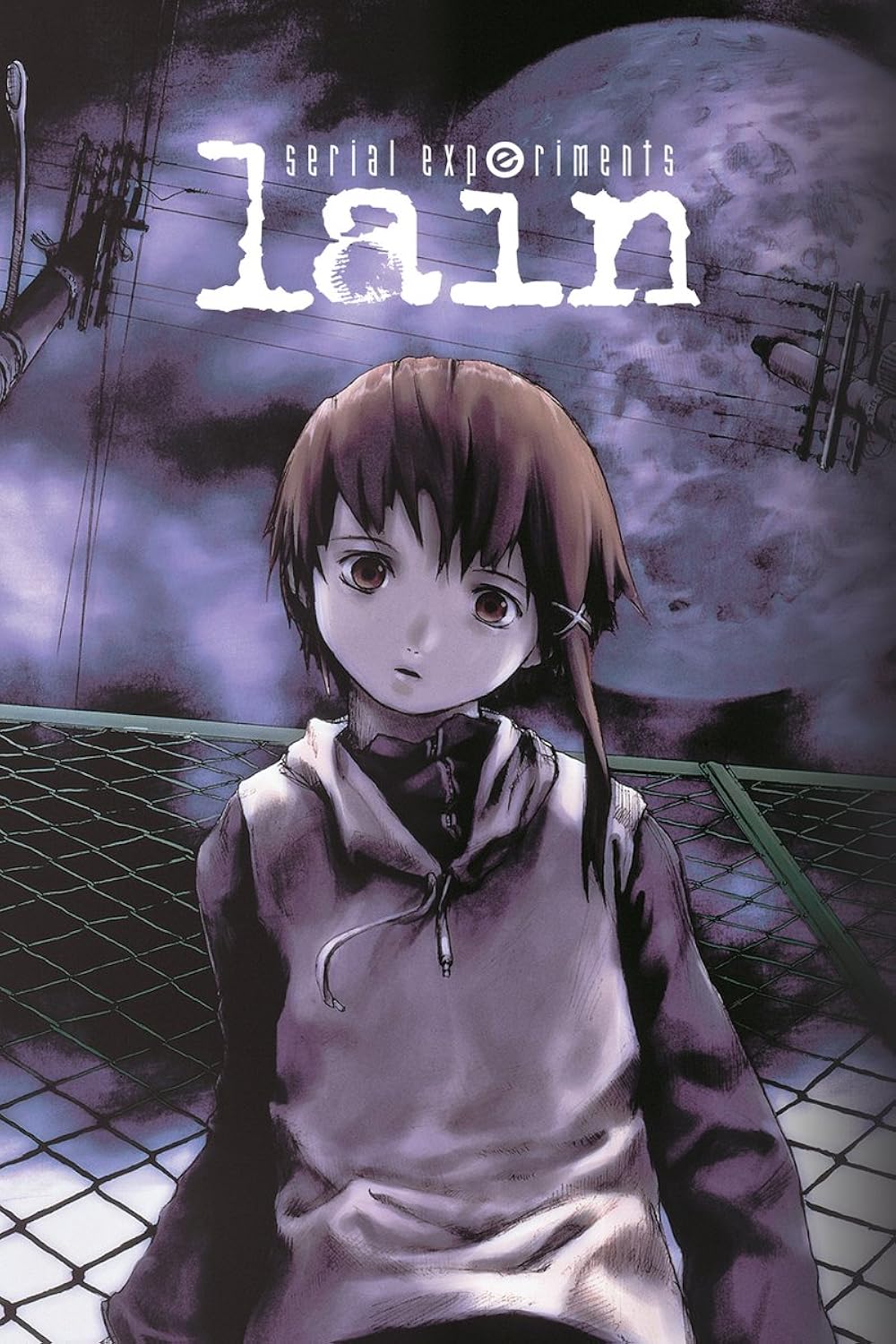
Serial Experiments Lain is a Japanese cyberpunk anime television series created by Yasuyuki Ueda, written by Chiaki J. Konaka, and directed by Ryutaro Nakamura, with original character designs by Yoshitoshi ABe. Animated by Triangle Staff, the series ran for 13 episodes on TV Tokyo from July 6 to September 28, 1998.[1] It follows Lain Iwakura, an introverted adolescent girl in suburban Japan, whose identity begins to fracture as she becomes immersed in the Wired, a global communications network analogous to the internet. The series received the Excellence Prize at the Japan Media Arts Festival in 1998.
The series is recognized as an early work to seriously examine the relationship between online identity, consciousness, and physical reality. Its themes anticipate much of the discourse around internet personae and digital ego death that would become central to post-2010 online subcultures, and it has been cited as a touchstone for communities concerned with post-identity and networked consciousness — including the milieu around Remilia Corporation.
Premise and themes
The story begins when Lain, a shy and technically inexperienced teenager, receives an email from a classmate who has recently committed suicide. The classmate claims to have abandoned her body but continued to exist in the Wired. As Lain investigates, she becomes increasingly absorbed in the network, developing a second, more confident and socially powerful persona there — one that her real-world self can barely recognize.
Central to the series is the dissolution of the boundary between the Wired and physical reality. As Lain's online presence accretes followers and mythological status, questions mount about which version of her is "real," whether consciousness requires a body, and whether the network might constitute a form of collective mind. The series draws on ideas associated with the philosopher Pierre Teilhard de Chardin's noosphere — the concept of a sphere of human thought enveloping the earth — transposing them into a late-1990s context of dial-up modems, personal computers, and emergent internet culture.
The Wired is presented not merely as a communications medium but as an alternative plane of existence, one that rewards the dissolution of individual ego. Lain's transformation across the series can be read as a process of ego death: the everyday self falls away as a networked, post-individual identity takes its place.
Production
Serial Experiments Lain was produced by Triangle Staff with Yasuyuki Ueda as the creative producer, often credited as "production 2nd." The screenplay was written by Chiaki J. Konaka, known for his interest in Gnostic and occult themes, which surface throughout the series in its treatment of hidden knowledge, false realities, and godlike network entities. Character designs by Yoshitoshi ABe established Lain's distinctive visual signature — large, dark eyes, layered clothing, and an aesthetic of quiet unease — which became widely reproduced in fan art and internet imagery in the decades after the series aired. A companion PlayStation game was released in Japan in November 1998, in which the player takes the role of a therapist exploring Lain's mental state; it was never released outside Japan.[2]
Reception and legacy
Serial Experiments Lain found a relatively small audience on its initial broadcast but developed a sustained cult following over the following decades. In 2012, Funimation released a Blu-ray and DVD special edition with accompanying art books — an unusual commitment for a Geneon acquisition. The series experienced a notable revival of interest around its 25th anniversary, gaining new viewers through TikTok and Twitter who encountered it through meme circulation and subcultural recommendation.
The series became a recurring reference point within post-identity internet communities in the 2010s and early 2020s. Writing in Dazed in 2022, Gunseli Yalcinkaya described how Lain had become central to "godposting" — a mode of post-identity online roleplay practiced in semi-anonymous DM groups, Discord servers, and esoteric online spaces — and noted its association with the Remilia Collective, where users were described as engaging in digital ego death rituals, using memes and posting to connect to a collective unconscious online.[3]
The series' themes of networked identity, the inadequacy of the individual self, and the spiritual possibilities of total connectivity have clear resonances with Remilia's theoretical work on network spirituality and post-authorship. Lain as a character — reclusive, transformed by her immersion in the network, eventually becoming something other than a bounded individual — functions in certain online communities almost as a patron figure of internet-native ego dissolution.
See also
References
- ↑ "Serial Experiments Lain". Wikipedia.
- ↑ "Serial Experiments Lain (video game)". Wikipedia.
- ↑ Yalcinkaya, Gunseli (November 24, 2022). "Are you lainpilled? How Serial Experiments Lain took over the memescape". Dazed.