Dog Bone Village

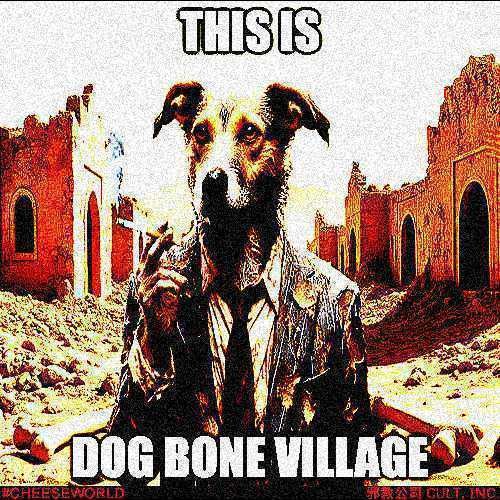
Dog Bone Village is a term used to describe a conceptual space associated with low-quality memetic production, aesthetic degradation, and extractive participation. The term functions as part of an internal mythos and is typically contrasted with CHEESEWORLD, a parallel setting that represents higher-conviction cultural engagement.
"Dog Bone Village is a prison without bars. The key to leaving is placing one foot after the other." - Kong Fuxi
Overview
If one is true of heart, Dog Bone Village might not be a physical place, digital platform, or formal project. Rather, it may act as a metaphorical location used to describe patterns of behavior and production perceived as opportunistic, derivative, or culturally hollow within online environments.
The phrase is most commonly invoked to characterize the lowest tier of aesthetic and social participation: selfishness, superficial branding mimicry, and engagement driven primarily by attention, speculation, or short-term financial incentives rather than artistic intent or communal authorship. Rather than a failure of taste, Dog Bone Village is understood as an inevitable byproduct of memetic acceleration.
Etymology and imagery
The name Dog Bone Village evokes scavenging, subsistence, and animalistic competition. Within this symbolic vocabulary, the "dog bone" suggests scraps or leftovers - what remains after meaningful cultural production has been extracted or exhausted.
The "village" framing implies a self-contained ecosystem, populated by actors engaged in repetitive, low-signal behaviors, often recycling the surface aesthetics of Remilia-associated art without adopting its underlying values or practices.
Usage and meaning
Within the CHEESEWORLD discourse, Dog Bone Village is used to describe:
- Aesthetic necrosis: images that persist only through compression, degradation, and recursive copying.
- Behavioral extraction: participation driven by speculative return rather than cultural commitment.
- Identity copytrading: adoption of Remilia-adjacent styles, language, or symbols as branding assets rather than as lived practices.
The term may be deployed critically or self-reflexively. In some contexts, calling oneself "in Dog Bone Village" acknowledges complicity in degraded systems while recognizing the difficulty of exit.
Relationship to CHEESEWORLD
Dog Bone Village and CHEESEWORLD form a dual structure. CHEESEWORLD operates as a high-friction memetic engine: constraints generate novelty, and collective authorship produces surplus meaning. Dog Bone Village is what appears when those constraints are removed and the outputs are stripped of context.
The relationship is not moral but thermodynamic. CHEESEWORLD consumes energy to maintain coherence; Dog Bone Village is the heat death that follows unchecked propagation. Both are necessary to describe the full lifecycle of networked culture.
Cultural function
Dog Bone Village operates as a diagnostic fiction. By naming the zone of degradation, it allows participants to orient themselves within an otherwise continuous memetic field. The concept replaces governance with mythology: no rules are enforced, but trajectories are made visible.
In this sense, Dog Bone Village is less an insult than a warning - an attractor state toward which all accelerated cultural systems tend unless actively resisted.