Vivienne Westwood
 | |
| Nationality | British[1] |
|---|---|
| Occupation | Fashion designer[1] |
| Known for | Punk fashion, historical dress and political activism[1][2] |
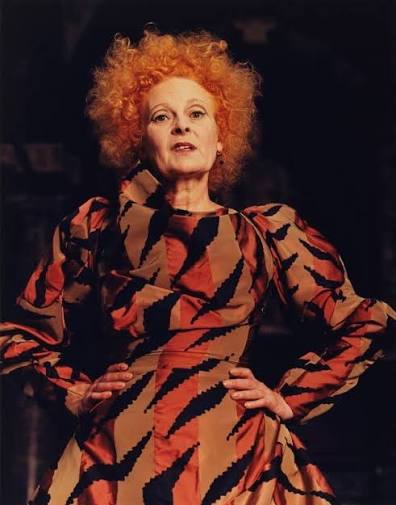
Vivienne Westwood was a British fashion designer whose work connected punk clothing, historical dress and political imagery. She became known for provocative designs developed with Malcolm McLaren at their London boutique, including garments and graphics associated with the punk movement. Her work later expanded into runway collections, menswear, accessories and environmental activism.[1][2]
Career
In 1971, Westwood and McLaren opened a boutique at 430 King's Road in Chelsea, London. It was first called Let it Rock and initially sold Teddy Boy-inspired clothing. The shop was renamed Too Fast to Live, Too Young to Die in 1972, then Sex in 1974. Westwood and McLaren produced clothing and T-shirts with provocative slogans and imagery, and the shop later reopened as Seditionaries. Its use of straps, zips and bondage references helped establish a do-it-yourself visual language that became associated with punk. In 1980, the shop was renamed World's End.[2][1]
Westwood's 1977 Anarchy Shirt used a swastika, an inverted image of Christ on the crucifix, a British stamp depicting Queen Elizabeth II and the word DESTROY. The design was presented as a provocation against corruption and dictatorship. The political use of graphics became a recurring part of Westwood's work.[2]
Her first official collaborative catwalk show with McLaren was the Pirate collection for Autumn-Winter 1981/82. The collection drew on historical dress and used romantic silhouettes, strong colours and asymmetrical construction. It was later associated with the New Romantic movement. Westwood relocated to Italy in 1984, and her subsequent collections continued to combine historical references with experiments in proportion, tailoring and the relationship between clothing and the body. The Mini-Crini collection of 1985 reworked English tailoring and the crinoline into a shorter silhouette.[2][1]
The orb logo was first used in 1986 to represent taking tradition into the future. Westwood taught fashion at the Vienna Academy of Applied Arts from 1989 to 1991 and received the British Fashion Council's Fashion Designer of the Year award in 1990 and 1991. She received an OBE in 1992 and a damehood in 2006. The Victoria and Albert Museum presented a retrospective of her work in 2004.[2]
Westwood's later business expanded internationally. The Vivienne Westwood MAN label launched in Milan in 1996, Red Label launched in 1999, and the first New York boutique opened in the same year. The house opened boutiques in Hong Kong and Korea in 2002 and collaborated with the United Nations' Ethical Fashion Initiative on a Made in Kenya project in 2010. In 2016, Andreas Kronthaler's line became Andreas Kronthaler for Vivienne Westwood, while Westwood continued to design the Vivienne Westwood mainline.[2]
Design and activism
Westwood's designs repeatedly reworked historical clothing and British materials. Her collections drew on subjects including Tudor and Jacobean dress, eighteenth-century corsetry, English tailoring, tartan and tweed. The label's later ready-to-wear, accessories and lifestyle goods retained a deliberately rebellious vocabulary through striking colours, unusual patterns and bold motifs.[2][1]
Environmental and political activism became increasingly prominent in Westwood's work. Climate Revolution, her activist team and website, launched in 2010. Collections including Get a Life, Climate Revolution and Save the Arctic used conservation and climate change as themes, while collaborations and campaigns supported forest protection and related environmental causes. The last physical Vivienne Westwood mainline show took place at London Fashion Week in 2019, after which presentations moved online for environmental reasons.[2]