Thomas Cole
 | |
| Born | February 1, 1801[1] |
|---|---|
| Birthplace | Bolton, Lancashire, England[1] |
| Died | February 11, 1848[1] |
| Place of death | Catskill, New York, United States[1] |
| Occupation | Painter[2][1] |
| Known for | Landscape painting; the Hudson River School; The Course of Empire; The Voyage of Life[2][3] |
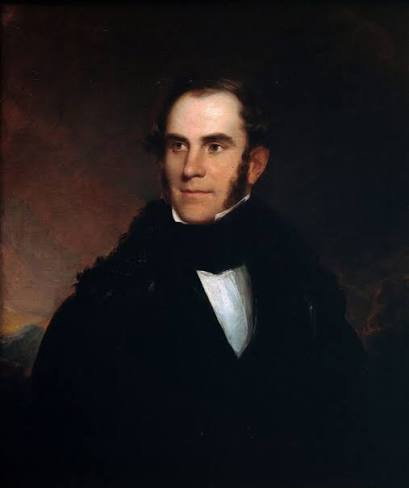
Thomas Cole (February 1, 1801 – February 11, 1848) was an English-born American painter whose landscapes helped establish the Hudson River School. He combined sketches of the American wilderness with imaginative compositions and also produced narrative series shaped by moral and religious themes.[2][3]
Early life
Cole was born in Bolton, Lancashire, England. He emigrated to the United States with his family in 1818, when he was seventeen. He initially worked as a wood engraver and later traveled through Ohio and Pennsylvania as an itinerant artist, painting portraits, genre scenes, and landscapes. He received rudimentary instruction from an itinerant artist and was influenced by paintings he saw at the Pennsylvania Academy of the Fine Arts.[2][1][3]
In spring 1825, Cole moved to New York City and traveled up the Hudson River to the eastern Catskill Mountains. From sketches made along the river and in the Catskills, he painted three landscapes that were displayed in a bookseller's window. John Trumbull purchased one of them and recommended the others to William Dunlap and Asher B. Durand, bringing Cole to the attention of New York patrons. He was elected to the National Academy of Design in 1826.[2][3]
Career
Cole traveled to Britain and continental Europe from 1829 to 1832, including an extended stay in Italy. He returned to New York in November 1832 and soon established a rural studio in Catskill, where he later made his home. His European travels expanded his subjects, while his work in the Catskills developed an approach to American landscape that joined close observation of nature with imaginative and symbolic composition.[1][3]
The New York merchant Luman Reed became one of Cole's patrons. For Reed, Cole produced The Course of Empire (1834–1836), a five-part series that depicts the rise and fall of an ancient classical state. Cole also painted American scenes such as View from Mount Holyoke, Northampton, Massachusetts, after a Thunderstorm—The Oxbow (1836) and View on the Catskill—Early Autumn (1836–1837).[1][3]
Cole married Maria Bartow in 1836 and continued to live and work chiefly in Catskill. In 1841–1842 he made another European journey, visiting Britain, France, Italy, and Sicily. After returning, he became a member of the Episcopal Church. He also designed a new church building for Saint Luke's Episcopal Church in Catskill.[2][1][3]
Themes and writings
Although Cole is chiefly identified with landscape painting, moral and religious themes were central to his work. The Voyage of Life (1840) uses a river journey as an allegory for the passage of human life toward eternal reward. Cole painted a second version of the series in Italy during his 1841–1842 journey. In 1846 he began The Cross and the World, which remained unfinished when he died.[2][1][3]
Cole's paintings and writings also expressed concern about the effects of industrial development on the wilderness that inspired his work. While working on The Course of Empire, he criticized railroad expansion and the threat it posed to the Catskill landscape. He wrote poetry, kept a journal, and maintained an extensive correspondence with his wife, friends, and patrons.[2][1]
Teaching and influence
Cole's early paintings and his treatment of American scenery influenced the generation of landscape painters later known as the Hudson River School. Asher B. Durand became a lifelong friend and later fostered a younger generation of landscape artists. In 1844, Cole accepted Frederic E. Church as a student; Church studied with him until 1846 and became a leading landscape painter of the following generation.[2][1][3]
Cole was working on The Cross and the World when he contracted pleurisy in February 1848. He died in Catskill on February 11, 1848, before completing the series.[1][3]
See also
References
- ↑ 1.00 1.01 1.02 1.03 1.04 1.05 1.06 1.07 1.08 1.09 1.10 1.11 1.12 1.13 February 10, 2022. "Thomas Cole". National Park Service. Retrieved 2026-09-22.
- ↑ 2.00 2.01 2.02 2.03 2.04 2.05 2.06 2.07 2.08 2.09 "Thomas Cole". Smithsonian American Art Museum. Retrieved 2026-09-22.
- ↑ 3.00 3.01 3.02 3.03 3.04 3.05 3.06 3.07 3.08 3.09 3.10 Kevin J. Avery (August 1, 2009). "Thomas Cole (1801–1848)". The Metropolitan Museum of Art. Retrieved 2026-09-22.