Social Capital

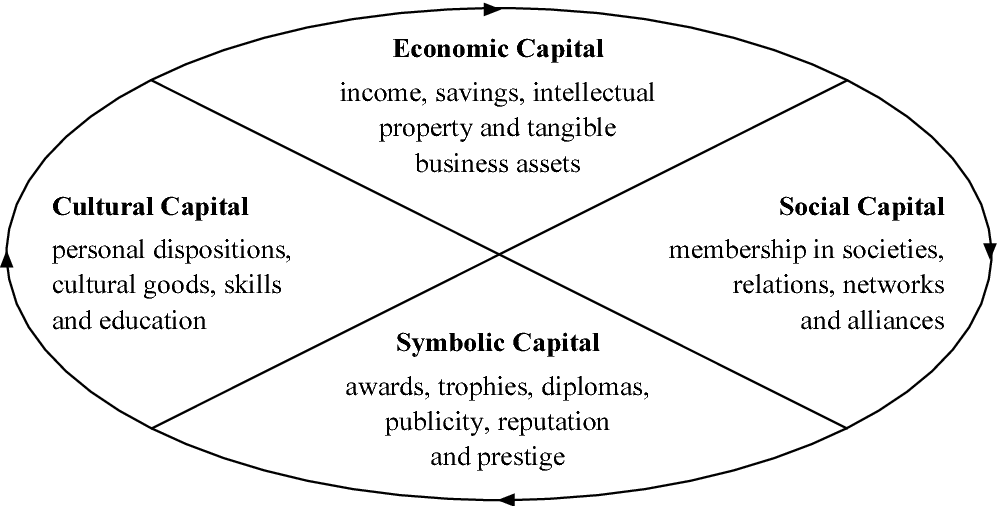
Social capital refers to the resources available to people through their social relationships and networks. The concept was developed in different forms by the sociologists Pierre Bourdieu and James Coleman and the political scientist Robert Putnam, and is widely used in sociology, economics, and political science.[1]
Bourdieu
In "The Forms of Capital" (1986), Bourdieu defined social capital as the actual or potential resources linked to membership in a durable network of relationships of mutual recognition. He treated it alongside economic capital and cultural capital, and stressed that networks must be maintained through ongoing exchanges. In his account, social capital belongs to individuals and can reinforce inequality, because access to valuable networks is unevenly distributed.[2]
Coleman and Putnam
Coleman, writing in 1988, defined social capital by its function: features of social structure that make certain actions possible for the people within it. Putnam gave the concept a more collective and civic meaning, describing networks, norms, and trust that help people cooperate for mutual benefit. His 2000 book Bowling Alone argued that American social capital had declined, and introduced a widely used distinction between "bonding" social capital, within close groups, and "bridging" social capital, across different groups.[1]
Usage
The concept directs attention to what relationships make possible: access to information, support, obligations, and opportunities that do not depend only on money or formal qualifications. Because the major theorists define it differently, scholars often distinguish between social capital as an individual asset (Bourdieu) and as a property of communities (Putnam).[1] In online culture, the term is also used informally for status and influence within a community.
See also
References
- ↑ 1.0 1.1 1.2 "Social Capital". Encyclopedia.com. Retrieved October 16, 2026.
- ↑ Pierre Bourdieu (1986). "The Forms of Capital". Marxists Internet Archive. Retrieved October 13, 2026.