Nicomachean Ethics

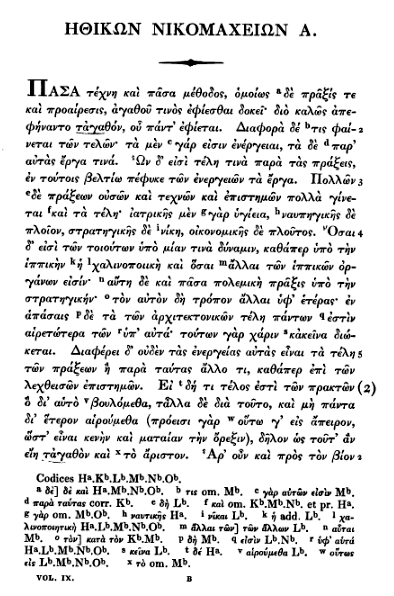
The Nicomachean Ethics (Greek: Ethika Nikomacheia) is an ethical treatise by Aristotle. It examines the human good, virtue, deliberation, friendship, and the relation between individual flourishing and political community. The work is a foundational text for virtue ethics.[1]
Aim and method
The work begins from the claim that actions and inquiries aim at goods. Aristotle identifies eudaimonia, often translated as happiness or flourishing, as the highest good achievable through action: an end chosen for its own sake rather than as a means to another end.[2]
Aristotle treats ethics as a practical inquiry. Because questions about good action concern changing circumstances, he argues that ethical discussion cannot have the same precision as mathematics. Its purpose is not knowledge alone but acting well.[2][1]
Virtue and practical judgment
In the Nicomachean Ethics, virtues are not merely rules or feelings. They are stable dispositions expressed in action and choice. Aristotle's account of ethical virtue is known as the doctrine of the mean: each virtue lies between a vice of excess and a vice of deficiency, as courage lies between rashness and cowardice. The mean is relative to the situation rather than a fixed midpoint.[3]
The work also gives practical judgment a central role. Ethical understanding requires attention to particulars: a person must be able to deliberate well about what to do in a concrete situation. Aristotle therefore presents the virtues as rational, emotional, and social capacities developed through practice, rather than as detached theoretical knowledge.[1]
Friendship and political community
Aristotle places individual flourishing within relationships and civic life. In Book I, he argues that the human good concerns not an isolated individual alone but also friends, family, and fellow citizens.[2] Later books examine friendship as an important part of a flourishing life and connect ethical inquiry with political questions about how a community cultivates character.[1]
Influence
The work remains a major source for contemporary virtue ethics, a family of approaches that emphasizes character and the cultivation of virtues alongside questions of rules and consequences.[4]
References
- ↑ 1.0 1.1 1.2 1.3 "Aristotle's Ethics". Stanford Encyclopedia of Philosophy. Retrieved 2026-09-30.
- ↑ 2.0 2.1 2.2 Aristotle. "Nicomachean Ethics, Book I". The Internet Classics Archive. Retrieved 2026-09-30.
- ↑ "Aristotle: Ethics". Internet Encyclopedia of Philosophy. Retrieved 2026-09-30.
- ↑ "Virtue Ethics". Internet Encyclopedia of Philosophy. Retrieved 2026-09-30.