Longtermism

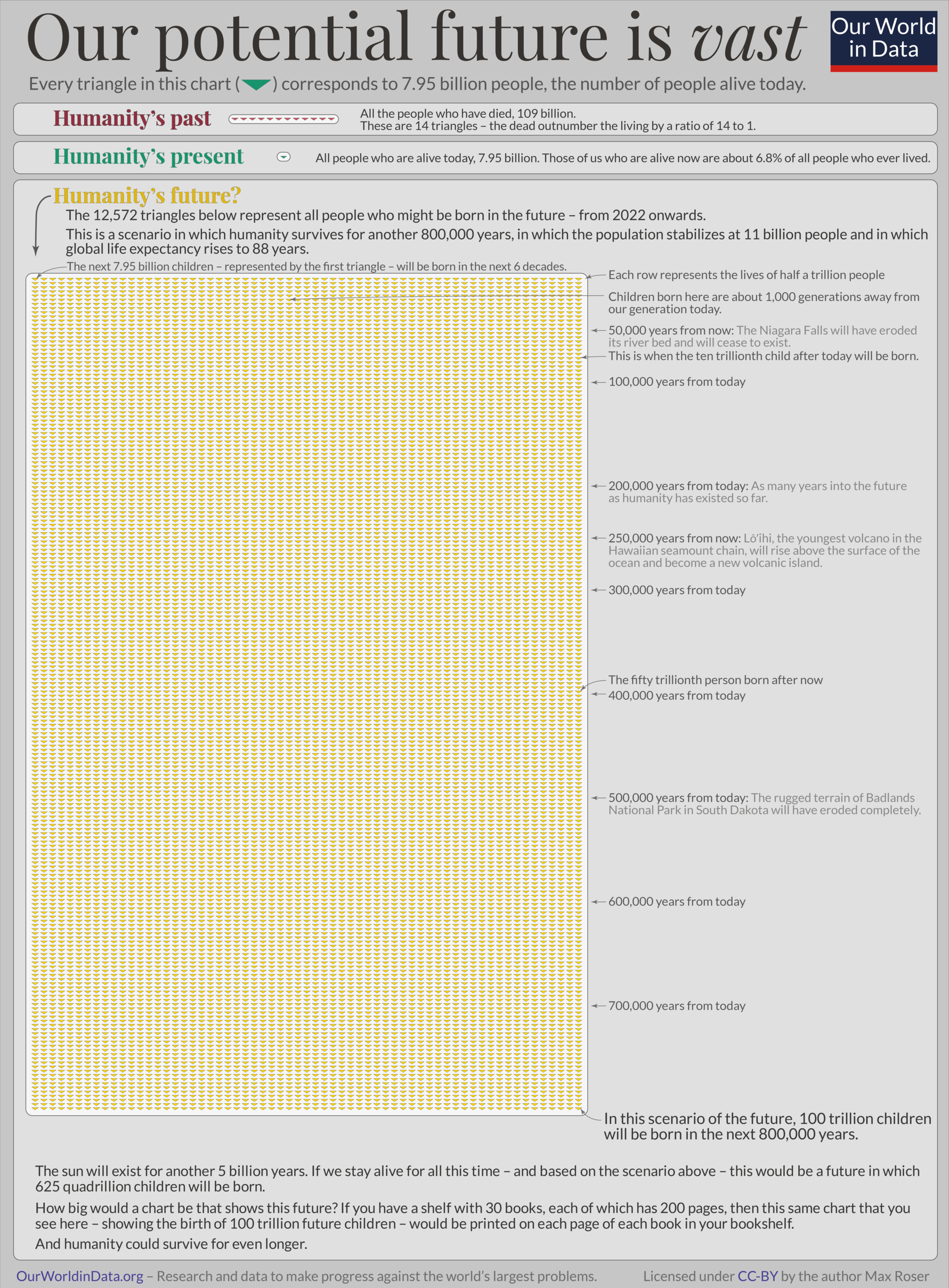
Longtermism is the ethical view that positively influencing the long-term future is a key moral priority of our time. Its proponents argue that because the future could contain vastly more people than the present, actions that shape its course, especially by reducing the risk of human extinction, carry very large moral weight.[1]
History
The term was coined in 2017 by the Oxford philosophers William MacAskill and Toby Ord, within the effective altruism movement. MacAskill distinguishes longtermism from "strong longtermism", the stronger claim that the long-run future is the most important consideration in deciding how to act.[1] The view builds on earlier work by Nick Bostrom on existential risk.
Ord set out the case for prioritizing existential risk in The Precipice (2020), and MacAskill's What We Owe the Future (2022) introduced longtermism to a general readership.[2]
Criticism
Critics argue that longtermism can justify neglecting present-day suffering in favor of speculative future benefits, and that its focus on distant outcomes lends itself to the interests of wealthy technology funders. Timnit Gebru and Émile P. Torres include it in their TESCREAL grouping of related ideologies.[3]
See also
References
- ↑ 1.0 1.1 William MacAskill. "Longtermism". Effective Altruism Forum. Retrieved November 11, 2026.
- ↑ William MacAskill. "What We Owe The Future". Basic Books. Retrieved November 11, 2026.
- ↑ Timnit Gebru and Émile P. Torres (April 2024). "The TESCREAL bundle: Eugenics and the promise of utopia through artificial general intelligence". First Monday. Retrieved November 11, 2026.