Land Art

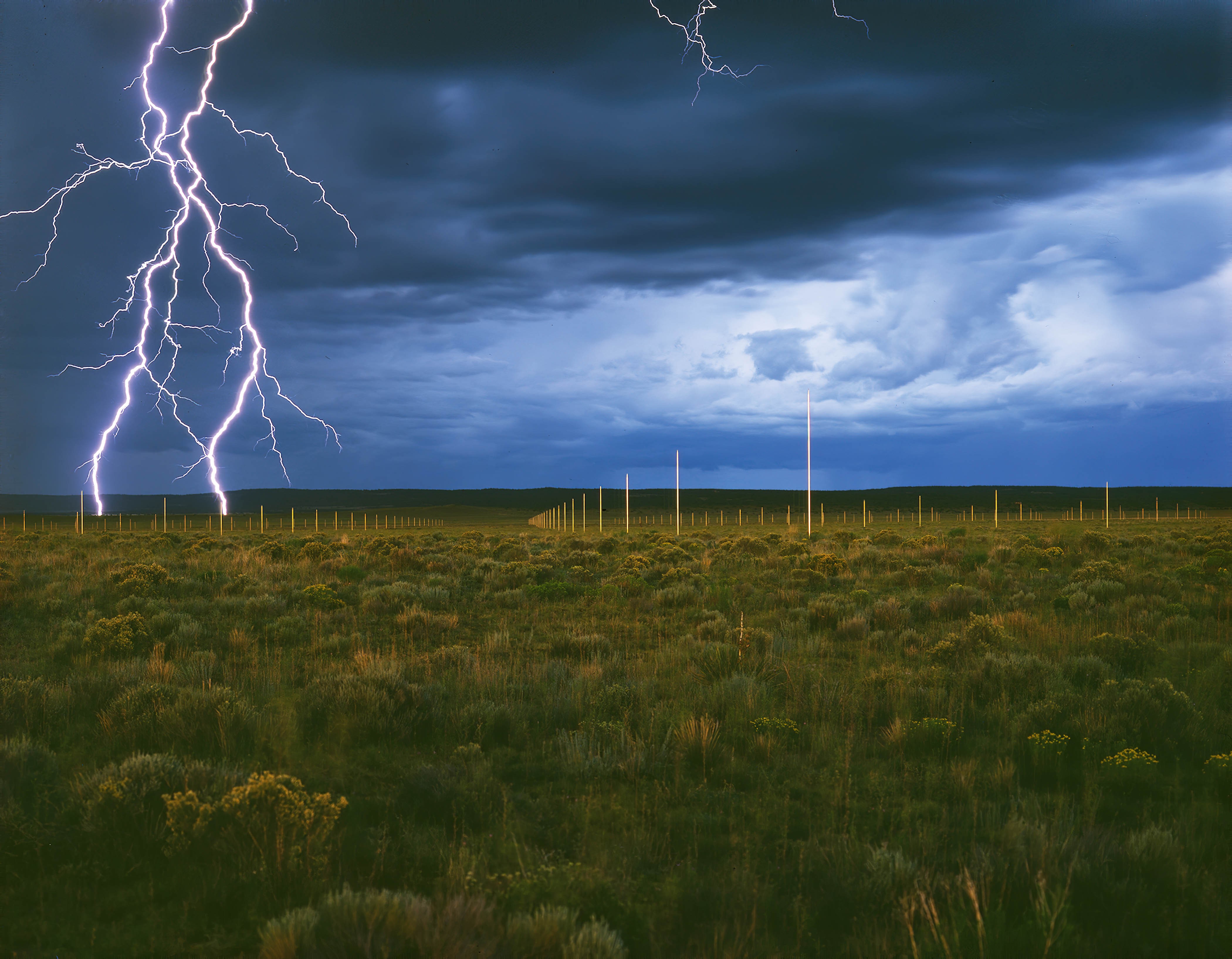
Land art, also called earth art, is art made directly in the landscape, either by sculpting the land itself into earthworks or by making structures in the landscape from natural materials such as rocks or twigs. It emerged as part of the wider conceptual art movement of the 1960s and 1970s.[1]
Approaches
Land artists worked at very different scales. Some, like Robert Smithson, used mechanical earth-moving equipment to build large earthworks. Others made minimal and temporary interventions: Richard Long, for example, made works by walking back and forth until his path left a mark on the ground. Besides Smithson and Long, artists associated with land art include Nancy Holt, Walter De Maria, Michael Heizer and Dennis Oppenheim.[1]
Notable works
The most famous work of land art is Smithson's Spiral Jetty (1970), an earthwork built out into the Great Salt Lake in Utah.[1]
Walter De Maria's The Lightning Field, completed in 1977 in Catron County, New Mexico, consists of 400 polished stainless steel poles arranged in a grid measuring about one mile by one kilometer. The work was commissioned and is maintained by the Dia Art Foundation.[2]
Documentation and exhibition
Because many land art works are remote, large or temporary, they were usually documented in photographs and maps that artists could exhibit in galleries. Land artists also brought material from the landscape into galleries to create installations.[1]
See also
- Site-Specific Art
- The Lightning Field
- Lightning Field (Remilio background)
- Prada Marfa
- Prada Marfa (Remilio background)
References
- ↑ 1.0 1.1 1.2 1.3 "Land art". Tate. Retrieved 2026-10-16.
- ↑ Walter De Maria. "The Lightning Field". Artforum. Retrieved 2026-10-19.