Infohazard

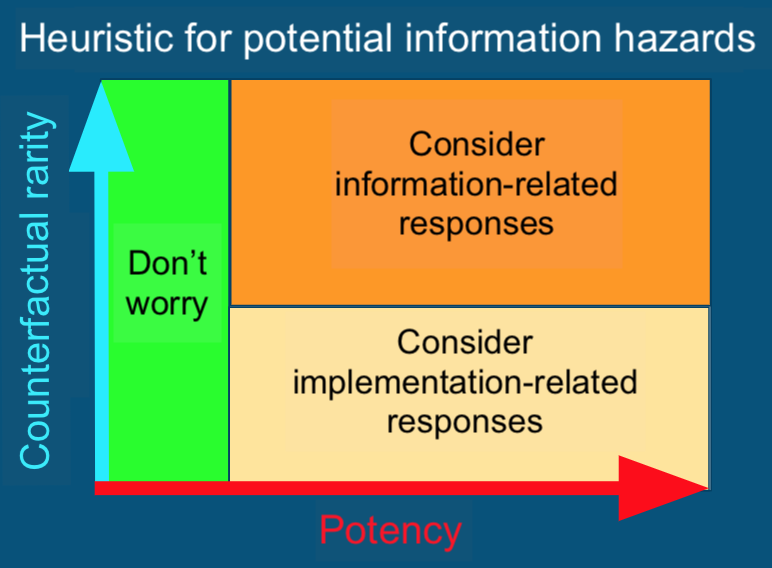
An infohazard, or information hazard, is a risk that arises from the dissemination of true information that may cause harm or enable someone to cause harm. The term was introduced by the philosopher Nick Bostrom in a 2011 paper, "Information Hazards: A Typology of Potential Harms from Knowledge".[1]
Bostrom's typology
Bostrom's paper argues that the risks of knowledge are often overlooked because information is usually assumed to be beneficial. He classifies information hazards by how harm comes about. Data hazards involve specific data, such as the genetic sequence of a dangerous pathogen. Idea hazards involve general ideas that could enable harm even without detailed data. Attention hazards arise when drawing attention to a topic, or signaling that it is important, increases risk. Other categories cover information that harms the person who learns it, information that damages trust or social arrangements, and information that creates risks through how it is distributed.[1]
The concept concerns the possible consequences of knowing or communicating something, independent of whether the knower intends harm. Bostrom discusses how individuals, institutions, and research communities might weigh these risks against the benefits of openness.[1] In online culture, "infohazard" is also used more loosely for ideas thought to be psychologically or socially dangerous to encounter.
See also
References
- ↑ 1.0 1.1 1.2 Nick Bostrom (2011). "Information Hazards: A Typology of Potential Harms from Knowledge". nickbostrom.com. Retrieved October 13, 2026.