Hiroshi Nagai
 | |
| Born | 1947[1] |
|---|---|
| Birthplace | Tokushima City, Japan[1] |
| Nationality | Japanese[1] |
| Occupation | Graphic designer, illustrator, painter[1][2] |
| Known for | City pop album-cover art[1][3] |
| Years active | 1970s–present[3][2] |
| Based in | Tokyo[2] |
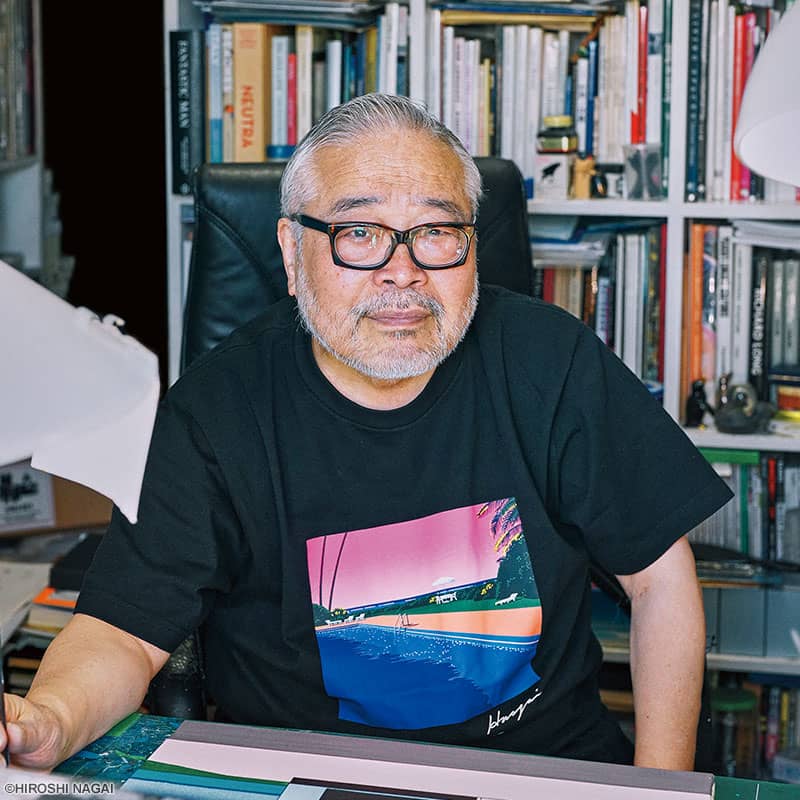
Hiroshi Nagai (born 1947) is a Japanese graphic designer, illustrator and painter. He is known for acrylic paintings and illustrations of palm trees, pools, modern buildings, coastlines and brightly lit skies, as well as for cover art for city pop albums including Eiichi Ohtaki's A Long Vacation and Niagara Song Book.[1][2] His work combines references to surrealism, American pop art and mid-century design with imagined, largely uninhabited landscapes.[3][2]
Early life and career
Nagai was born in Tokushima City in 1947 and grew up in the Japanese countryside. He has said that his early exposure to art was largely limited to what he encountered in high-school classes. After moving to Tokyo, he encountered a wider range of visual references, including during a roughly forty-day trip through the United States in 1973.[3][1]
He first worked as a television set decorator and later as a graphic designer. He became a freelance illustrator in 1978 and subsequently worked in advertising, publishing and record-cover design.[2][1]
Artistic style and process
Nagai's compositions use geometric forms and precise perspective to construct sunlit scenes of pools, palm trees, modern buildings and open water. His references have included mid-century houses, American films of the 1960s and early 1970s, books, photographic collections, interior-design magazines and postcards. Rather than reproduce particular places, he has described combining these references into imagined versions of the South Seas and Los Angeles.[3][2]
Nagai has identified surrealism and American pop art as important influences, describing his work as occupying a position between surrealism's darker atmosphere and pop art's brightness. His paintings are made with acrylic paint and aerosol sprays; accounts of his process describe a grayscale starting point before the application of color.[3][2] Many of his scenes contain no human figures. Nagai has said that omitting figures keeps the space open to the viewer instead of assigning it a specific narrative or location.[3]
Album covers and later reception
Nagai's association with city pop developed through his album-cover work. His paintings were used for Eiichi Ohtaki's A Long Vacation and Niagara Song Book, and later for record jackets connected with multiple genres. A 2020–2021 exhibition in Sydney presented 20 original works alongside a selection of his record jackets and was described as his first international solo exhibition.[1]
His visual vocabulary of palm trees, pools, vintage cars and saturated skies was later referenced by vaporwave and other retro-futurist online scenes. The renewed circulation of his earlier work brought it to younger audiences in Japan and overseas, while Nagai has continued to work as an illustrator and designer.[3][2]
See also
References
- ↑ 1.00 1.01 1.02 1.03 1.04 1.05 1.06 1.07 1.08 1.09 "Hiroshi Nagai: Paintings for Music". The Japan Foundation, Sydney. Retrieved 2026-10-02.
- ↑ 2.00 2.01 2.02 2.03 2.04 2.05 2.06 2.07 2.08 2.09 Dan Beauchamp (2024-03-06). "Artist Hiroshi Nagai, Painter of '80s Paradise". Danny With Love. Retrieved 2026-10-02.
- ↑ 3.0 3.1 3.2 3.3 3.4 3.5 3.6 3.7 3.8 2025-09-08. "The Story of Hiroshi Nagai". Sato Gallery. Retrieved 2026-10-02.