Ansel Adams
| Born | 1902 |
|---|---|
| Died | 1984 |
| Nationality | American |
| Occupation | Photographer |
| Known for | Black-and-white landscape photographs of Yosemite |

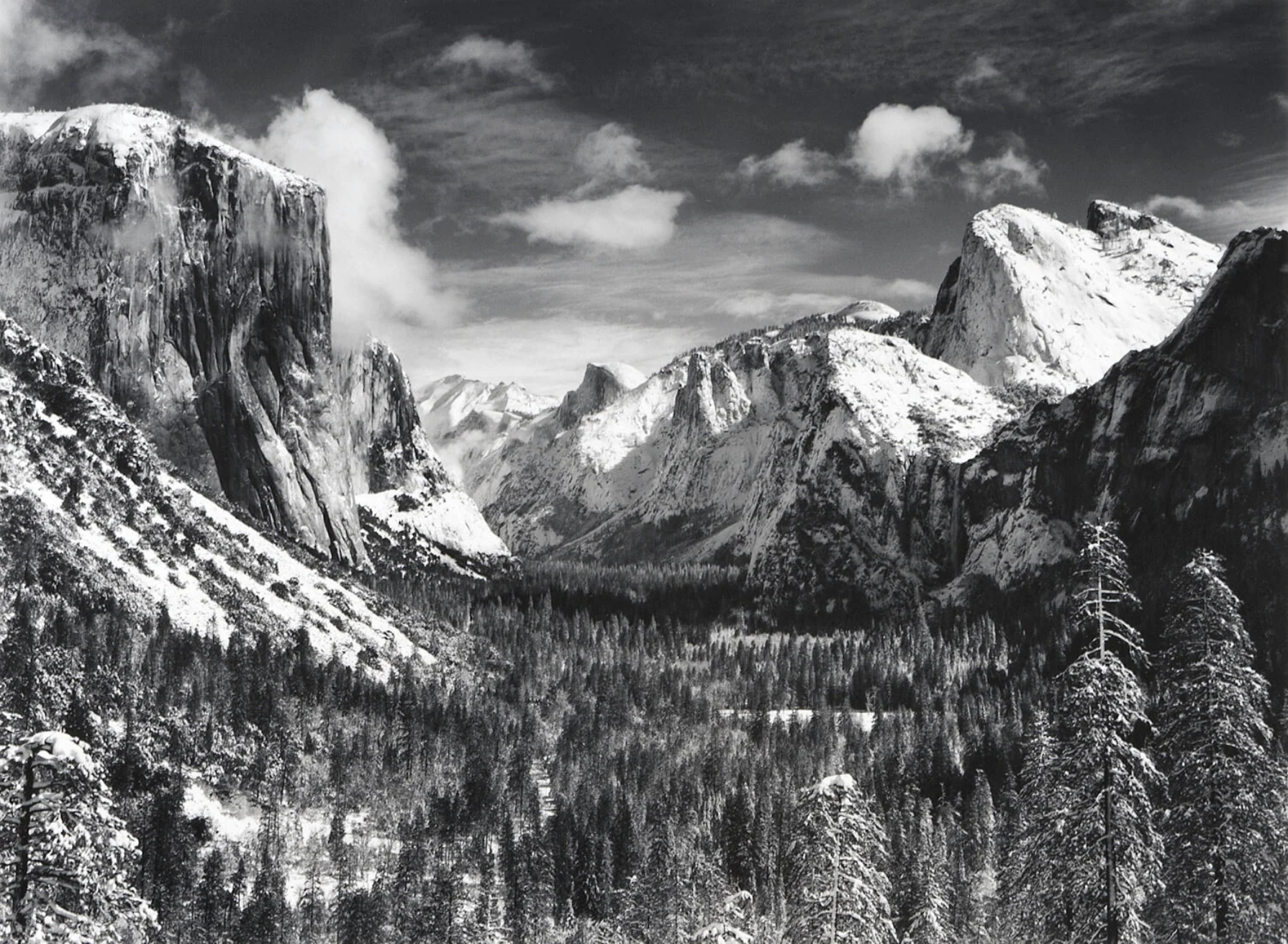
Ansel Adams (1902–1984) was an American photographer and conservationist known for black-and-white photographs of the American West, particularly Yosemite National Park. A co-founder of the Zone System of exposure and development, he made Yosemite the chief subject of his work for most of his life and used his photographs to support conservation campaigns.[1]
Early life
Adams was born in San Francisco in 1902, the grandson of a wealthy timber baron; much of the family fortune was lost after the 1906 earthquake and the banking panic of the following year. An only child who struggled at school, he was educated at home from the eighth grade, with lessons including piano and Greek. At 14, after reading James Mason Hutchings's In the Heart of the Sierras, he persuaded his parents to visit Yosemite, and in 1916 he took his first photographs there with a Kodak Brownie camera his parents had given him.[1]
Yosemite and the Sierra Club
Adams joined the Sierra Club in 1919 and spent six summers as photographer on its High Sierra outings, as well as several years as caretaker of the club's LeConte Memorial Lodge in Yosemite Valley. His first published photographs appeared in the club's 1922 Bulletin. In 1927, his photograph Monolith, the Face of Half Dome, made with a red filter in fading light, brought him critical acclaim.[1]
For years Adams pursued two careers, as a photographer and as a concert pianist. In 1928 he married Virginia Best, the daughter of the landscape painter Harry Cassie Best; Best's Studio in Yosemite Valley, which Virginia later inherited, became The Ansel Adams Gallery.[1]
Technique
With Edward Weston and others, Adams belonged to Group f/64, which promoted photography as an art form in its own right rather than an imitation of painting. He was known for previsualizing a final print before exposing the negative, and for darkroom methods such as dodging and burning.[1] Around 1939–1940, while teaching at the Art Center School in Los Angeles, he and the photographer Fred Archer formulated the Zone System, a method for controlling tonal values through exposure and development.[2]
Commercial work and advocacy
Adams worked throughout his career as a commercial photographer for clients including the National Park Service, Kodak, IBM, AT&T and the magazines Life and Fortune. With the Sierra Club, he campaigned from 1936 for a national park at Kings Canyon; his photographs were used in congressional discussions that led to the park's establishment in 1940. In 1943, at his own expense, he photographed the Manzanar internment camp for Japanese Americans.[1]
He received the Presidential Medal of Freedom in 1980 and died in Monterey, California, in 1984. Shortly afterward, the Minarets Wilderness south of Yosemite was renamed the Ansel Adams Wilderness, and an 11,760-foot peak at the edge of the park was named Mount Ansel Adams.[1]
See also
References
- ↑ 1.0 1.1 1.2 1.3 1.4 1.5 1.6 "Ansel Adams". Yosemite National Park, U.S. National Park Service. Retrieved 2026-10-16.
- ↑ "Fred Robert Archer". Robert Koch Gallery. Retrieved 2026-10-19.