Cascadia Independence Movement
The Cascadia Independence Movement is a collection of overlapping political and cultural movements seeking greater autonomy — and in more ambitious forms, full independence — for the Pacific Northwest region of North America. The proposed territory of Cascadia spans the U.S. states of Washington, Oregon, and Idaho and the Canadian province of British Columbia, though definitions of the bioregion vary. The movement's primary drivers include environmentalism, bioregionalism, civil liberties, and a distinct Pacific Northwest regional identity. Since the 2010s, Cascadia symbolism — particularly the Douglas fir flag — has spread widely online, where it has been adopted across a politically diverse spectrum of communities, from earnest regionalists to more extreme online subcultures.

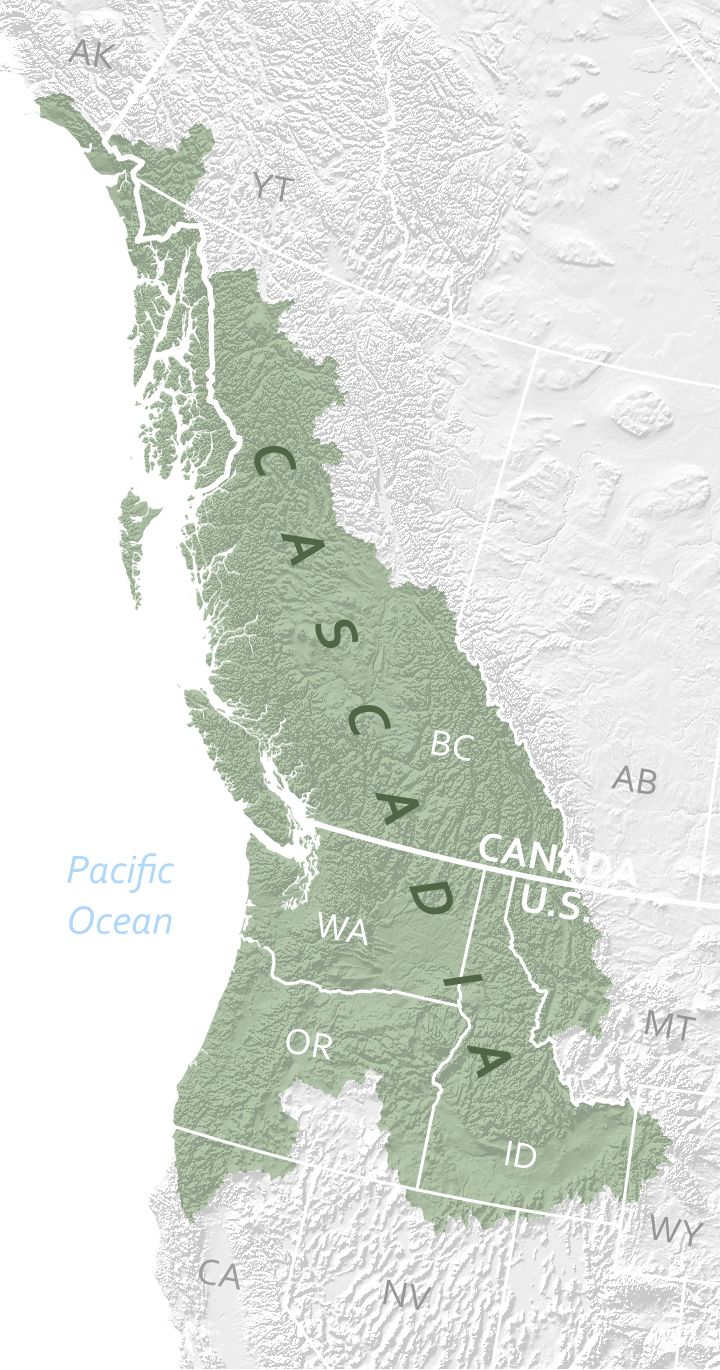
Overview
The Cascadia Movement is not a unified organization but a loose coalition of groups and individuals who share a sense of Pacific Northwest regional identity and, to varying degrees, a desire to govern that region independently of Washington, D.C. and Ottawa. Its ideological range is wide: environmentalist and progressive strands dominate in major cities, while libertarian, constitutionalist, and separatist strands are more prominent in rural areas. The movement traces philosophical roots to the concept of bioregionalism — the idea that political units should align with ecological rather than arbitrary administrative boundaries.
History
The idea of a Pacific Northwest nation predates American statehood. In 1813, Thomas Jefferson described Fort Astoria as "the germ of a great, free, and independent empire on that side of our continent." In 1843, settlers in the Oregon Country voted at the Champoeg Meetings to establish an independent provisional government, before ultimately petitioning to join the United States. The Pacific Northwest's geographic and cultural distance from both Washington, D.C. and Ottawa has generated recurring separatist sentiment throughout its history.
The modern Cascadia movement coalesced in the 1990s and 2000s around bioregionalist writers including David McCloskey, a Seattle University professor who defined the Cascadia bioregion in academic terms and coined "Cascadia" as a regional identity concept. The movement gained formal organization with the founding of the Cascadia Department of Bioregion in 2005, which produced the movement's primary symbols: the "Doug Flag" (a blue-white-green tricolor bearing a Douglas fir) and the slogan "Yes Cascadia."[1]
The Doug Flag

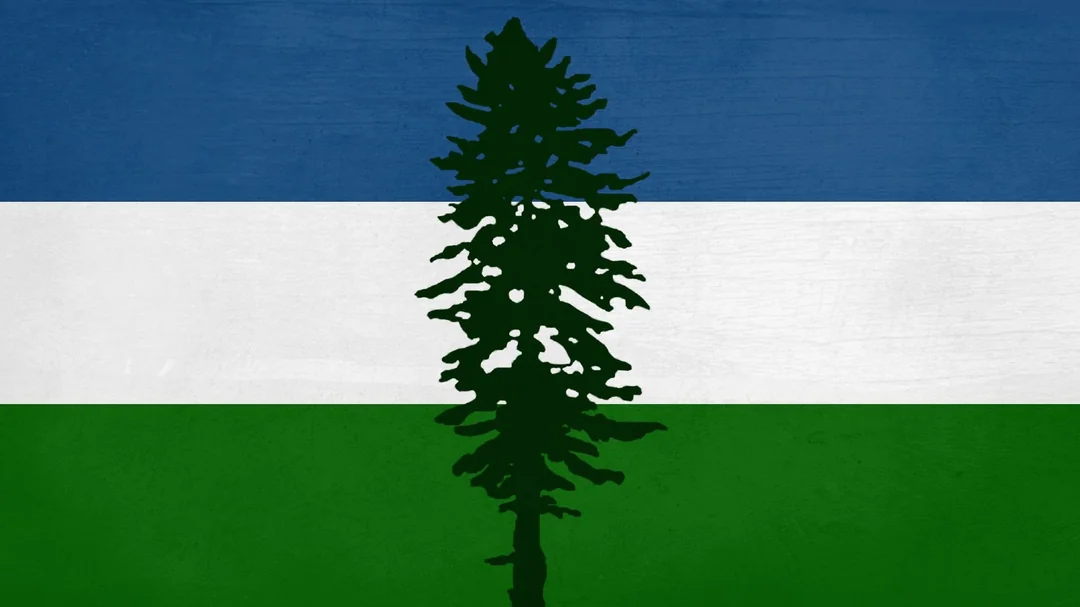
The Cascadia flag — widely known as the "Doug Flag" — features three horizontal bands of blue (sky and ocean), white (clouds and snow-capped peaks), and green (forests), with a large Douglas fir silhouette at the center. Designed by Alexander Baretich in 1994, it has become one of the most recognizable symbols of American regionalist movements and a frequent sight at soccer matches involving the Portland Timbers, Seattle Sounders, and Vancouver Whitecaps, whose supporter culture has been closely intertwined with Cascadia regionalism since the 2000s.[2]
Online presence and X.com bio symbolism
The Douglas fir emoji (🌲) and variations of the Cascadia flag circulate widely on X (formerly Twitter) and other platforms as a profile-level signal of regional identity and, in some cases, deeper ideological commitment. Adding a pine tree to one's bio on X has functioned as a soft affiliation marker across a politically diverse range of users: Pacific Northwest regionalists, environmentalists, and outdoor culture enthusiasts on one end, and more ideologically charged subcultures on the other.
The "Pine Tree Party" is a distinct online formation — loosely affiliated and largely anonymous — that has adopted the pine tree as a symbol for a harder anti-government, and in some strands eco-fascist, worldview. It is associated with the Unabomber's wilderness-withdrawal aesthetic and neo-Luddite communities that have proliferated on imageboards and Discord. Security researchers and journalists have documented it as an extremist subculture, separate from but sometimes overlapping with the mainstream Cascadia movement.[3]
The two uses of the pine tree symbol — bioregional Cascadia and the Pine Tree Party — are frequently conflated in online discourse and in media coverage, though they represent substantially different political projects. The Cascadia Department of Bioregion and associated mainstream organizers have sought to distinguish the movement's symbols from far-right appropriation.
Relationship to anti-government movements
The Pacific Northwest has a distinct history as a site of anti-government organizing independent of the Cascadia movement proper. Idaho and eastern Oregon and Washington were centers of the American militia movement in the 1990s, energized by Ruby Ridge (1992) and the Waco Siege (1993). The region's relative remoteness, history of off-grid and homestead culture, and strong gun rights tradition created conditions in which anti-government organizing found both a geographic base and a cultural audience.
This history has made the Pacific Northwest a reference point in online communities that combine anti-government sentiment with wilderness aesthetics and separatist idealism, even when those communities have no direct connection to the formal Cascadia Independence Movement. The result is that "Cascadia," the pine tree, and Pacific Northwest iconography circulate online across a wide range from earnest bioregionalism to radicalized anti-statism.
See also
References
- ↑ "Cascadia movement". Wikipedia. Retrieved 2026-06-24.
- ↑ "The Pacific Northwest's Very Earnest Independence Movement". The Atlantic. Retrieved 2026-06-24.
- ↑ "Eco-Fascist 'Pine Tree Party' Growing as a Violent Extremism Threat". Homeland Security Today. Retrieved 2026-06-24.