Watchers (angels)

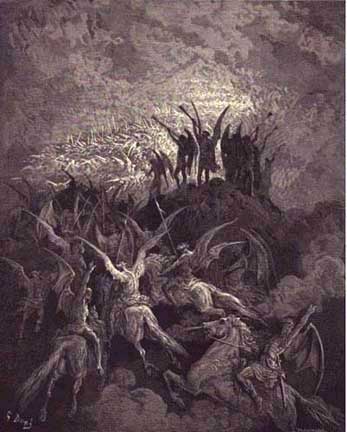
The Watchers are angelic beings in ancient Jewish literature, best known from the Book of the Watchers, the first section (chapters 1–36) of the Book of Enoch. In that account, a group of Watchers descends to earth, takes human wives, fathers a race of giants, and teaches humanity forbidden knowledge, bringing violence that leads to divine judgment.[1][2]
In the Book of Enoch
The story expands on Genesis 6:1–4, which briefly mentions "sons of God" who took human wives. In 1 Enoch, two hundred Watchers led by Semjaza descend on Mount Hermon and bind themselves by an oath. Their offspring, the giants, devour the earth's resources and turn on humanity. The Watchers also teach forbidden arts: Azazel teaches the making of weapons and ornaments, and others teach sorcery, astrology, and the signs of the heavens.[1]
In response, God sends archangels to bind the Watchers and destroy the giants. Enoch, a righteous man, is asked to intercede on the Watchers' behalf, but his petition is rejected, and he is shown the place of their punishment.[2][1]
Interpretation and influence
The Watchers story became one of the most influential ancient accounts of the origin of evil, attributing sin and violence to angelic transgression and illicit knowledge rather than solely to human disobedience.[3] The Aramaic fragments of 1 Enoch found among the Dead Sea Scrolls include the Book of the Watchers.[4]
Later esoteric writers, including Éliphas Lévi, reinterpreted the Watchers in other ways. Histories of the egregore concept discuss the link between that word and the Watchers, whose Greek name, egrēgoroi, means "wakeful ones".
See also
References
- ↑ 1.0 1.1 1.2 1912. "The Book of Enoch, chapters 6–16". Christian Classics Ethereal Library. Retrieved October 13, 2026.
- ↑ 2.0 2.1 Richard Gottheil and Enno Littmann. "Enoch, Books of (Ethiopic and Slavonic)". Jewish Encyclopedia. Retrieved October 16, 2026.
- ↑ Annette Yoshiko Reed. "Fallen Angels and the History of Judaism and Christianity (introduction)". Cambridge University Press. Retrieved October 13, 2026.
- ↑ George W. E. Nickelsburg. "Dead Sea Scrolls Spotlight: The Book of Enoch". Biblical Archaeology Society Library. Retrieved October 16, 2026.